
What PJM’s Reliability Compliance Update Reveals About New NERC Requirements for Data Center Modeling, Protection, and Grid Reliability
Large data centers are moving into a new phase of grid integration. Once a facility becomes large enough to affect bulk-system voltage, frequency, protection, or transfer capability, the engineering question is no longer only whether the utility can serve the MW. The grid also needs to know how the load will behave during a disturbance, how accurately it is modeled, who operates it, and what data are available after an event.
NERC Project 2026-02 is beginning to formalize that shift. The proposed framework creates dedicated computational-load standards and new registered entity types for large facilities such as data centers and crypto-mining sites. The proposals are still under development, but the technical direction is already clear.
Three standards cover three engineering problems
NERC’s proposed CLO standards separate the large-load problem into planning, operations, and protection. A data center can look acceptable in a steady-state power flow and still create a reliability concern through its controls or protection behavior.
- CLO-001-1: interconnection studies, commissioning, qualified changes, and modeling data.
- CLO-002-1: operational data, communications, Operating Instructions, and the facility’s response to those instructions.
- CLO-003-1: protection coordination and disturbance monitoring needed for post-event analysis.
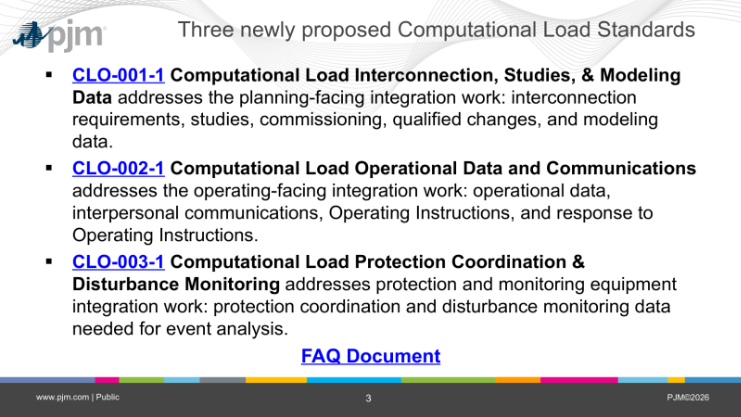
Figure 1. NERC’s three proposed Computational Load Standards.
Source: PJM, “Reliability Compliance Update,” RSCS, Sept. 14, 2026, slide 3.
The 50 MW / 100 kV threshold is an important line
NERC is also proposing two new registered functions: Computational Load Owner (CLO) and Computational Load Operator (CLOP). The registry criteria shown in PJM’s update would apply when a Computational Load Site has at least 50 MW of total connected load and is supplied through equipment connected at 100 kV or above from one or more points of connection.
That threshold matters because a facility that crosses it may move from being treated mainly as a retail or transmission customer to having direct reliability obligations tied to the Bulk-Power System.
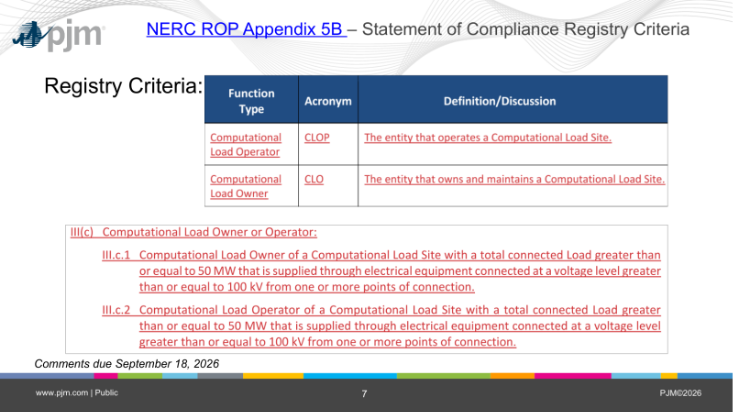
Figure 2. Proposed registry criteria for Computational Load Owners and Operators.
Source: PJM, “Reliability Compliance Update,” RSCS, Sept. 14, 2026, slide 7.
The harder problem is disturbance behavior
The most important engineering question is often not the normal operating point. It is what happens when voltage or frequency leaves the normal range. Modern data centers contain many similar power-electronic devices: UPS systems, rectifiers, server power supplies, variable-speed drives, static transfer equipment, and battery systems.
If those devices share similar protection thresholds, a transmission fault can trigger a common-mode response across a very large load block. A 300-500 MW site that disconnects or reconnects nearly at once can materially change regional power flows and frequency.
| Technical question | Why it is crucial |
| Voltage sag | Ride through, partial shedding, UPS transfer, or a full block trip? |
| Frequency excursion | Could hundreds of MW disconnect or reconnect at nearly the same time? |
| Recovery ramp | Will demand return gradually or create another large MW step? |
| Protection settings | Are utility and facility protection coordinated? |
| Event data | Can operators reconstruct actual behavior after a disturbance? |
NERC’s Large Loads Working Group is also developing a separate Standard Authorization Request focused on computational-load disturbance performance, reinforcing that aggregate ride-through behavior is becoming a core reliability issue.
Modeling becomes part of the reliability evidence
For large computational loads, a single constant-PQ representation may be too simple for all study types. Planning studies may need to capture load composition, UPS behavior, protection thresholds, transfer logic, reactive-power response, backup generation, BESS controls, and the timing of load recovery.
The model also has to fit the question. Phasor-domain models are efficient for wide-area stability studies, while EMT models may be needed when fast controls, converter behavior, or protection logic drive the response. NERC’s Data Center Load Modeling Workshop is focused on these issues: advanced load models, screening studies, stability assessment, and interconnection applications.
Operations and communications are now part of the design
CLO-002 is easy to read as a compliance requirement, but it is also an engineering requirement. Grid operators need to know the facility’s actual MW demand, operating state, available flexibility, and how it will respond to an instruction during stressed conditions.
- If UPS or BESS systems can reduce grid draw, the available MW, response time, duration, and state-of-charge limits need to be defined.
- If backup generation can operate in parallel with the grid, that operating state belongs in short-circuit and protection studies.
- If compute load can be curtailed or shifted, planners need to know whether that flexibility is dependable enough to count on during a reliability event.
Protection and monitoring close the loop
CLO-003 moves the discussion from model assumptions to measurable performance. Protection coordination determines what disconnects during a fault; disturbance monitoring helps confirm whether the actual facility behaved the way the studies predicted.
That feedback loop matters because operating logic can change through software, firmware, UPS replacement, protection revisions, or expansion of the data halls. A model that was accurate at commissioning can become stale if material changes are not tracked.
What developers and utilities should prepare for
- More detailed technical data earlier in the interconnection process.
- Explicit dynamic and disturbance-performance requirements, not only steady-state MW/MVAr limits.
- Clear ownership of models, protection settings, operational data, and event records.
- A formal process for reviewing facility expansions or control changes that could alter bulk-system behavior.
What to watch next
- Sept. 15-16: NERC’s Data Center Load Modeling Workshop focuses on load models, screening studies, stability assessment, and interconnection applications.
- Sept. 18: comments and initial ballots are due on the current computational-load standards and related registration proposals.
- Sept. 24: comments close on the separate SAR addressing computational-load disturbance performance.
RMS Energy perspective
The important change is not simply that data centers are getting larger. Their size, concentration, and control behavior can make them visible to the Bulk-Power System during a disturbance.
For developers, grid behavior should be treated as part of facility design from the beginning. A strong interconnection package should explain not only how much power the site needs, but how the site behaves when voltage or frequency changes, what protection can disconnect, what flexibility is available, and how that behavior will be measured and validated.
Learn how RMS Energy supports complex transmission projects through our T&D Engineering and Consulting Services
#PJM #NERC #DataCenters #ArtificialIntelligence #PowerGrid #GridReliability #LargeLoads #EnergyInfrastructure #RMSEnergy