

What developers and generator owners need to deliver across PSS®E TSAT and PSCAD
SPP’s enhanced generating-facility modeling requirements now have an accepted tariff basis. On November 5, 2026, FERC accepted SPP’s filings in Docket Nos. ER26-3625-000 and ER26-3625-001, effective October 26, 2026. The revisions cover synchronous generators and inverter-based resources. [1]
For developers, that changes how model delivery should be managed. Equipment selection, OEM model availability, testing, and the interconnection schedule need to be planned together. A model package can become a condition of executing the Generator Interconnection Agreement, and later equipment or control changes can require additional engineering work.
The recent changes also involve separate proceedings for EMT studies and IBR performance. Understanding how those requirements connect is essential to budgeting the work and setting realistic milestones.
For CPP applicants, the immediate distinction is between the currently open transitional ICS 2028 window and later clusters. ICS 2028 follows pre-RR764 modeling requirements because its window opened before the new framework became effective. SPP’s process materials identify ICS 2029 and subsequent clusters as following the new framework. [13, 14]
Three related regulatory changes
SPP’s modeling changes, EMT study process, and IBR performance requirements serve different purposes. The following dates refer to the specific actions identified here; they should not be treated as interchangeable applicability dates for every project.
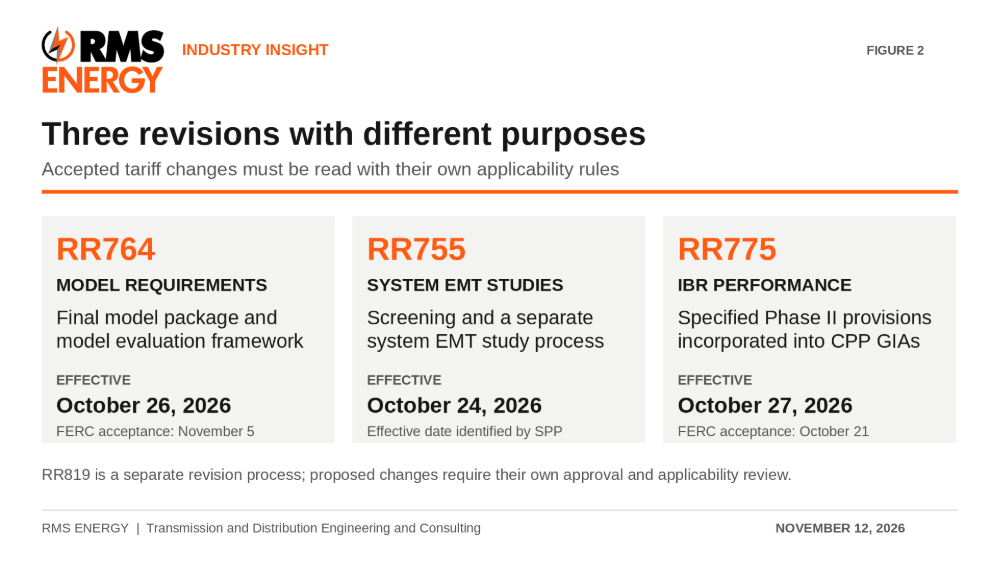
Figure 2 Accepted revisions address model requirements, system EMT studies, and IBR performance separately. Sources 1, 4, and 7.
Sources: FERC acceptance letters and SPP’s October 21 special-studies presentation. [1, 4, 7]
FERC’s November 5 action is an acceptance for filing under delegated authority. It establishes the effective tariff revisions; it does not constitute FERC validation of an individual plant model or a project’s technical performance.
How the tariff makes the modeling manual consequential
The November 5 acceptance covers Attachment V Section 11 and Appendices 1, 2, 3, 5, and 15, together with Attachment AY Section V.11 and Appendices 1, 2, and 3. [1]
These records connect the modeling framework to the interconnection procedures and study data forms. SPP replaced narrower EMT-model references with references to a generating-facility model package under its modeling manual. The October 7 amendment added language that had been omitted from Attachment B to Appendix 3 of Attachment V. [2, 3]
Section 11.3 is particularly relevant to project schedules. The accepted language requires the final generating-facility model package and states that SPP will not execute the final GIA without the information described in that paragraph. [2]
The engineering implication is straightforward: work backward from GIA execution. An OEM’s equipment delivery schedule may be acceptable while its model development schedule is too late. Procurement
Determine applicability before defining the scope
SPP’s August filing describes the new framework as applying to ICS cluster windows opening on or after the tariff’s effective date and to specified special-study requests submitted on or after that date. Those requests include surplus service, replacement, modification, interim service, and affected-system studies. Earlier requests follow the tariff provisions in effect when submitted. SPP also states that Generator Owners must provide applicable models upon request when reasonably necessary for its planning, operational, or reliability responsibilities. [2]
A useful first deliverable is a project-specific applicability record: request type, submission or window date, governing tariff attachment, manual revision, and any written SPP instructions. This prevents a team from importing a requirement from a newer presentation into an older study cohort without checking the transition provisions.
CPP applicability for ICS 2028 and later clusters
SPP’s posted schedule identifies April 1, 2026 as the opening date for the transitional ICS 2028 window, with a projected closing date of January 11, 2027. Its process overview identifies the next annual window as December 15, 2027 through February 15, 2028. Dates remain subject to SPP’s official postings and notices. [13, 14]
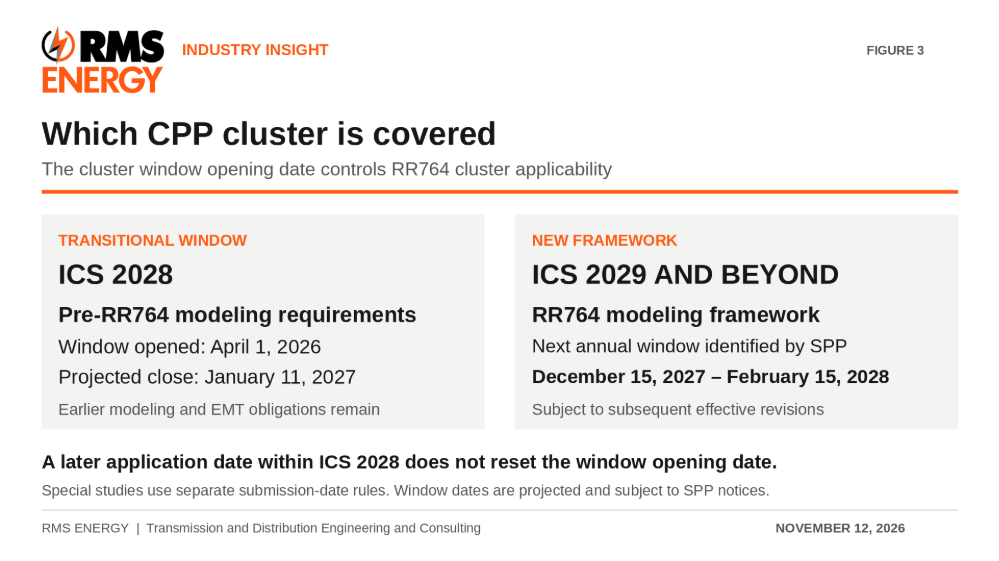
Figure 3 ICS 2028 follows the earlier framework; ICS 2029 onward follows RR764, subject to later effective revisions. Dates remain subject to change. Sources 2, 13, and 14.
Sources: SPP’s RR764 filing, posted study schedule, and October CPP process overview. [2, 13, 14]
For cluster applicability, the relevant date is the opening of the window. An application submitted after October 26, 2026 into the already-open ICS 2028 window does not automatically become subject to the full RR764 package solely because of its individual submission date. The submission-date rule for special-study requests is different. [2, 14]
ICS 2028 still carries its applicable modeling, performance, and PSCAD or EMT obligations under the earlier framework. Its transitional treatment should not be read as an exemption from those obligations. Nor should the RR764 transition rule be used to decide the applicability of every separate IBR performance revision. The applicable tariff, GIA, and request-specific instructions remain necessary to establish the complete scope.
It also matters when comparing regulatory drivers. SPP cites Orders 2023 and 901 and related reliability initiatives, but its particular multi-platform package should be attributed to SPP’s accepted framework. Order 2023 alone is not a sufficient explanation for every software deliverable or milestone. [2]
Build a coordinated package across modeling platforms
The RR764 manual identifies standard-library dynamic models, PSS®E user-defined models, TSAT user-defined models, and PSCAD user-defined models. A further positive-sequence format can be required when the interconnecting Transmission Planner uses another platform. [5]
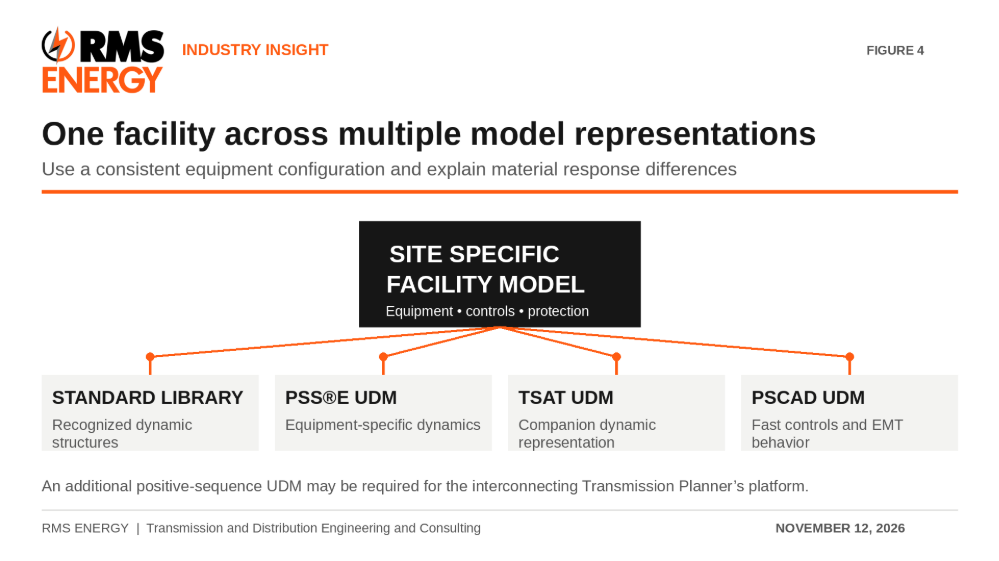
Figure 4 Model representations should describe the same site-specific facility. Additional TP-required formats may apply. Source 5.
Each representation must satisfy the applicable SPP requirements.
For project delivery, I recommend maintaining one controlled set of facility data behind all representations. That set should identify equipment ratings, unit counts, collector equivalents, transformer data, reactive support, operating modes, controller revisions, and protection assumptions.
Consider a hybrid plant with PV and storage under a common plant controller. Separate OEM files can each run successfully while the combined package describes inconsistent dispatch limits or voltage control. The integration review should establish how the resources share the POI limit, which controller regulates voltage, and how charging and discharging modes affect the study cases.
Cross-platform comparisons should also account for what each simulation method represents. Identical fault waveforms are not a sensible universal expectation when positive-sequence and EMT models resolve different phenomena. Engineers should compare quantities and time scales that are meaningfully comparable, then explain material differences.
Schedule submissions and model evaluation together
The RR764 manual describes the following milestones for projects subject to its framework. This is a planning summary for applicable future clusters and covered requests, not a replacement checklist for transitional ICS 2028. [5, 14]
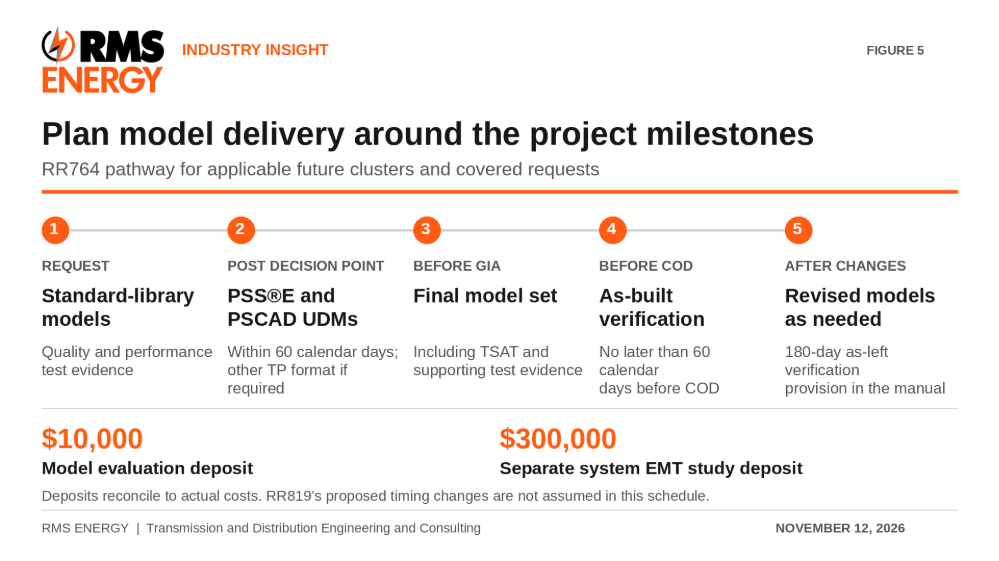
Figure 5 Milestones for requests covered by RR764, with separate model evaluation and EMT study deposits. Sources 5, 6, and 9.
Model evaluation also carries its own agreement and funding requirement. The RR764 Model Evaluation Agreement specifies a $10,000 deposit and reconciliation to actual evaluation costs. The deposit therefore should not be described as a fixed total price. [6]
For the special-study requests it covers, SPP’s October presentation lists the signed agreement and deposit at application, together with the generic model package, test report, and completed checklist. It lists PSS®E, TSAT, and PSCAD UDM packages before GIA execution. Teams should incorporate the applicable request-specific checklist into their submission schedule. [4]
A workable internal schedule should allow time for OEM delivery, consultant integration, testing, SPP review, and corrections. Treating the submission date as the date the OEM first delivers a model leaves no allowance for defects discovered during integration.
Test model quality and evaluate plant performance
SPP’s RR764 manual addresses initialization, disturbance response, and comparisons among model representations. It distinguishes required performance tests from supplemental tests and uses a SMIB-based test framework. [5]
The following graphic lists the 15 test families in Sections 5.1 and 5.2 of the posted RR764 manual. Each family can contain multiple simulation cases. This is the RR764 framework for applicable projects; it should not be treated as a new mandatory checklist for transitional ICS 2028. [5, 14]
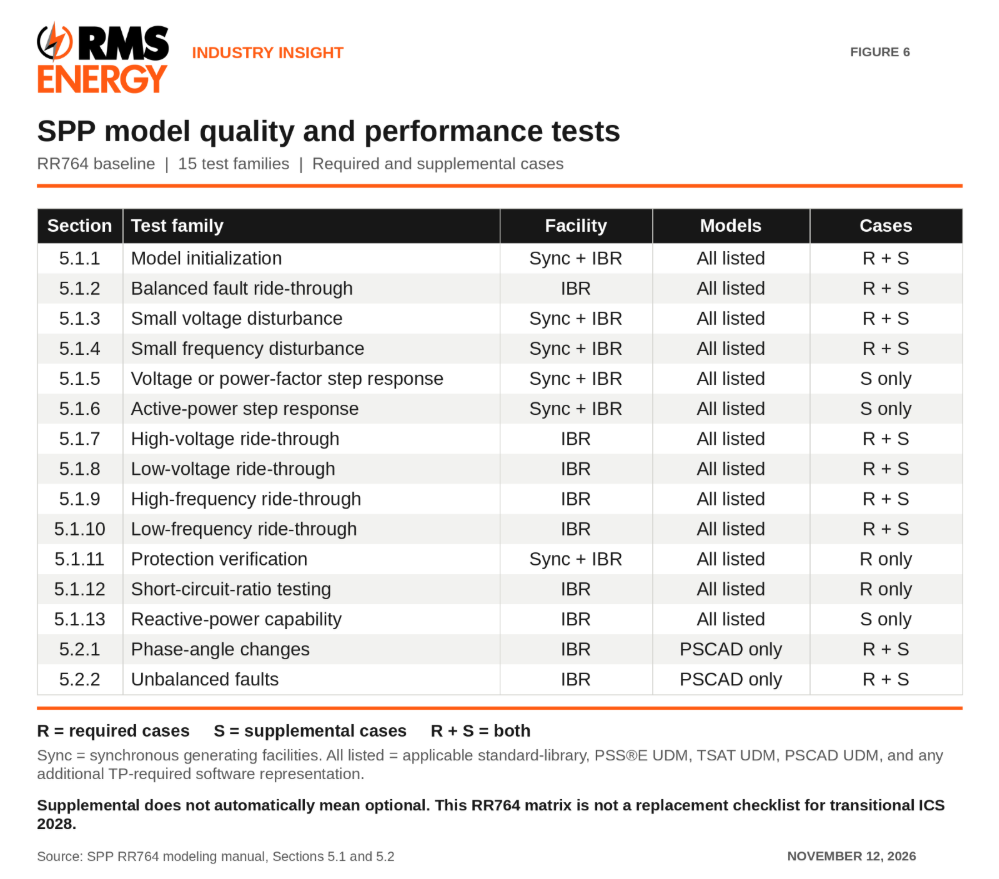
Figure 6 RR764 model quality and performance test matrix. Required and supplemental classifications refer to individual cases within each family. Source 5.
Sync means synchronous generating facilities. All listed means the applicable standard-library, PSS®E UDM, TSAT UDM, PSCAD UDM, and any additional TP-required software representation. R identifies required cases; S identifies supplemental cases. R + S means the family contains both. Source: RR764 manual, Sections 5.1 and 5.2. [5]
Supplemental does not automatically mean a case can be omitted. The manual states that Section 5.1 tests are to be performed for each modeling package, distinguishes the cases that must achieve the required performance to pass, and notes that SPP may need required and supplemental results before commercial operation. The applicable manual and SPP’s project instructions control the final scope. [5]
The matrix summarizes test families and case classifications. It does not replace the manual’s operating points, disturbance profiles, durations, or acceptance criteria. Proposed RR819 additions should be reviewed separately from this RR764 baseline.
Those activities answer related engineering questions. Can the model initialize and run reliably? Does it represent the intended control behavior? Does the modeled facility satisfy the applicable performance requirements? A successful compilation answers only a small part of that review.
For a reviewable submission, I recommend recording the model and firmware revisions, software environment, test conditions, measured channels, applicable criterion, result, and explanation of exceptions. Overlaid plots are most useful when they show the same operating point and disturbance across the comparable model representations.
For project engineering, I would organize the review around initialization across the operating range; voltage and frequency response; balanced and unbalanced disturbances; active and reactive power controls; current limits and protection; and performance under reduced grid strength. The applicable SPP test matrix determines the required cases and acceptance criteria. This review structure helps assign the work without implying that every check has the same status for every technology.
Synchronous generation needs its own equipment review. Generator, excitation, governor, stabilizer, and limiter representations should be reconciled to the proposed equipment and settings. For IBRs, the equivalent review should reconcile the inverter and plant controller, including their interaction with reactive support. A parameter mapping between field settings and model inputs makes either review easier to audit and update.
Weak-grid testing deserves particular care. A benchmark case with an assumed grid strength can demonstrate model behavior under that test condition. It cannot establish that the actual POI is acceptable for every topology. Project studies need to consider the relevant network configuration, outages, nearby resources, and control settings.
When a discrepancy appears, the correction should address its cause. Retuning one software representation solely to improve plot agreement can conceal an incorrect equipment setting or a missing control function. The model package should preserve the connection to the planned or installed plant.
Keep model evaluation separate from the system EMT study
SPP’s GI EMT Study Manual v1.0 applies to ICS windows opening on or after October 24, 2026, and specified special-study requests submitted on or after that date. For ICS, SPP performs Short Circuit Ratio and Critical Clearing Time screening. An IBR that fails that screening enters the EMT study process unless the customer withdraws. [8]
For that ICS pathway, the manual specifies execution of the EMT agreement within 30 calendar days after the decision point, study completion no later than 15 months before COD, and implementation of mitigation no later than 60 calendar days before COD. Special-study schedules must be checked separately against the tariff and the manual’s request-specific provisions. [8]
Because the ICS 2028 window opened before October 24, 2026, these new RR755 cluster provisions should not automatically be applied to it. Its applicable earlier EMT requirements remain relevant. For later clusters and covered special-study requests, use RR755’s own applicability date, which differs from RR764’s October 26 date. [8, 13]
The separate GI EMT Study Agreement specifies a $300,000 deposit with reconciliation to actual costs. This funds the system EMT study and is distinct from the $10,000 model evaluation deposit. [9]
That distinction has a practical consequence. A usable PSCAD model is an input to studying network interactions. Model qualification does not by itself demonstrate that the plant performs acceptably in its surrounding network. Conversely, passing an EMT screening does not remove the need to provide models required by the applicable modeling framework.
For development teams, this means keeping separate budget and schedule entries for model preparation, model evaluation, and any required system EMT study. The same PSCAD package may support more than one activity, but the engineering objectives and review steps differ.
Connect the models to the applicable IBR performance requirements
The October 21 acceptance in ER26-3630 concerns Attachment AY’s CPP procedures and GIAs. SPP’s filing explains that RR775 extends specified IEEE 2800-2022 Phase II provisions previously accepted under Attachment V into the CPP framework, rather than creating an entirely new technical standard. [7, 10]
The relationship is that performance provisions establish what an applicable facility must do, while models and test evidence allow planners to assess the represented behavior. Teams should map the applicable GIA requirements to model functions and evidence, including relevant control modes, limits, ride-through behavior, and protection.
Referencing IEEE 2800 in a study report is not enough to establish the project’s full obligations. The applicable tariff and GIA provisions determine which requirements have been adopted and how they apply to that facility.
Distinguish RR819 proposals from the accepted RR764 baseline
SPP continues to develop its framework. TWG approved RR819 and supplemental materials on October 27, 2026. The minutes describe expansion beyond generation to additional equipment categories and a proposed $10,000 model evaluation funding structure split between a $2,000 nonrefundable application fee and an $8,000 deposit. [11]
The posted RR819 materials propose a broader Dynamic Model Requirements Manual and changes to the assessment process. They also show a proposed final-model deadline no later than 120 calendar days after GIA execution. SPP’s October special-studies presentation explicitly flags that potential deadline change. [4, 12]
That proposed extension should not be used to relax a project schedule based on the November 5 RR764 acceptance. TWG approval of RR819 is a different action from FERC acceptance of the RR764 tariff records. A team should establish the final approval, effective language, and project applicability of any later revision before relying on it.
Make model delivery part of project execution
For developers and owners, my recommendation is to assign a single person responsibility for the complete model package, supported by the OEMs and study engineers. That person should maintain the governing requirements, revision history, unresolved issues, and delivery schedule.
OEM scopes should explicitly address the needed software representations, usable documentation, settings verification, and support for corrections. Engineering reviews should reconcile the models to a common facility configuration. Commissioning changes should enter the same revision process used during studies.
SPP’s accepted revisions make that coordination consequential to interconnection milestones. The most useful response is to bring model delivery into equipment procurement and schedule management early, then preserve the evidence connecting the studied facility to the plant that is built.
Official sources
[6] RR764 supplemental Generating Facilities Model Evaluation Agreement, Article 3.
[7] FERC acceptance letter issued October 21, 2026, ER26-3630-000, effective October 27, 2026.
[8] SPP GI EMT Study Manual v1.0, published October 24, 2026, Sections 1.1–1.3 and Table 1.1.
[9] SPP GI EMT Study Agreement v1.0, deposit and cost provisions.
[10] SPP filing dated August 27, 2026, ER26-3630-000, transmittal Sections II and III.