
(SPP GIAG Meeting — August 19, 2026)
SPP’s August Generation Interconnection Advisory Group (GIAG) meeting covered three topics that will directly shape how storage, generation, and large load projects operate and interconnect under the new Consolidated Planning Process (CPP).
Each item is at a different stage of development, but all three affect how interconnection customers plan their projects, structure their agreements, and model their resources in SPP’s footprint.
1. Storage Charging Limits and Resource Adequacy Are Being Defined (RR 807 — SRFI)
SPP’s Storage Reliability and Flexibility Initiative (SRFI) establishes the first comprehensive framework for how Electric Storage Resources (ESRs) charge, qualify for resource adequacy, and participate in SPP’s market.
At the center of the initiative is the ESR-LA — Electric Storage Resource Load Assessment. This assessment ensures that Market Storage Resources (MSRs) are studied in the charging scenario to maintain NERC FAC-002 compliance. The ESR-LA does not assign network upgrades — it assigns charging limitations.
SPP is defining a hierarchy of charging limits, each with different operational consequences:
- Inlet facility limit (from the System Impact Study) — hard cap, no charging above this level
- Stability and voltage limits (from ESR-LA) — defines the upper bound for MSR bids; charging above this level requires operator directive only
- Thermal limit (from ESR-LA) — advisory for the operations horizon; charging above this level is permitted but subject to more frequent curtailment
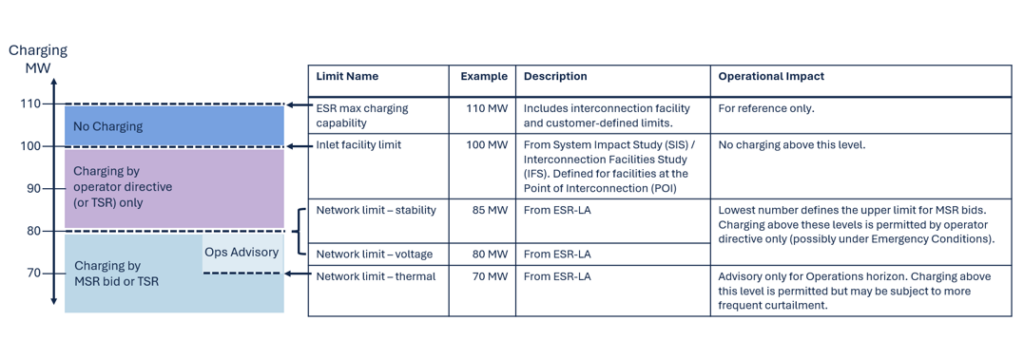
Source: SPP, “ESR Charging Limits,” GIAG Meeting, August 19, 2026.
For resource adequacy, ESRs must meet minimum ESR-LA charging requirements to participate in SPP’s ELCC study. The thresholds are duration-based: an 8-hour resource needs at least 50% of its ESR-LA limit available, 6-hour needs 37.5%, and 4-hour needs 25%. ESRs with firm transmission service for charging are exempt from ESR-LA limits entirely.
A key requirement is thatESRs seeking Designated Network Resource (DNR) status must have firm transmission service for their charging load. Without it, future load growth could displace the storage resource’s ability to recharge — undermining the reliability value the resource was accredited for.
SPP is also requiring CMLD (Composite Motor Load Dynamic) model files for self-charging ESRs going through the AQ/AX designation process.
Approval timeline: MWG (Sep 22), SAWG (Sep 23), RTWG (Sep 24), TWG (Sep 27), ESWG (Sep 29), CAWG (Oct 1), ORWG (Oct 8), MOPC (Oct 13), RSC and Board (Nov 16). Resource adequacy impacts are expected as early as the Winter 2027–2028 season.
2. SPP Staff Recommends Against Fixed Series Capacitors (SIR 852)
SPP is asking stakeholders a fundamental question: should Fixed Series Capacitors (FSCs) be allowed on SPP’s transmission system?
SPP staff’s recommendation is no. FSCs, even with passive damping filters, carry a high risk of sub-synchronous oscillation (SSO) during operation. SSO can damage equipment, trip generators, and destabilize the grid — and the risk increases when synchronous generators, IBRs, or large loads are nearby.
SPP presented four scenarios for stakeholder input:
- Scenario I: No FSCs on generator interconnection facilities, no FSCs on network facilities — SPP staff supports this
- Scenario II: FSCs allowed on both — SPP staff opposes
- Scenario III: No FSCs on GI facilities, FSCs allowed on network facilities — SPP staff opposes
- Scenario IV: FSCs on GI facilities, not on network facilities — SPP staff opposes
The cost difference is significant. For a 345 kV, 75-mile line where the goal is to double transfer capability:
- FSC: $25–35M (18–24 months) — cheapest, but highest SSO risk
- TCSC: $50–70M (24–36 months) — dynamic control, very low SSO risk
- APC/SSSC: $60–90M (30–42 months) — no SSO risk, best controllability
- Reconductoring: $50–65M (12–24 months) — increases ampacity without new right-of-way
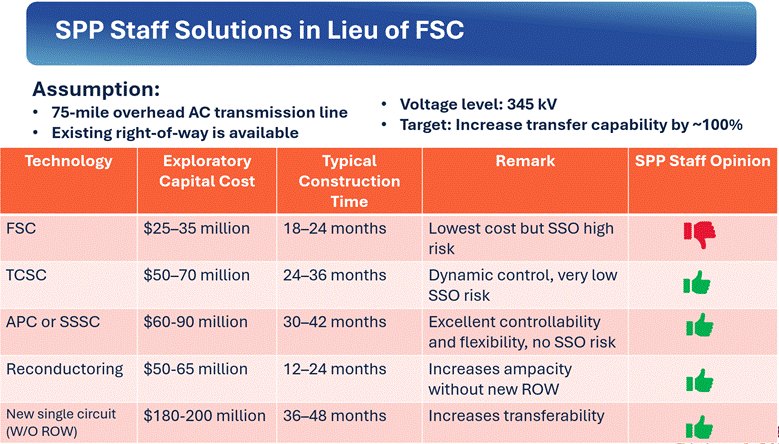
Source: SPP, “SPP Staff Solutions in Lieu of FSC,” GIAG Meeting, August 19, 2026.
For interconnection customers, this policy decision directly affects the cost of network upgrades assigned to their projects. If SPP prohibits FSCs, upgrade costs for transmission-constrained areas could be 2–3x higher — but the reliability risk drops substantially.
Stakeholder feedback deadline: September 5, 2026.
3. HILLGIA Generators Get a Path into the CPP (RR 790)
Generators that were studied under SPP’s High Impact Large Load (HILL) process and hold a HILLGIA now have a defined transition path into the new Consolidated Planning Process.
Under the HILL framework, these generators received Load Limited Resource Interconnection Service (LLRIS) — a temporary interconnection service that allows them to inject power, but only to serve the paired large load, not the wider grid. The question was: what happens to that LLRIS when the generator enters the ICS cluster study seeking full ERIS or NRIS?
RR 790 answers this:
- LLRIS carries forward into the CPP GIA — it does not expire when the generator enters the ICS
- LLRIS and LOIS stack — generators can use both their HILLGIA-based LLRIS amount and any Limited Operation amount from the ICS, up to the total requested interconnection service
- LLRIS ceases once all contingent transmission upgrades are in service and unconditional ERIS/NRIS becomes available
- The HILLGIA itself expires at the earlier of 5 years from COD or the effective date of the CPP GIA
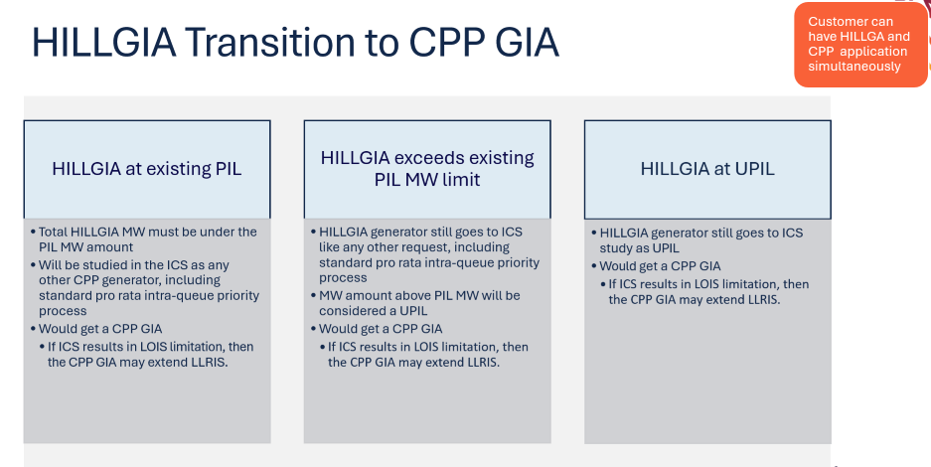
Source: SPP, “HILLGIA Transition to CPP GIA,” GIAG Meeting, August 19, 2026.
Generators with existing HILLGIA projects can hold a CPP application simultaneously. The ICS LOIS study will assume the LLRIS values from the HILLGA as a base, then determine any additional limited operation amounts on top.
For developers with HILL-paired generation, this provides continuity: the transition to CPP does not create a gap in interconnection service.
What Should SPP Market Participants Watch?
Key dates to track: September 5 is the stakeholder feedback deadline for the series compensation policy (SIR 852). RR 807 (SRFI) approvals begin September 22 and run through the Board vote on November 16. RR 790 (HILLGIA transition) continues through the GIAG and CPPTF stakeholder process.
For storage developers: Understand the ESR-LA charging limit hierarchy and how it affects your market registration, resource adequacy accreditation, and DNR qualification. The CMLD model requirement for self-charging ESRs is new — confirm your OEM can provide it.
For generation and transmission developers: The series compensation policy will directly affect network upgrade costs. If FSCs are prohibited, alternative technologies at higher cost become the baseline. Engage in the comment process before September 5.
For HILL-paired generators: RR 790 confirms that LLRIS carries into the CPP GIA. Review the proposed tariff language to ensure your project’s limited operation conditions are accurately reflected.
RMS Energy sees these developments as part of SPP’s broader effort to build a more integrated and transparent interconnection framework under the CPP. Navigating the new storage rules, transmission technology decisions, and agreement transitions will require coordinated expertise across interconnection studies, power system modeling, dynamic simulation, protection engineering, and market design.
SPP’s Consolidated Planning Process is still in its first cycle. The rules being written now will define how every resource connects, operates, and is valued for years to come.
Source: SPP Generation Interconnection Advisory Group (GIAG) Meeting, August 19, 2026.
#SPP #EnergyStorage #SeriesCompensation #InterconnectionReform #GridPlanning #ConsolidatedPlanningProcess #IBR #TransmissionPlanning #ResourceAdequacy