

(August 26, 2026)
THE CENTRAL SHIFT: MISO is reshaping storage charging rules, interconnection studies, transmission planning, load-pocket reliability analysis, and merchant HVDC procedures at the same time.
Five items, one system under pressure
Five PAC items stood out: the ESR charging TSR exemption, Light Load storage studies, MTEP26, MISO South load-pocket risk, and Attachment GGG improvements for merchant HVDC projects.
Together, they show MISO adapting its planning framework to faster load growth, more storage, and new transmission needs.
1. Economic Dispatch could remove a storage charging barrier
MISO proposes exempting ESRs from TSR requirements when charging under Economic Dispatch, treating that charging as a grid service rather than a traditional load withdrawal.
- More than 95% of ESR charging intervals from January through July 2026 used Economic Dispatch.
- Self-scheduled charging would still require Transmission Service; operators can preserve flexibility through offers and commitment status.

Figure 1. Monthly ESR charging dispatch status in 2026 shows Economic Dispatch accounting for the vast majority of charging intervals, with Self Schedule representing a small share.
- ZGIAs would not qualify. Co-located ESRs with large network load could qualify only when economically dispatched by MISO.
- Non-compliance could lead to exemption disqualification and unreserved-use charges; implementation details are expected in October.
Feedback deadline: Sept. 11, 2026.
2. Light Load replaces Shoulder for storage charging studies
MISO plans to replace the Shoulder charging case with a Light Load case in the DPP, reflecting the early-morning hours when storage charging is more pronounced.
- Light Load dispatch assumptions include storage at -100%, solar at 0%, combined cycle and steam-coal at 25%, wind at 87%, and nuclear/hydro at 100%.
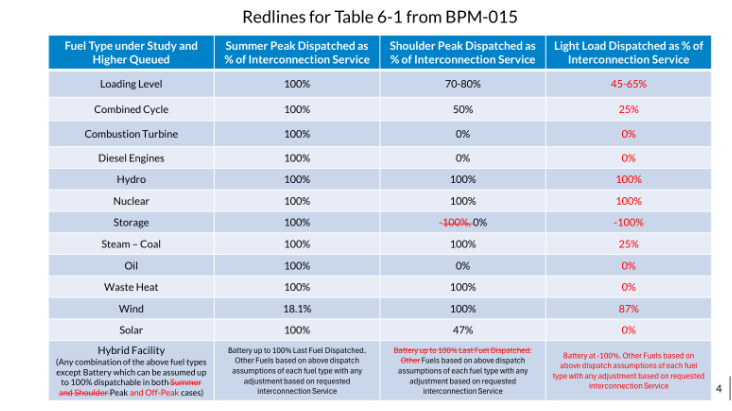
Figure 2. New Light Load dispatch assumptions for the DPP charging case show major changes in modeled dispatch across generation types.
If a constraint appears only in the Light Load charging case, a reduced battery charging limit can be used as mitigation and documented in the GIA.
The change also brings DPP and MTEP study assumptions into closer alignment at the Year 5 horizon.
Feedback deadline: Sept. 16, 2026.
3. MTEP26 reflects a sharp rise in load-driven transmission needs
The preliminary MTEP26 portfolio is large, and load growth is the dominant driver:
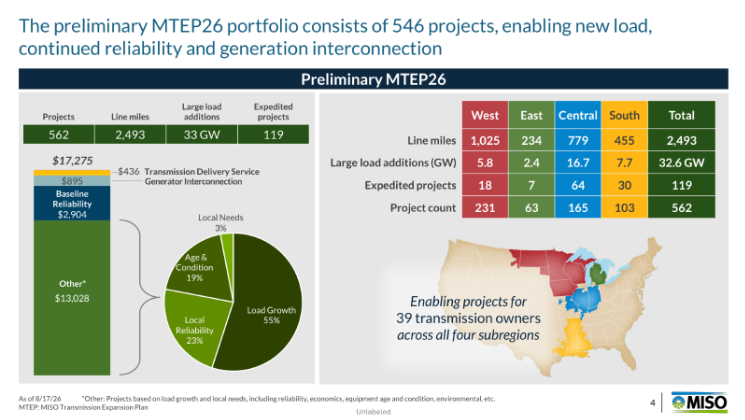
Figure 3. The preliminary MTEP26 portfolio summary shows project counts, line miles, large load additions, and expedited projects across MISO’s four subregions.
Source: MISO, “MTEP26 Report Preview,” Planning Advisory Committee, Aug. 26, 2026, p. 4.
- 562 projects, 2,493 line miles, 33 GW of large-load additions, 119 expedited projects, and about $17.3 billion in estimated investment.
- Load growth accounts for 55% of project need. Large-load additions supported by EPRs rose from 0.1 GW in 2020 to a projected 32.6 GW in 2026.
The draft report is scheduled for Sept. 28, followed by a two-week stakeholder feedback window through Oct. 12. Board approval is targeted for Dec. 3.
4. MISO South load-pocket risk is becoming a planning input
For planning year 2025/26, all four studied MISO South load pockets show LOLE above the 0.1 days/year reference threshold, while the rest of LRZ 9 remains below 0.01.
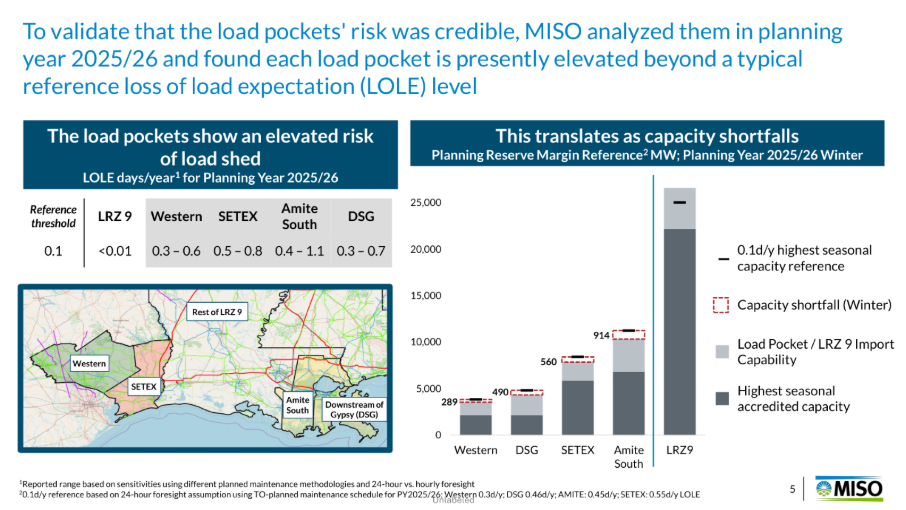
Figure 4. Load pocket LOLE values and corresponding capacity shortfalls for planning year 2025/26 show all four MISO South pockets exceeding the reference threshold.
Source: MISO, “Load Pocket Risk Assessment,” Planning Advisory Committee, Aug. 26, 2026, p. 5.
- Key structural challenges include limited import capability, reliance on local generation, and geographic constraints on new development.
- Planned generation and transmission investments improve the outlook, but some pockets may still face tighter margins through 2030. The assessment now directly informs LRTP South.
Feedback deadline: Sept. 9, 2026.
5. Attachment GGG clarifies the merchant HVDC interconnection path
MISO is finalizing Phase 2 changes to Attachment GGG after stakeholders asked for clearer upgrade definitions and study sequencing.
- Necessary Upgrades relate to the physical connection and are not tied to injection or withdrawal; Network Upgrades are associated with injection and/or withdrawal.
- MHVDC customers can pursue Injection Rights through Attachment X or Transmission Service under Module B, with sequencing clarified relative to Attachment GGG.
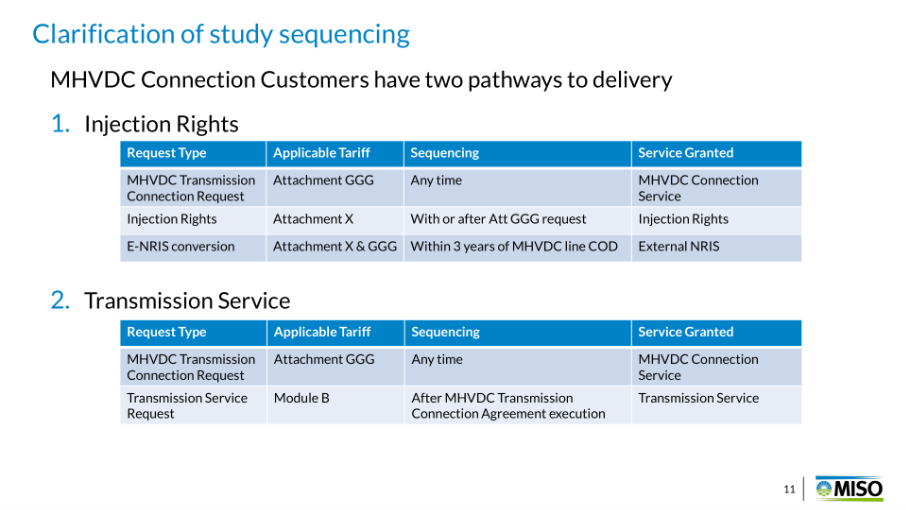
Figure 5. MISO clarifies the study and tariff sequencing for MHVDC customers pursuing Injection Rights or Transmission Service.
MISO planned to finalize the Phase 2 updates at the Aug. 26 PAC and is targeting a Q4 FERC filing.
What stakeholders should do now
- Watch the deadlines: Sept. 9 for load pockets, Sept. 11 for the TSR exemption, and Sept. 16 for storage charging study changes.
- Recheck storage economics: Model the effect of the Economic Dispatch exemption and its operational limits.
- Revisit DPP assumptions: Assess whether the Light Load case could create GIA charging limits for projects in study.
- Review MTEP26: The Sept. 28 draft will open a short window to assess upgrade, cost, and schedule implications.
- Engage on LRTP South: Load-pocket assumptions are now feeding long-range planning, especially in Louisiana and Texas.
- Track Attachment GGG: Merchant HVDC developers should follow the Q4 filing and final upgrade classifications.
RMS Energy perspective
These five items are connected. Storage policy is changing alongside study methodology, load-driven transmission expansion, localized reliability planning, and HVDC interconnection rules.
For developers, transmission owners, and load-serving entities, the advantage will come from tracking how one change affects assumptions in the others, not treating each workstream in isolation.
#MISO #TransmissionPlanning #EnergyStorage #GridReliability #MTEP26 #BESS #HVDC #RMSEnergy