What Interconnection Customers Need Before the October 5 2026 Window Opens
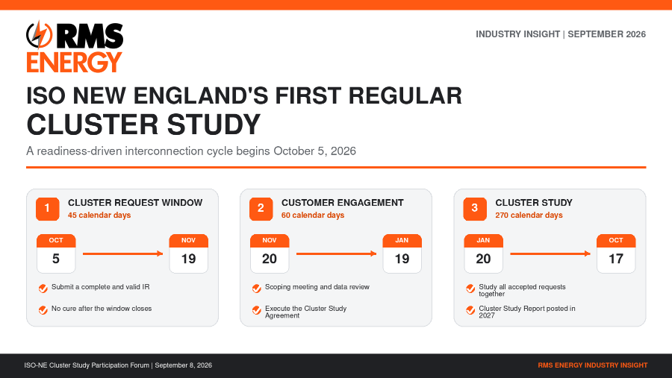
ISO New England will open the Cluster Request Window for its first regular Cluster Study on October 5, 2026. Interconnection customers will have 45 calendar days, through November 19, to submit a complete and valid Interconnection Request. The short window makes advance preparation essential because an application that remains incomplete at the deadline will be withdrawn without an opportunity to cure.
The most important work will occur before the portal opens. Project teams need to align the requested service, deposits, site control, point of interconnection, technical forms, PSS/E, PSCAD and ASPEN models, benchmarking documentation and PP5-6 attestations. Administrative prerequisites such as Critical Energy Infrastructure Information access and a Customer Asset Management System identifier can also require up to 10 business days.
For developers entering the first regular cluster, readiness will mean more than submitting files on time. It will mean presenting one internally consistent project across every form, model and study platform.
FIRST REGULAR CLUSTER STUDY
The Schedule Is Compressed and Sequential
ISO New England’s process begins with two entry phases before the technical Cluster Study starts. The Cluster Request Window establishes which projects enter the cohort. The Customer Engagement Window then provides the scoping, agreement and technical-review period that determines which projects remain in the cluster when the study begins.
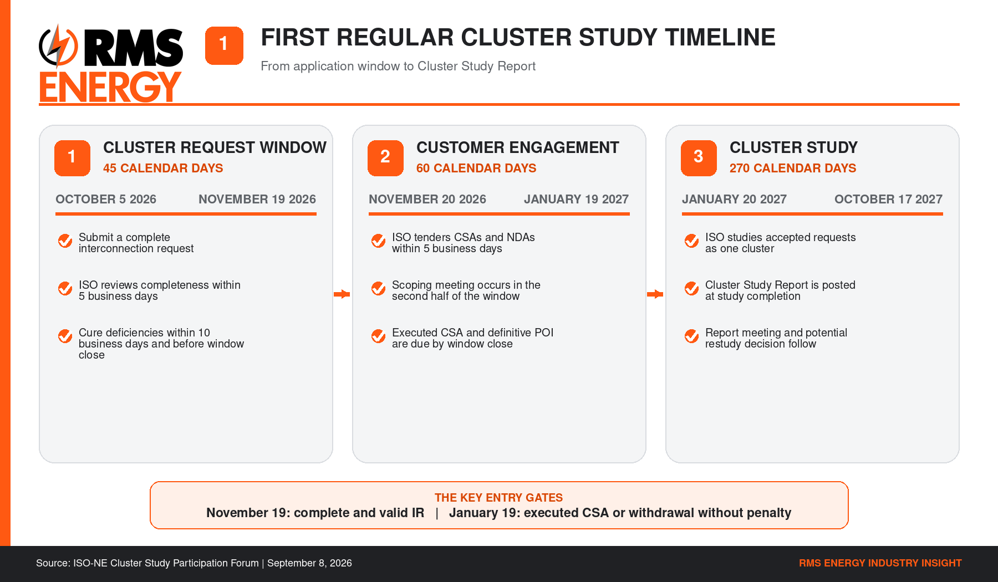
Figure 1 Key phases and decision gates for the first regular ISO New England Cluster Study.
The Cluster Request Window opens October 5 and closes November 19, 2026. The Customer Engagement Window runs from November 20, 2026 through January 19, 2027. The Cluster Study is scheduled to begin January 20 and conclude October 17, 2027, when ISO New England expects to post the Cluster Study Report.
The report meeting is expected within 10 business days after October 17, and ISO New England will decide whether a restudy is needed within 30 calendar days of that meeting. An updated heatmap is expected within 30 calendar days after October 17, 2027, and a restudy would begin November 30 if required.
The two critical entry gates are November 19 for a complete and valid Interconnection Request and January 19 for an executed Cluster Study Agreement with a definitive point of interconnection.
CLUSTER ENTRY
A Complete Interconnection Request Requires Coordinated Readiness
A complete Interconnection Request is not a single application form. It is a coordinated package submitted under Schedule 22 for large generators, Schedule 23 for small generators or Schedule 25 for Elective Transmission Upgrades. ISO New England identified six workstreams that should be treated as one integrated submission program.
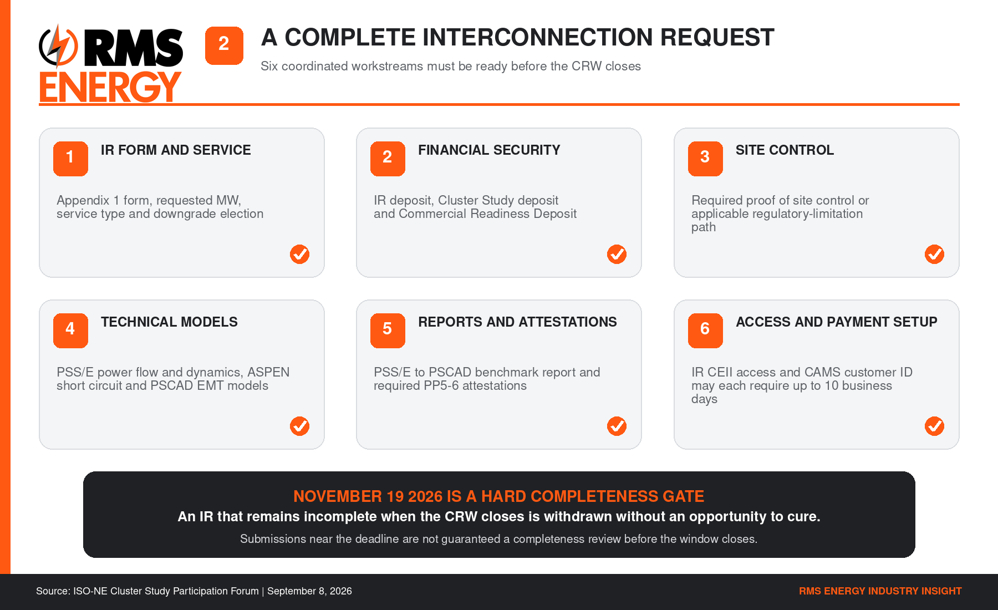
Figure 2 The workstreams required to assemble a complete Interconnection Request before the Cluster Request Window closes.
Core Submission Components
• A complete Interconnection Request form, including the MW amounts to be studied and the requested type of interconnection service
• The applicable Interconnection Request deposit, Cluster Study deposit and Commercial Readiness Deposit
• Proof of site control for the proposed generating facility or Elective Transmission Upgrade
• All technical data required by Appendix 1, Attachment A and, when applicable, Attachment A-1
• PSS/E power-flow and stability models, an ASPEN OneLiner short-circuit model and a PSCAD model when required
• The PSS/E-to-PSCAD benchmarking report and required PP5-6 attestations
ISO New England expects to provide additional instructions for its overhauled Interconnection Request software application before the window opens. Project teams should not wait for the portal to begin compiling and validating the underlying data.
Financial and Site Control Requirements Must Be Resolved Early
All required deposits must be received by ISO New England before the Cluster Request Window closes. The Interconnection Request and Cluster Study deposits must be submitted in cash by wire. Checks are not accepted. The Commercial Readiness Deposit may be provided through cash, a letter of credit, a surety bond or an accepted combination, depending on the applicable requirements.
Deposit Requirements at the Cluster Request Window
| Project | Service Request | IR Deposit | Study Deposit | CRD |
| Large or ETU | NRIS/NIIS or CNRIS/CNIIS | $50,000 | $250,000 | $500,000 |
| Large or ETU | CNRIS or CNIIS only | $50,000 | $100,000 | $200,000 |
| Small | NRIS or CNRIS | $15,000 | $100,000 | $200,000 |
| Small | CNRIS only | $15,000 | $50,000 | $100,000 |
The table summarizes the deposit levels presented by ISO New England. The Commercial Readiness Deposit is the source of any applicable withdrawal penalty. Unused Cluster Study deposit amounts are refundable, while treatment of the initial deposit depends on the timing and circumstances of withdrawal.
Payment logistics are part of schedule readiness. A CAMS identifier is required for payment processing, and ISO New England indicated that a new customer identifier may take up to 10 business days to establish. The customer name must match across ISO registrations, submissions and systems.
Site Control
Requests seeking CNRIS or CNIIS must demonstrate exclusive site control for 100 percent of the proposed facility. NRIS requests must demonstrate 100 percent site control or follow the regulatory-limitations pathway and associated deposit requirements. Additional documentation may be required when a project’s acreage does not meet the technology-specific values in PP5-6.
Service Selection Shapes Study Exposure
Interconnection customers must specify both the service requested and the MW amount to be studied. Generator requests may seek NRIS, CNRIS or both; applicable external controllable transmission requests may seek NIIS, CNIIS or both. A project may request capacity service at a lower MW level than its energy-service request.
For CNRIS or CNIIS, the customer may elect an automatic downgrade to NRIS or NIIS when violations appear only in the capacity analysis. That election can materially change the project’s upgrade responsibility and resulting service. It should be evaluated as an interconnection strategy decision rather than treated as a form-completion detail.
PROCESS DISCIPLINE
The Deadline Leaves Little Room for Late Corrections
During the Cluster Request Window, ISO New England will acknowledge receipt of an Interconnection Request and identify completeness deficiencies within five business days. The customer generally has 10 business days after notice to provide the required information, but every cure must be completed by November 19.
Submissions received near the deadline are not guaranteed to receive a completeness review before the window closes. If an application is incomplete at the close of the window, it will be withdrawn without an opportunity to cure. This makes an early internal completeness review one of the most valuable risk-control steps available to a project team.
The Customer Engagement Window Is a Decision Period
The Customer Engagement Window opens November 20. Within five business days, ISO New England expects to tender Cluster Study Agreements and issue nondisclosure agreements. The public list of Interconnection Requests in the cluster is expected within 10 business days. The scoping meeting will occur during the second half of the window and will address the accepted requests, general point-of-interconnection feasibility, system characteristics and potential internal affected systems or parties.
The executed Cluster Study Agreement is due by January 19, 2027 and must identify the project’s definitive point of interconnection. The agreement will include a good-faith, nonbinding estimate of study cost and schedule. Cluster Study costs are allocated 50 percent per capita and 50 percent by MW among the projects being studied.
Technical Data Deficiencies Continue to Matter
ISO New England will begin its deeper technical-data review during the Customer Engagement Window. A customer will have 10 business days to cure an identified deficiency. If the issue remains, ISO New England may issue a formal Notice of Withdrawal that provides an additional 15 business days to cure. Failure to resolve deficiencies after the window closes may expose the project to the applicable withdrawal-penalty provisions.
Projects may withdraw by the end of the Customer Engagement Window without a withdrawal penalty, but that does not necessarily mean every deposit remains refundable. The initial deposit becomes nonrefundable 10 business days after the scoping meeting, and an Interconnection Request without an executed Cluster Study Agreement at the January 19 deadline will be withdrawn.
TECHNICAL READINESS
Model Quality Is a Cluster Dependency
ISO New England’s message on technical data was direct: accurate and validated models are necessary to complete the study on schedule and identify the appropriate interconnection facilities, network upgrades and cost allocations. In a cluster, one project’s deficient data can affect the work performed for every other participant.
The project represented in PSS/E, PSCAD, ASPEN, the one-line diagram and the tariff attachments must be the same electrical facility. Ratings, impedances, transformer configurations, collector-system equivalents, reactive devices, controls and protection settings should tell one consistent technical story.
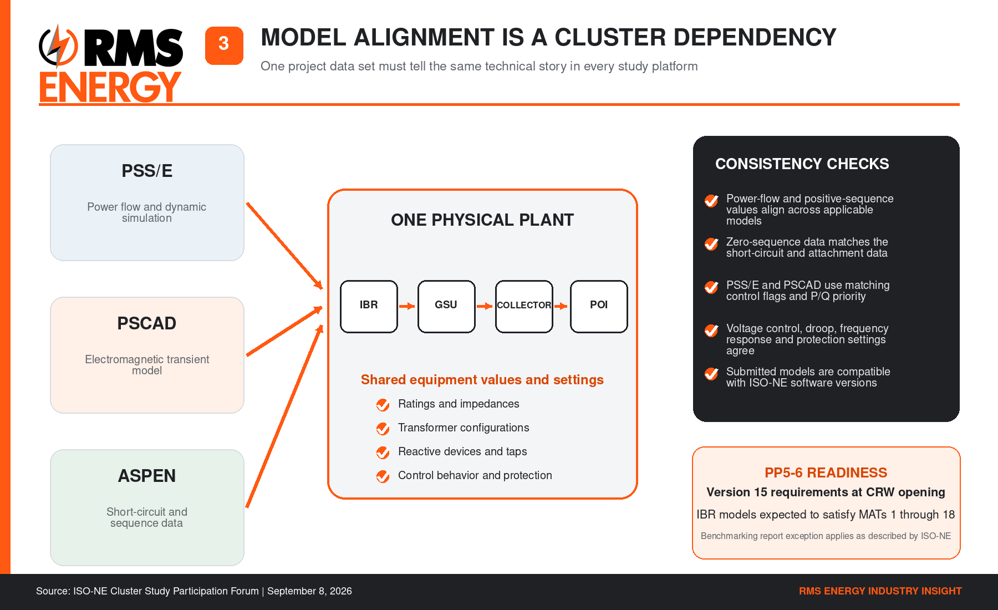
Figure 3 Model alignment across PSS/E, PSCAD, ASPEN and the project design is essential to cluster-study readiness.
Key Alignment Expectations
• Power-flow data and positive-sequence impedances should align across applicable models
• Zero-sequence impedances and winding configurations should match the short-circuit model and Attachment A-1 data
• PSS/E and PSCAD control flags, P and Q priority, voltage-regulation point, frequency-control parameters, droop and protection settings should agree
• Models must be compatible with the software versions used by ISO New England
• EMT models must not include restrictions that prevent ISO New England from sharing them with its study consultants
MODEL ACCEPTANCE
PP5 6 Version 15 Raises the Readiness Standard
ISO New England stated that PP5-6 version 15 will become effective before the Cluster Request Window opens and that technical data submitted for the first regular cluster must meet the new requirements. The revision includes changes to the main body, Appendices C-1 and C-2 and a new Appendix F-1.
Because of the timing of the updated Appendix C-2, ISO New England will accept a benchmarking report prepared under the existing Appendix C-2 revision 1.0. That limited exception does not reduce the expected model-performance standard. Inverter-based resource models are expected to satisfy all 18 model acceptance tests in the updated Appendix C-2 revision 2.0, and ISO New England plans to use the revised tests in its own review.
Projects entering the cluster should therefore run the revised model acceptance tests before submission. A passing benchmark alone may not identify parameterization, initialization, control-response or protection issues that emerge during the full acceptance-test suite.
RMS Energy Perspective
The first regular ISO New England cluster introduces a more disciplined first-ready, first-served environment. The practical challenge is not any single requirement. It is coordinating commercial decisions, application data, engineering design and validated models on one schedule while preserving consistency across every deliverable.
RMS Energy believes project teams should manage the October 5 opening as the end of the preparation period, not its beginning. Early readiness reviews can identify mismatched MW values, unresolved service elections, incomplete site-control evidence, payment and access delays, model-version conflicts and benchmarking gaps before those issues threaten cluster entry.
Learn how RMS Energy supports complex transmission projects through our T&D engineering and consulting services
What Project Teams Should Do Now
• Confirm the Schedule 22, 23 or 25 application pathway and requested service levels
• Evaluate the automatic-downgrade election and MW levels for energy and capacity service
• Initiate CEII access, CAMS registration and deposit logistics early
• Validate site-control documentation against PP5-6 requirements
• Freeze a coordinated one-line diagram and plant-data baseline
• Align PSS/E, PSCAD and ASPEN data and complete the benchmarking report
• Run the revised PP5-6 model acceptance tests and close deficiencies before submission
The November 19 deadline is a hard gate, but the more consequential deadline is internal: the date by which the project’s commercial, administrative and technical workstreams are ready to submit one complete and defensible Interconnection Request.
Source materials ISO New England Cluster Study Participation Forum, September 8, 2026. ISO New England notes that the effective Tariff, Planning Procedures and Market Manuals govern if guidance conflicts.
#ISONE #Interconnection #ClusterStudy #EnergyStorage #RenewableEnergy #PowerSystems #RMSEnergy