

ERCOT’s Inverter-Based Resource Working Group meeting on August 17, 2026, reinforced an important industry message: establishing requirements is only the first step. Grid reliability ultimately depends on whether the installed controls, protection systems, models, telemetry, and commissioning practices perform as expected during actual grid disturbances.
The meeting covered recent ERCOT ride-through events, negative-sequence current injection performance, NERC standards development, EMT modeling, commissioning, and broader efforts to harmonize interconnection study practices.
Recent events highlight more than generator tripping
ERCOT reviewed two recent disturbances that demonstrated the complexity of evaluating IBR performance.
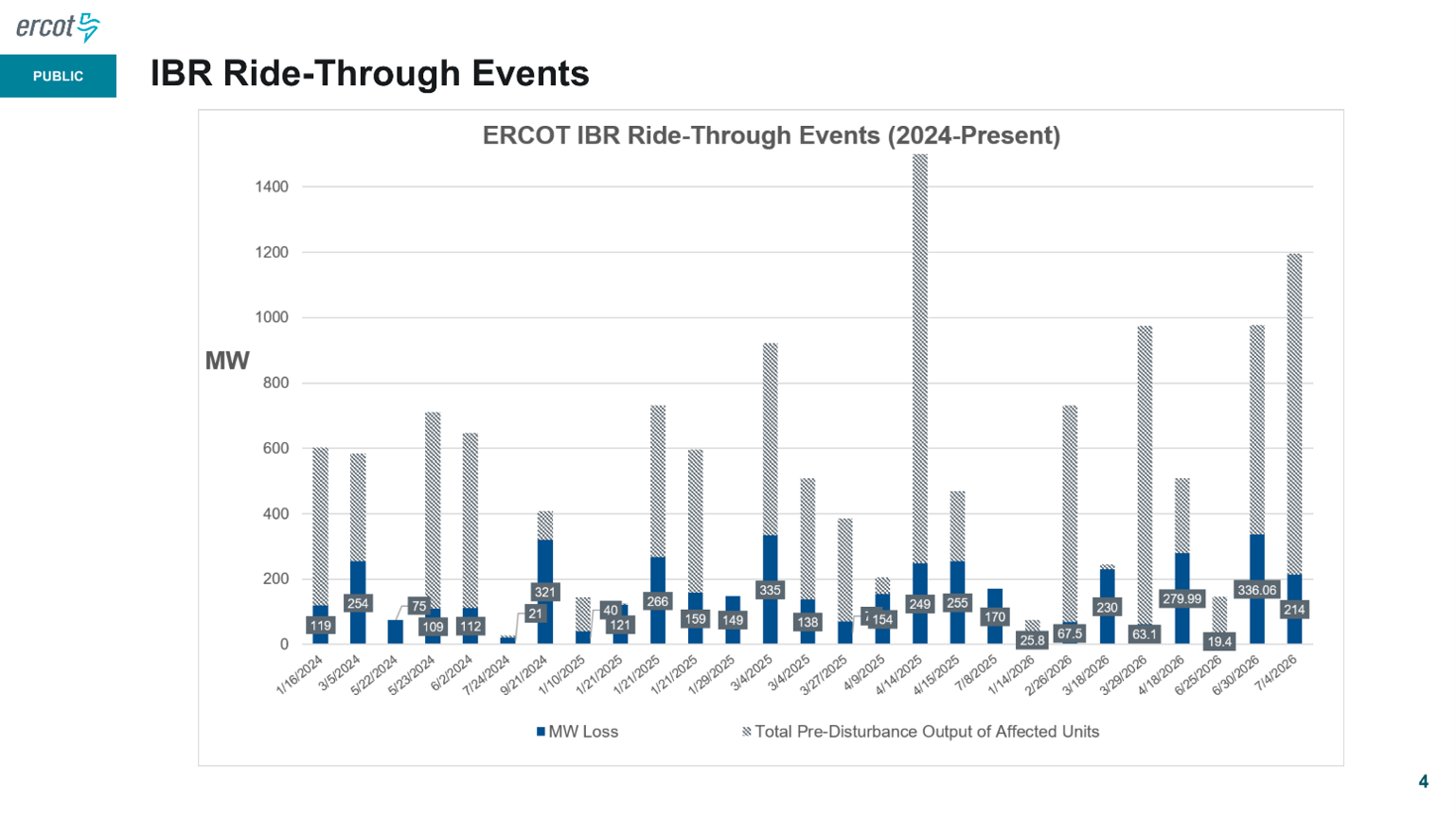
During a June 30 fault on the 345-kV system, ERCOT observed approximately 401 MW of generation reduction:
- 336 MW immediately following the event
- 65 MW as a delayed reduction
- Follow-up investigations involving nine generating resources
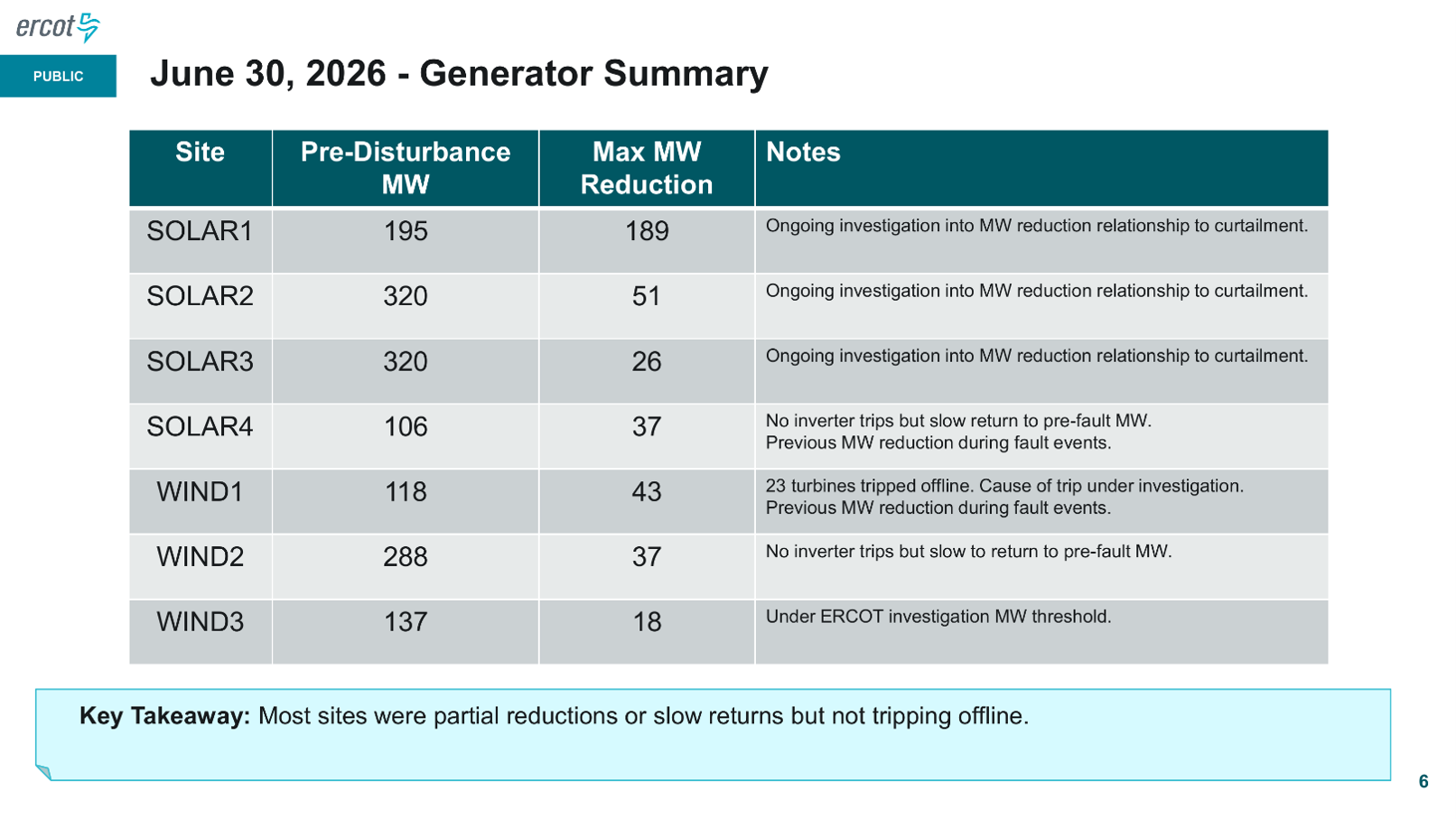
ERCOT noted that most affected sites experienced partial output reductions or slow recovery rather than complete plant trips. This distinction is important. A resource can technically remain connected while still failing to provide the expected active-power recovery or plant-level response.
The July 4 event provided another important preview. Four consecutive faults occurred on the Far West 345-kV system near Odessa. Preliminary findings identified approximately 214 MW of IBR generation reduction, approximately 370 MW of load reduction, and frequency swings between 59.969 Hz and 60.20 Hz within approximately 20 seconds. ERCOT also reported that some energy storage resources overreacted to the frequency variations.
These events show that ride-through performance cannot be evaluated as a simple “trip versus no-trip” question. The evaluation must consider:
- Partial MW reductions
- Delayed recovery
- Plant-controller response
- Inverter and turbine availability
- Frequency response behavior
- Interaction with simultaneous curtailment instructions
ERCOT specifically identified challenges in distinguishing fault-related reductions from curtailment response using SCADA data. Accurate High Sustained Limit and Number of Turbines On telemetry, together with appropriate ramping to a new base point, will be increasingly important for post-event analysis.
Corrective Action Plans also need to be completed promptly. Having a CAP in progress does not suspend the resource’s operating obligations or eliminate the risk of additional Apparent Performance Failure notifications.
Negative-sequence current injection is becoming a major coordination issue
Another significant discussion focused on negative-sequence current injection, or NSCI.
Through NOGRR 245, applicable new and modified IBR projects in ERCOT are required to provide NSCI consistent with relevant IEEE 2800 requirements. However, the detailed performance profile still needs further definition based on ERCOT system needs.
This is not simply an inverter-control requirement. It is a cross-functional coordination issue involving:
- Transmission protection
- Converter current limitations
- Ride-through performance
- Stability objectives
- OEM control logic
- Short-circuit and sequence-modeling capability
Unlike synchronous generators, whose negative-sequence response is largely governed by physical machine and network impedances, an IBR’s response is control-driven. It can vary based on inverter type, current-priority logic, control mode, plant impedance, OEM implementation, and converter current limits.
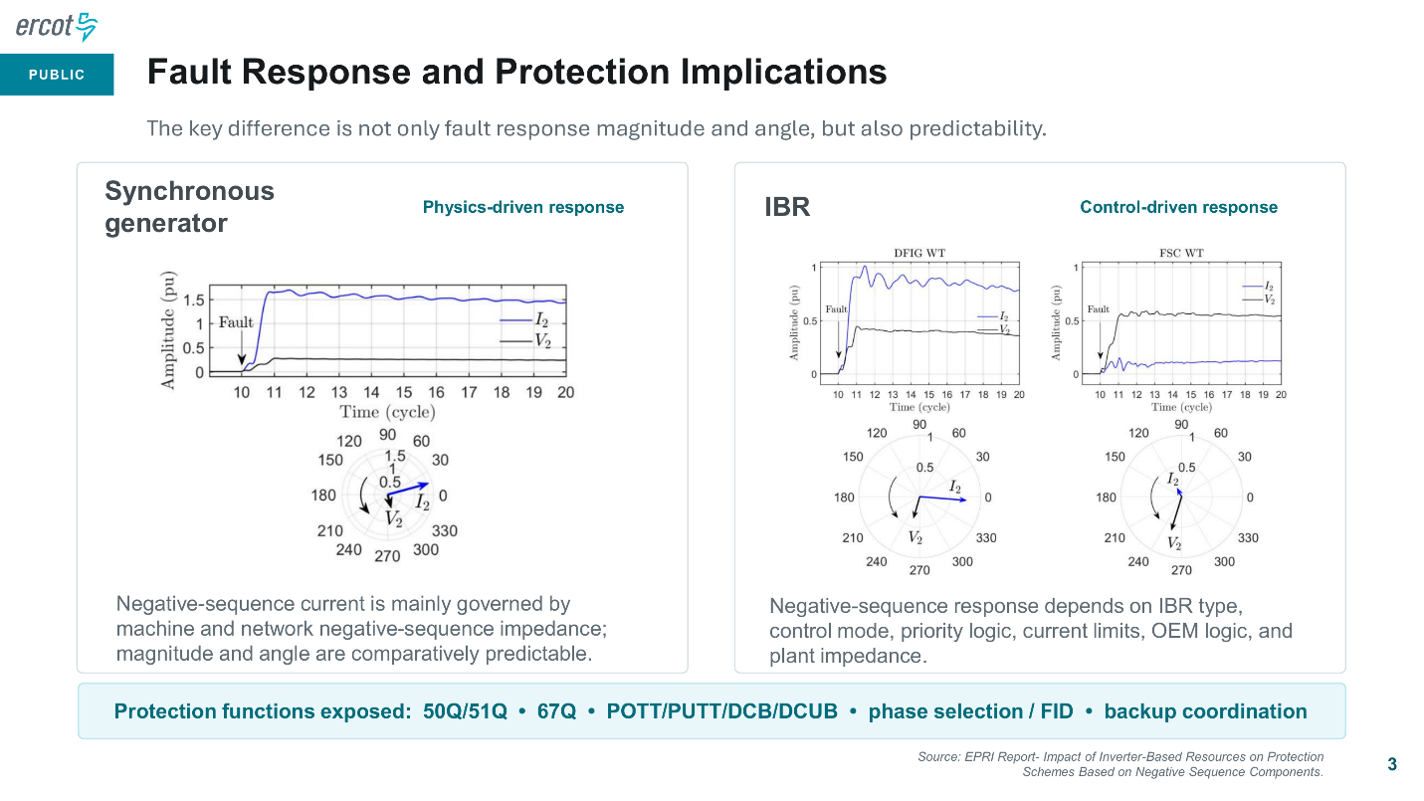
For protection engineers, predictability is critical. Undefined or control-dependent negative-sequence current can affect directional protection sensitivity, phase selection, fault identification, pilot protection schemes, and backup coordination.
Feedback from 14 Transmission Service Providers showed increasing use of weak-source-tolerant protection in high-IBR areas. However, it also identified limited industry guidance, legacy directional elements that may require review, and continuing model and data gaps.
The next step is collaboration among ERCOT, TSPs, OEMs, developers, and consultants to define an NSCI performance envelope that is both achievable by the equipment and adequate for system protection. That profile should address magnitude, phase angle, response time, duration, and current-priority behavior, with corresponding requirements for models, validation, and event monitoring.
IBR requirements are becoming lifecycle obligations
The NERC update further demonstrated that IBR compliance is moving beyond one-time interconnection studies.
Progress continues across PRC-028, PRC-029, PRC-030, MOD-026, and other standards associated with FERC Order No. 901. The meeting also highlighted draft guidance covering:
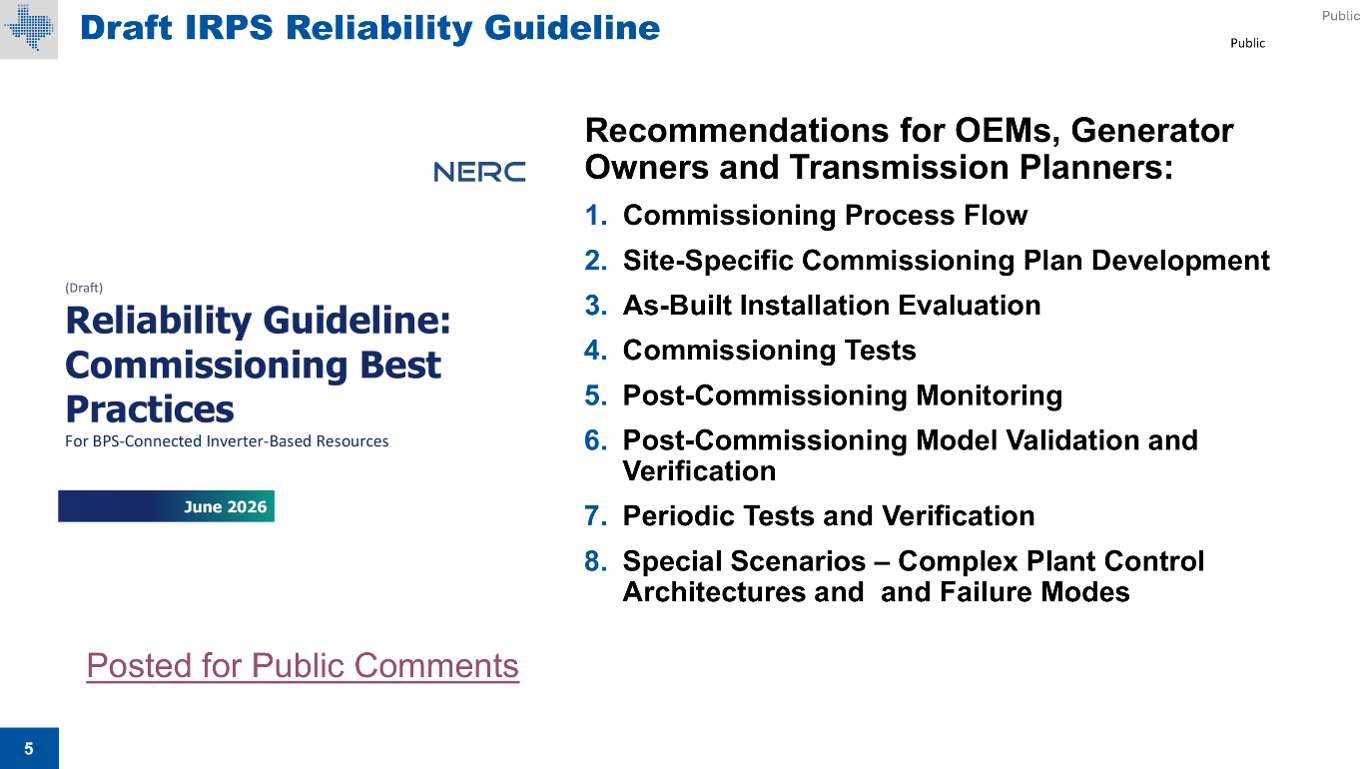
NERC’s draft white paper on IBR equipment EMT model validation was also posted for public comment through September 3, 2026.
At the same time, national EMT standard development continues to face implementation challenges, while ERCOT and other ISO/RTO regions are moving forward with increasingly detailed EMT and dynamic-modeling requirements.
The direction is clear: model quality must be managed throughout the complete asset lifecycle, from interconnection and design through commissioning, commercial operation, plant modifications, and post-event validation.
Practical implications for developers and asset owners
The meeting provides several immediate takeaways for developers, IPPs, OEMs, and operating asset owners:
- Treat ride-through as a plant-level performance obligation, not merely an inverter setting or interconnection-study check.
- Confirm that positive-sequence, dynamic, short-circuit, and EMT models reproduce the installed control behavior, protection settings, current limits, and plant architecture.
- Define NSCI performance explicitly in OEM specifications, models, protection studies, and acceptance-testing procedures.
- Strengthen commissioning and model-validation plans before commercial operation.
- Maintain accurate operational telemetry and sufficient disturbance data to separate grid-event response from curtailment or dispatch actions.
- Track evolving ERCOT and NERC requirements proactively instead of waiting for a disturbance, compliance deadline, or model-quality issue.
RMS Energy sees these developments as part of a broader transformation in IBR integration. Successful projects will require coordinated expertise across interconnection studies, EMT and dynamic modeling, protection, plant design, commissioning, event analysis, and NERC compliance.
The future of IBR reliability will not be defined only by what a model predicts or what a standard requires. It will be defined by whether the installed facility can demonstrate the expected performance when the grid is under stress.
Source: ERCOT IBRWG Meeting – August 17, 2026
#ERCOT #IBR #GridReliability #RenewableEnergy #BatteryStorage #PowerSystems #EMT #GeneratorInterconnection #NERC #IEEE2800