

What the September 2026 stakeholder workshop signals for large-load and generation interconnections
ERCOT is considering a more integrated way to study new large loads and regional reliability needs. The September 24, 2026 stakeholder workshop described a proposed process that combines Batch and reliability studies, builds a coordinated set of planning cases, and runs steady-state, dynamic-stability, and short-circuit analyses in parallel. The goal is to reduce repeated work and connect project allocation more directly to an actionable transmission plan. These are proposals under stakeholder development, not adopted requirements.
For interconnection applicants, the practical questions are how project data will enter the process, when a change triggers re-study, and how study results translate into transmission solutions. The workshop’s survey results and technical proposals offer an early view of what developers and utilities should watch.
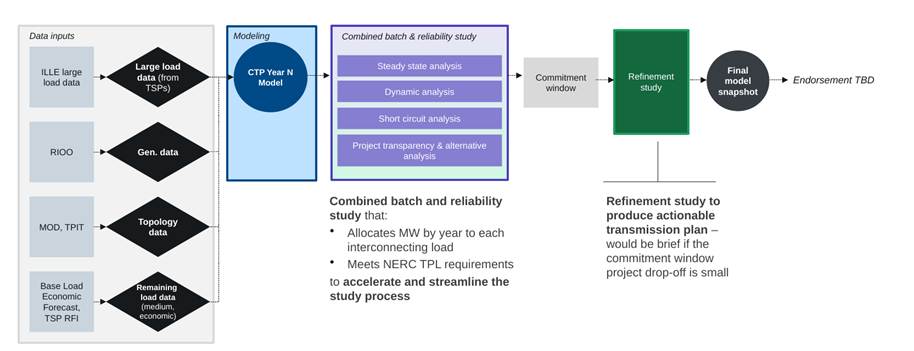
Figure 1. ERCOT’s proposed study sequence from model preparation through the combined study, commitment window, and refinement. Workshop #slide 69.
What happens next in ERCOT’s planning redesign?
The September workshop deck places the Comprehensive Transmission Planning (CTP) and Batch 1+ proposals within a longer stakeholder and approval process. It shows further workshops and working-group discussions, followed by proposed NPRR/PGRR revisions, Technical Advisory Committee (TAC) review, and ERCOT Board consideration.
- October–December 2026: Workshops 3–5 were listed for October 14, November 9, and December 2.
- November 2026: Initial revision requests were targeted for filing on November 1.
- March–April 2027: TAC and ERCOT Board approval were shown as target milestones.
These are roadmap dates from the workshop materials, not confirmed implementation dates. The deck does not specify an effective date.
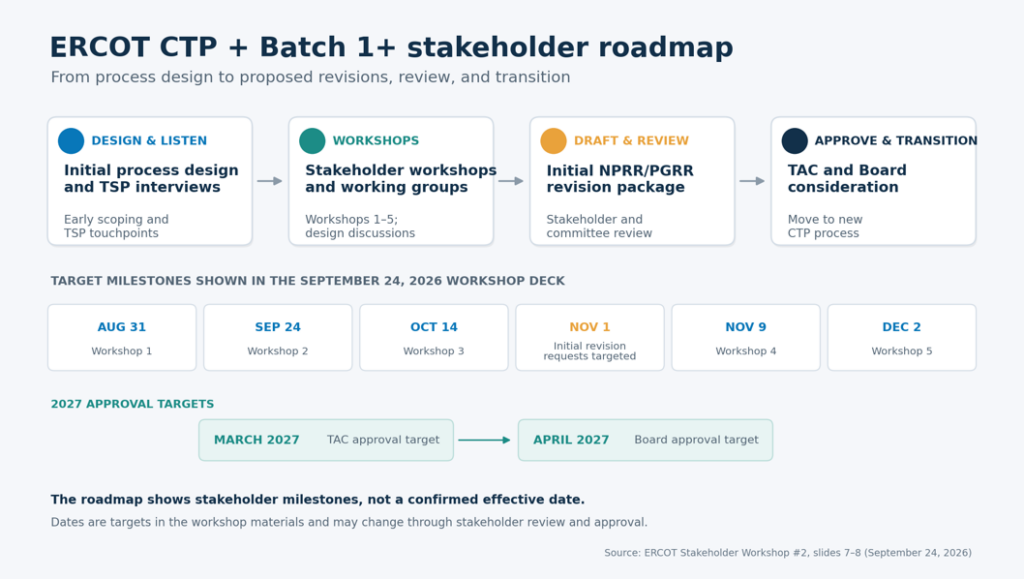
Figure 2. ERCOT’s stakeholder roadmap for developing the proposed CTP and Batch 1+ processes, from workshops and revision requests through TAC and Board consideration. Source: Workshop #slide 7,8.
A combined study for allocation and reliability
ERCOT is considering combining Batch and reliability studies into one streamlined process:
- Study load requests across five years in about 17 cases.
- Include conditions such as summer and fall peaks, minimum load, and no-solar scenarios.
- Use one modeling process to meet NERC Transmission Planning (TPL) requirements.
The goal is to reduce duplicate analysis. After the commitment window, ERCOT would refine the transmission plan based on projects that remain. The timing would depend on how many projects continue and how many drop out.
Parallel technical studies still need one consistent model
The proposed flow runs steady-state, dynamic-stability, and short-circuit studies in parallel. They answer different engineering questions: steady-state analysis evaluates system performance across operating cases; dynamic studies assess response to disturbances; and short-circuit analysis checks fault-current levels and related equipment or mitigation needs. Parallel work can reduce calendar time, but only if the analyses use consistent topology, project assumptions, and model data.
This makes model quality and change control central to the proposed process. Changes to project size, ramp, in-service date, point of interconnection, or load characteristics may affect more than one study. The workshop included dedicated discussion of project changes, dynamic-model review and subsynchronous oscillation (SSO) studies, and short-circuit modeling.
Short-circuit analysis is a near-term pressure point
ERCOT described a specific challenge in Batch Zero: Transmission Service Providers (TSPs) currently have 60 days to build a short-circuit case and analyze transmission needs associated with fault currents from the proposed expansion plan. The workshop identified concern that this window may be too short as fault-current levels rise and mitigation may be needed when equipment margins are approached.
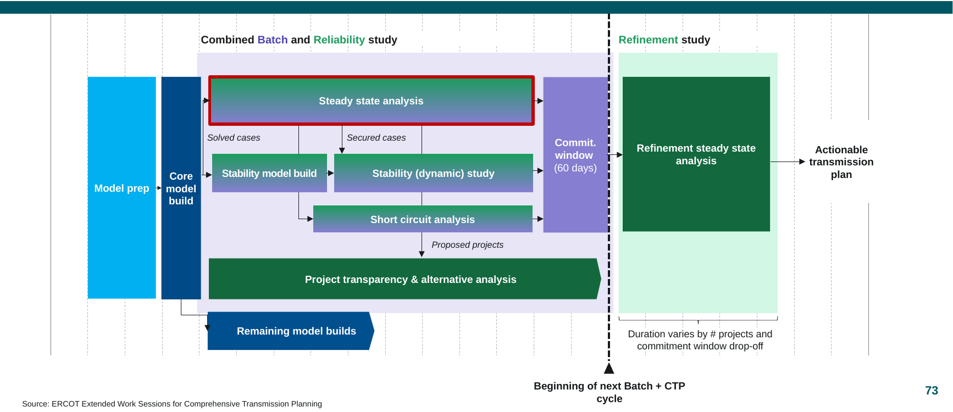
Figure 3. ERCOT’s proposed sequence showing parallel steady-state, dynamic, and short-circuit studies. Workshop slide #73.
ERCOT proposed developing a short-circuit case for the final Batch Zero year, 2032, conditioned to match the Batch Zero topology and generation. The deck describes using Batch project information, updated topology, generic TSP impedances, and generation models or representative impedances. Initial stakeholder feedback suggested 60 days may be workable if ERCOT supplies the model, but could be tight when projects must be developed or modified.
POI definition and early screening matter
- POI selection: The survey gathered 74 responses. A majority of responding TSPs favored having the TSP select a large load’s point of interconnection (POI). Interconnecting load-serving entities were more evenly divided.
- Timing: Respondents commonly cited about 30 days for a TSP to submit steady-state POI and modeling information after an Intermediate Agreement. For complex configurations, some suggested allowing six to eight weeks.
- Early feasibility screens: Respondents supported early screens, especially for POI identification and minimum interconnection identification. A majority favored completing these screens before a Batch application.
- Practical takeaway: These are survey findings, not finalized ERCOT requirements. They point to the value of resolving the POI and assembling consistent network and facility data before the formal study cycle begins.
Project changes can affect prior allocations
ERCOT presented proposed change rules for large-load Batch projects:
- Higher requested MW could trigger re-study of the increased amount in a later Batch; decreases would not.
- Earlier service dates or higher ramps could trigger re-study. Pushed-out dates or ramps may be reflected in a later Batch or CTP study.
- POI changes could trigger re-study unless ERCOT finds the new POI electrically equivalent.
Under the general proposal, a load sent to a later Batch could forfeit previously allocated MW and need to re-enter as a studied load, pay the study fee, and meet applicable prerequisites and deadlines. Applicants should assess changes early and document their study assumptions.
Transparency and alternatives are part of the CTP design
The CTP concept would add a transparency and alternatives pathway for transmission projects identified through planning:
- Stakeholders would receive transparency on projects across the proposed pathways.
- Some projects could undergo a fuller alternatives analysis.
- Projects unresolved through CTP could continue through a proposed Regional Planning Group (RPG) 2.0 pathway.
For interconnection participants, this could show what system need a project addresses, how it affects regional flows, and where alternatives and stakeholder feedback fit. A project in one TSP’s footprint can still affect flows, transfer capability, or costs elsewhere. Eligibility and governance remain open design questions.
RMS Energy Perspective
An integrated study process can be valuable if it reduces duplicate analysis without sacrificing model consistency or stakeholder visibility. For project teams, the near-term work is familiar but consequential: define the POI, validate power-flow and dynamic models, document load ramp and operating assumptions, and manage changes before they disrupt study cases or allocated capacity. For TSPs and developers, short-circuit data and equipment limits should be addressed early enough to shape solutions rather than delay them.
Learn how RMS Energy supports complex transmission projects through our T&D engineering and consulting services
Conclusion
ERCOT’s September workshop points toward a more connected planning process for large loads, generation, and regional transmission needs. Combining Batch and reliability studies, coordinating technical analyses, and refining solutions after commitments could create a clearer path from project request to transmission plan. The outcome will depend on the final rules, data requirements, study scope, and handoffs adopted through stakeholder review.
For now, applicants should treat the concepts as proposals and prepare for the issues already visible: study-ready data, a defensible POI, clear project-change controls, and timely short-circuit and dynamic-model information.
#RMSEnergy #InterconnectionStudies #PowerSystems #LargeLoads #TransmissionPlanning #GridReliability #ERCOT