

ERCOT’s proposed battery requirements, PJM’s coordinated study framework, SPP’s CHILLS clarifications, and NERC’s developing computational-load standards
A data center’s battery configuration can change the studies and models its connection requires. An uninterruptible power supply (UPS), a parallel battery without grid exports, and a market-participating resource receive different treatment under ERCOT’s proposed requirements. SPP’s zero-injection pathway also makes operating arrangements part of the study question, while PJM proposes coordinating load and generation studies.
Together with NERC’s developing computational-load requirements, these discussions point to one engineering priority: define the facility’s intended operation, reflect it in the models, and keep the application consistent as the design develops.
The initiatives are at different stages. NERC’s standards have passed ballot but still face approval; ERCOT’s battery requirements and change-evaluation approach are preliminary, and PJM’s framework remains under stakeholder development.
The timeline below brings NERC’s filing and conditional implementation milestones together with PJM’s proposed filing target.
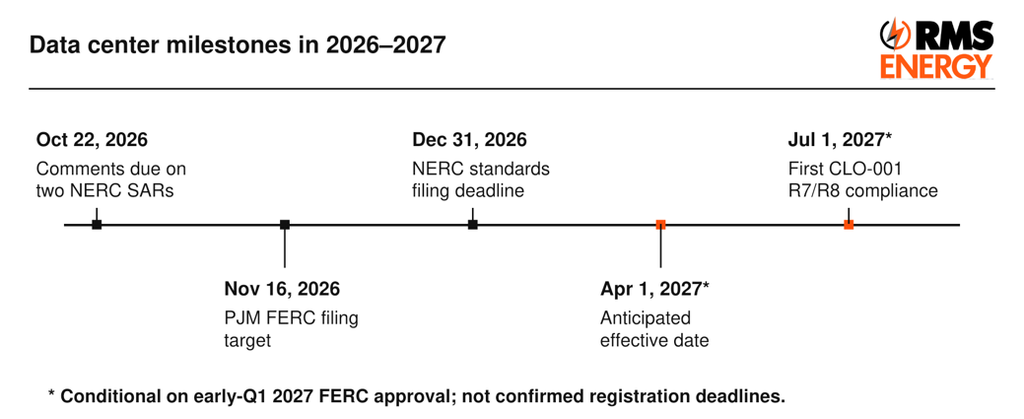
Figure 1. NERC milestones and PJM’s proposed filing target, 2026–2027. April and July dates depend on early-Q1 2027 FERC approval. Sources: ERCOT LLWG, October 15, 2026, slides 4, 13 and 15; PJM September 30 framework, slide 19.
NERC’s CLO/CLOP framework brings reliability responsibilities into design
The computational-load update presented at ERCOT’s October 15, 2026 Large Load Working Group describes new NERC registrations for Computational Load Owners (CLOs) and Computational Load Operators (CLOPs). The stated registration criteria cover Computational Load Sites of at least 50 MW connected at least 100 kV.
The three CLO standards passed ballot with affirmative votes ranging from 77.93% to 82.40%, above the 66.67% threshold.
- CLO-001 covers interconnection, studies, and modeling data;
- CLO-002 covers operational data and communications;
- CLO-003 covers protection coordination and disturbance monitoring.
Those responsibilities reach into facility design. Modeling data must include tripping, ride-through, and disturbance-recovery parameters. The proposed update cycle is at least every 13 months, with additional updates after specified changes. Monitoring provisions include Sequence of Event Recording, Fault Recording, and Dynamic Disturbance Recording.
The immediate task: Check the site against the registration criteria and assign responsibility for modeling data, operating communications, and monitoring. Review the two Standard Authorization Requests (SARs) open for comments until October 22, 2026: event reporting/model validation and computational-load loss in planning and operational studies.
The update’s implementation dates remain conditional: early first-quarter 2027 FERC approval would likely imply an April 1 effective date and July 1 first compliance date for CLO-001 R7 and R8, covering qualified-change definitions and modeling-data specifications. Those are not confirmed registration deadlines.
ERCOT battery proposals and SPP CHILLS clarifications make configuration decisive
ERCOT’s October 15 Batch 1+ workshop distinguishes three battery configurations under its proposed requirements:
- UPS-only battery: Modeled as part of the large load, with no separate registration.
- Parallel battery without grid exports: Requires the load’s Batch process plus Generation Interconnection or Modification (GIM), separate load and battery dynamic models, and applicable generation registration.
- Market-participating battery: Follows the Energy Storage Resource (ESR) pathway, with market-available MW and state-of-charge capability derated.
The engineering task: Define the battery’s electrical connection and operating modes before setting the study scope. A no-export designation alone does not determine modeling or registration treatment.
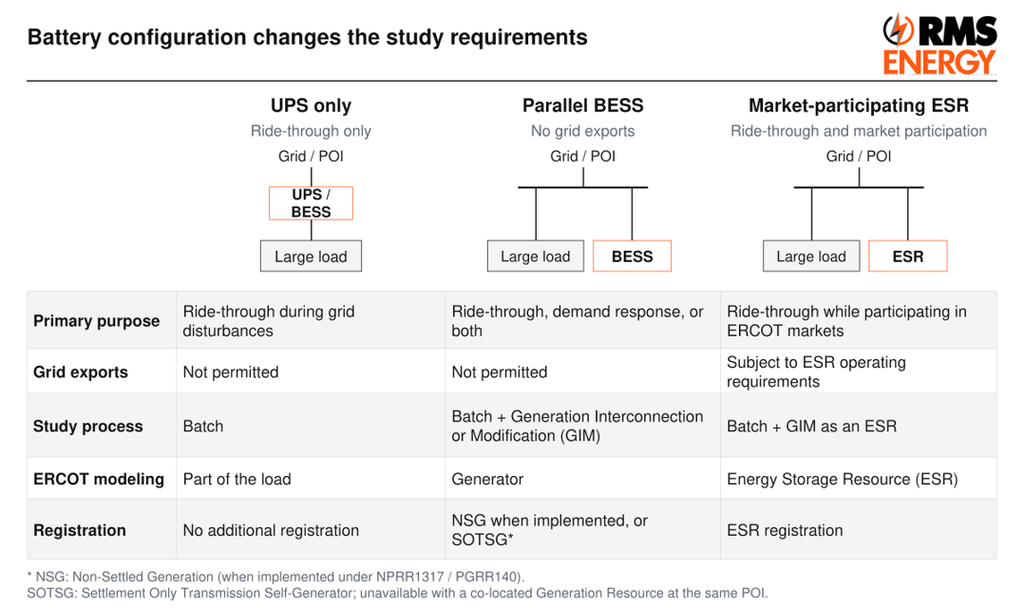
Figure 4. ERCOT’s comparison of UPS-only, parallel non-exporting, and market-participating battery configurations. Source: ERCOT Stakeholder Workshop #3, Batch 1+, October 15, 2026, version 2, slide 25. Proposed treatment; registration and implementation qualifications are detailed on slides 26–28.
The distinction matters before equipment and operating assumptions are finalized. A no-export designation alone does not determine the proposed modeling or registration treatment. Teams need to specify the electrical connection and whether the battery will provide ride-through, demand response, or market participation.
SPP’s October 15 Q&A on Conditional High Impact Large Load Service (CHILLS) makes a related distinction for behind-the-meter generation. Generation configured for zero injection can undergo a 90-day SPP study or an equivalent stability study by the transmission owner. Generation above 10 MW must be market registered, and each load and generator requires separate metering. Transmission billing does not use net metering.
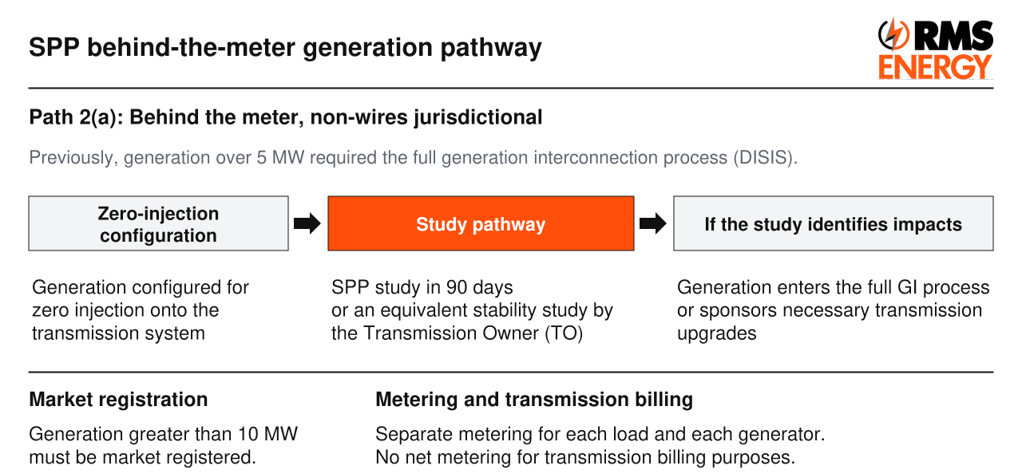
Figure 6. SPP’s behind-the-meter generation pathway, including zero-injection study conditions, metering, and transmission-impact provisions.
If the study identifies potential transmission impacts, the generation must enter the full generation-interconnection process or sponsor necessary upgrades. The study pathway is not a guaranteed energization date. ERCOT and SPP describe different arrangements, but both discussions make the operating configuration essential to establishing the study scope.
ERCOT change assessments and PJM’s study proposal connect design decisions to timing
ERCOT’s preliminary approach connects model changes to project timing:
- Adverse voltage or frequency ride-through changes: Restudy required.
- Other material dynamic changes: Assessment may be needed in the next Batch stability study. Allocation remains unchanged, but initial energization could be affected.
The practical implication is to review control and load-characteristic changes before assuming that the original study and schedule still apply.
PJM’s September 30 proposal coordinates load and generation studies through an annual 12-month process:
- Screening: Approximately four months.
- System Impact Study: Approximately seven months.
- Agreement finalization: Approximately one month.
The proposed assessment covers summer, winter, and light-load conditions, including:
- Load and generation deliverability.
- N-1 and N-1-1 thermal and voltage performance.
- Short circuit, stability, and transmission-owner criteria.
Study readiness requires:
- A defined POI, co-location arrangement, requested MW, and service elections.
- A site plan, study deposit, verified site control, permits, and technical data.
- Transmission-owner approval.
- For large loads, a proposed $30,000/MW readiness commitment, described as not at risk.
The development task: Align load, battery, generator, and service assumptions before entering the process. Resolve operating modes early so the study reflects the project you intend to build.
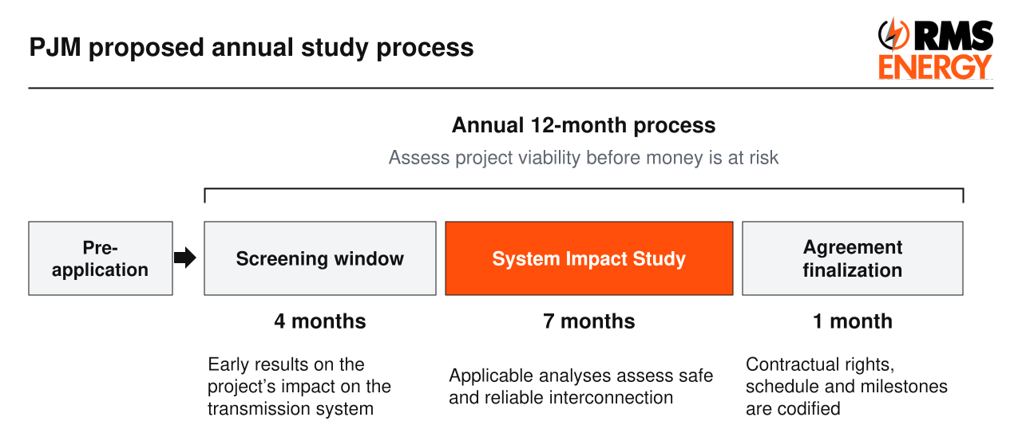
Figure 5. PJM’s proposed annual study sequence. Source: PJM Co-Located Load Order Workshop, September 30, 2026, slide 7. The schedule remains a proposal, not an energization guarantee.
Actions before the next project decision
- Developers: Settle configuration and service assumptions before entering studies. Review changes for potential assessment or restudy implications.
- Utilities and transmission owners: Reconcile model data with the proposed controls, protection, metering, and monitoring responsibilities.
- Large-load customers: Define how UPS equipment, batteries, and on-site generation will operate. Assign owners for registration preparation and model-data updates.
Sources
- ERCOT Large Load Working Group — October 15, 2026: computational-load update, slides 3, 5, 7–10, 13, and 15.
- ERCOT Batch/CTP Workshop 3a — October 15, 2026: version 2, slides 13–16 and 25–28.
- PJM Co-Located Load Order Workshops: September 30 framework, slides 6–11; October 16 agenda and draft tariff redlines.
- SPP Large Load Processes Q&A: October 15 presentation, slide 6.