

Batch Zero was the bridge. Comprehensive Transmission Planning and Batch 1+ are being designed as the repeatable framework.
ERCOT’s first Comprehensive Transmission Planning and Batch 1+ workshop points to a broader change than another round of Batch rules. The goal is to connect large-load qualification, Batch studies, common planning models, reliability analysis, and transmission endorsement in one planning architecture.
THE CENTRAL SHIFT ERCOT is moving from a temporary Batch Zero framework toward a continuous planning process where committed large-load information can flow directly into full transmission planning.
That distinction matters because Batch Zero exposed a recurring problem: the same transmission need can be touched by multiple processes, models, and review steps. CTP is intended to reduce that duplication while preserving the reliability requirements imposed by NERC, PUCT, and PURA.
Batch Zero exposed a bigger planning challenge
ERCOT is proposing a future process built around four connected ideas:
- A single source of truth for load, generation, topology, and planning assumptions.
- An integrated Batch process tied to the annual planning cycle.
- Consolidated modeling and reliability studies.
- A streamlined path from study results to an actionable and endorsed transmission plan.
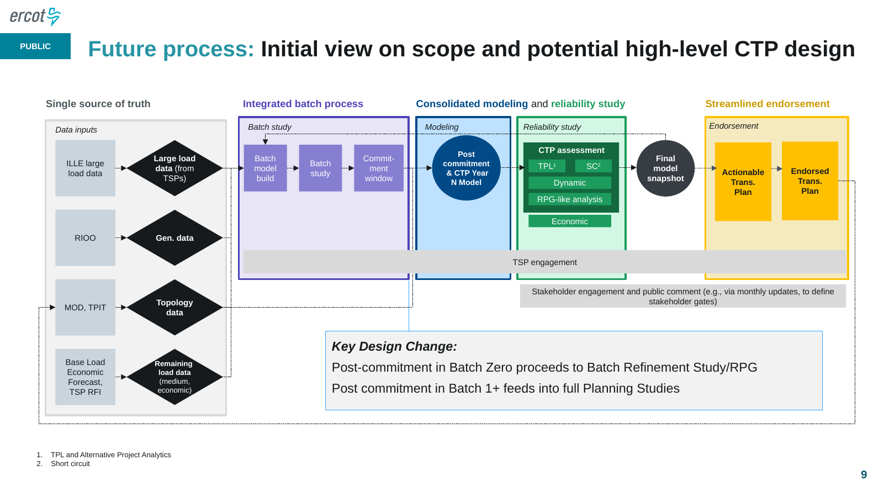
Figure 1. ERCOT’s initial high-level Comprehensive Transmission Planning framework. Source: ERCOT, Comprehensive Transmission Planning and Batch 1+, Stakeholder Workshop #1, Aug. 31, 2026, slide 9.
1. Batch 1+ would feed committed load directly into full planning studies
One of the most important design changes is what happens after a large load commits. In Batch Zero, projects move into a Batch Refinement Study and then RPG. ERCOT’s initial Batch 1+ concept would instead carry committed load into the broader planning studies.
- Use committed Batch load as firm planning input.
- Reduce repeated analysis across Batch, RTP, RPG, and independent review.
- Potentially integrate RPG-like project alternatives and stakeholder review into the CTP reliability study.
The principle is straightforward: where the technical work is sufficient, carry it forward rather than rebuild the same answer in the next planning process.
2. One common planning model could replace several parallel case sets
Modeling may be the quiet machinery behind the biggest efficiency gain. ERCOT is considering a single CTP case set that could eventually replace separate SSWG and RTP case sets.
- Begin with a streamlined set of roughly 8-10 cases so reliability work can start earlier.
- Standardize case assumptions, taxonomy, and data-submission requirements.
- Clarify ERCOT and TSP responsibility for case development and model conditioning.
- Develop shared short-circuit modeling and potentially a network-data library.
A faster interconnection process still slows down if each planning cycle begins by rebuilding the system model. CTP is aimed at removing that friction.
3. The Batch Zero parking deck is becoming the Batch 1+ work program
The Batch Zero parking deck contains more than 20 deferred design questions. ERCOT has narrowed that broader list into an initial set of 12 priorities for Batch 1+.
- Large Load Interconnection: ILLE-TSP-ERCOT interaction, re-entry of unmet ramps, carry-forward treatment, and post-study change governance.
- Eligibility: financial security for transmission upgrades and direct interconnection costs.
- Study Frameworks: Batch scope, short-circuit and SSO treatment, and dynamic-model change evaluation.
- Market & Operations: reporting, confidentiality, BYOG, and PCLR enhancements.
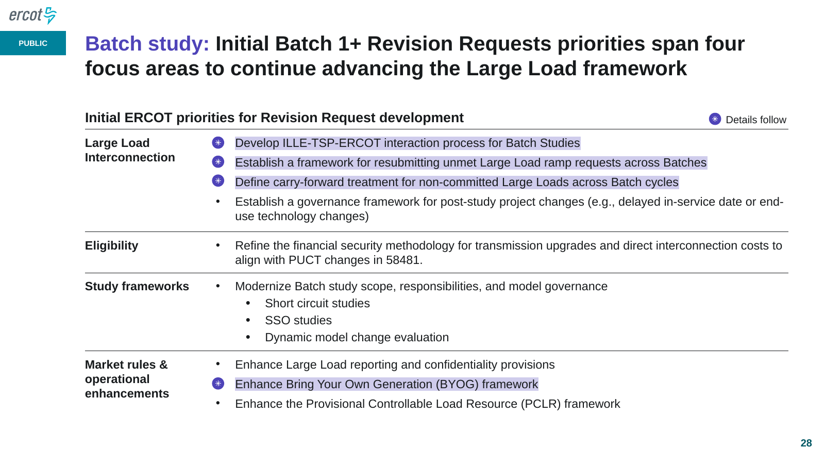
Figure 2. ERCOT’s initial Batch 1+ Revision Request priorities. Source: ERCOT, Comprehensive Transmission Planning and Batch 1+, Stakeholder Workshop #1, Aug. 31, 2026, slide 28.
Parking-deck reference: ERCOT, Batch Zero Carryover Parking Deck, posted with the Aug. 31, 2026 workshop materials.
4. Non-committed projects may no longer restart from zero
ERCOT also presented a concept for carrying a non-committed large-load project into the next Batch while limiting material changes.
- Retain the same Large Load Batch tracking number.
- Carry forward portal information and steady-state and dynamic models.
- Carry forward the $50,000/MW financial security and Intermediate Agreement, while paying the next Batch study fee.
- Allow limited changes such as lower project size or later energization and ramp dates.
This creates a middle ground between forcing a project to start over and allowing a materially different project to inherit an old study position.
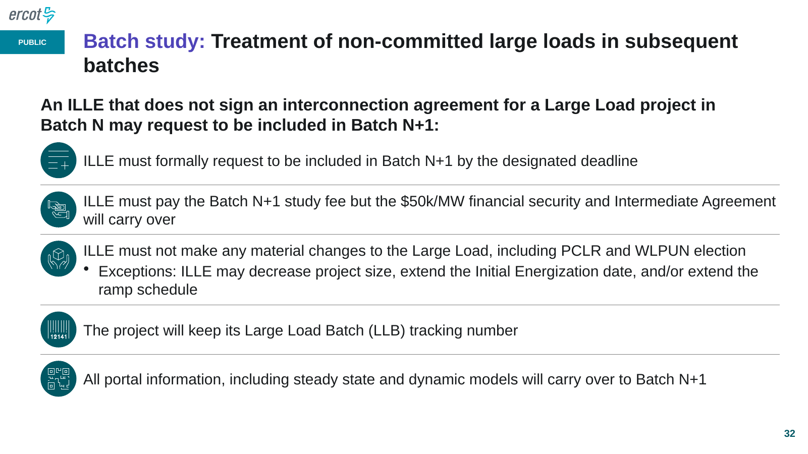
Figure 3. Proposed treatment of non-committed large loads in subsequent Batches. Source: ERCOT, Comprehensive Transmission Planning and Batch 1+, Stakeholder Workshop #1, Aug. 31, 2026, slide 32.
What stakeholders should watch next
ERCOT’s current roadmap moves quickly from design workshops into formal Revision Requests:
- Workshop 2: Sept. 24, 2026.
- Workshop 3: Oct. 14, 2026.
- Initial Revision Requests targeted for Nov. 1, 2026.
- Additional workshops: Nov. 9 and Dec. 2.
- Current roadmap points toward TAC action in March and Board consideration in April 2027.
THE DESIGN QUESTION How much technical work should remain in Batch, and how much should move into the full CTP reliability and endorsement process?
RMS Energy perspective
The biggest story from this workshop is not a single Batch 1+ rule. ERCOT appears to be designing a planning architecture around continuous information flow.
Large-load data enters the Batch process. Committed demand moves into common planning models. Reliability and economic studies use those models. Transmission solutions then move through a more integrated endorsement pathway.
If ERCOT can make that architecture work, the benefit will be larger than faster large-load studies. It could reduce duplicated analysis across the transmission-planning cycle at a time when Texas load growth is making planning speed itself a reliability issue.
#ERCOT #TransmissionPlanning #LargeLoads #DataCenters #GridReliability #BatchZero #Batch1 #PowerSystems #RMSEnergy