
Why the Load Is No Longer Passive
A large data center can appear to be a steady load at its point of interconnection while behaving very differently during a voltage disturbance. Its grid response depends on power-electronic converters, protection settings, UPS operating modes, cooling equipment and load recovery logic. Peak megawatts alone do not describe that response.
This article explains where electromagnetic transient analysis adds value, what a useful facility model should represent, and how developers can prepare credible models before interconnection and commissioning decisions depend on them.
The facility behind the load bus
Modern facilities combine electrical subsystems with different time constants and disturbance responses. IT power conversion may react in milliseconds; cooling motors, backup generation and supervisory controls respond on other time scales. UPS coverage and topology also vary between facilities. Two sites with identical demand can therefore produce different transmission-system responses.
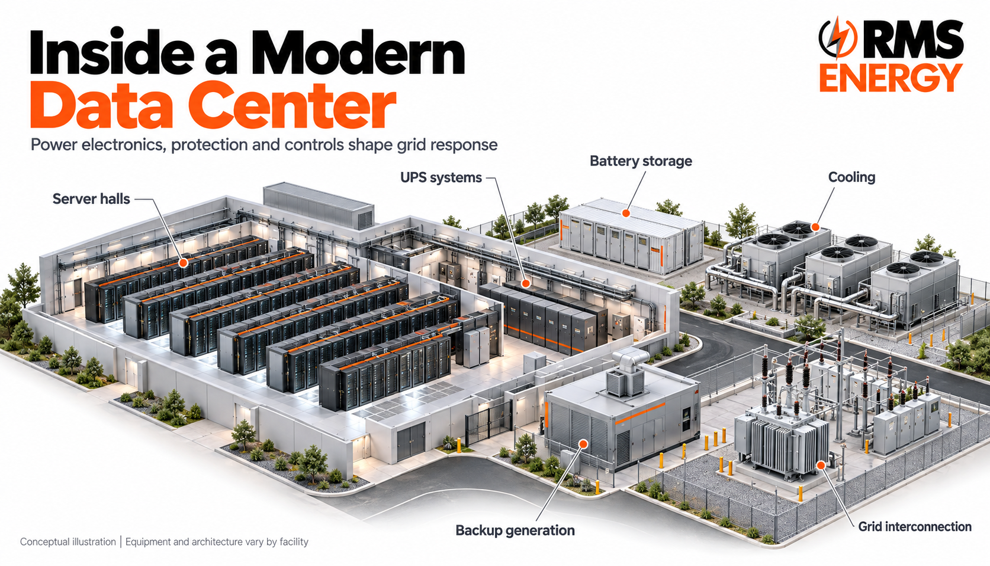
Figure 1. Conceptual data center campus. Equipment and architecture vary by facility.
Electrical architecture changes the study outcome
The model should preserve the path between the grid and major load groups. Transformer impedances, distribution topology, UPS conversion stages, battery interfaces and transfer logic influence what the utility sees during a disturbance. Backup generation must be represented according to its actual connection and interlocking; its presence does not imply permission to operate in parallel with the grid.
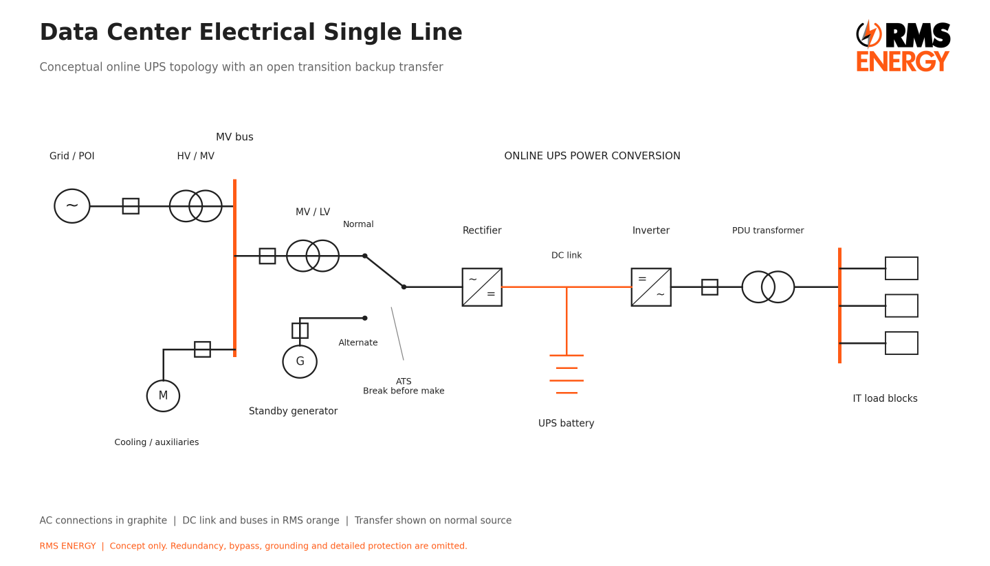
Figure 2. Conceptual single line with AC and DC connections and an open transition backup arrangement. Not a construction drawing.
Where positive sequence analysis remains essential
Positive-sequence power flow and dynamic simulation remain central to transmission planning. They provide broad network coverage and efficient contingency screening. Well-designed phasor-domain load models can also represent voltage sensitivity, disconnection and recovery when those behaviors are within their intended bandwidth.
EMT analysis complements that work when phase-specific response, fast converter controls, current limiting, DC-link dynamics or switching and protection interactions materially affect the result. An EMT model need not contain every server. Aggregation should retain the electrical behavior relevant to the study question.
The first question is disturbance response
A voltage sag can cause converters to maintain power within their limits, reduce demand, transfer to battery support or disconnect. Similar equipment and settings across many racks can create correlated responses. The resulting loss of grid demand may be much larger than a conventional static-load representation suggests.
The grid impact depends on the amount and speed of load loss, system strength and the surrounding network. Frequency, voltage and power-flow consequences require system-level analysis. A single equipment curve cannot establish the response of an entire interconnection.
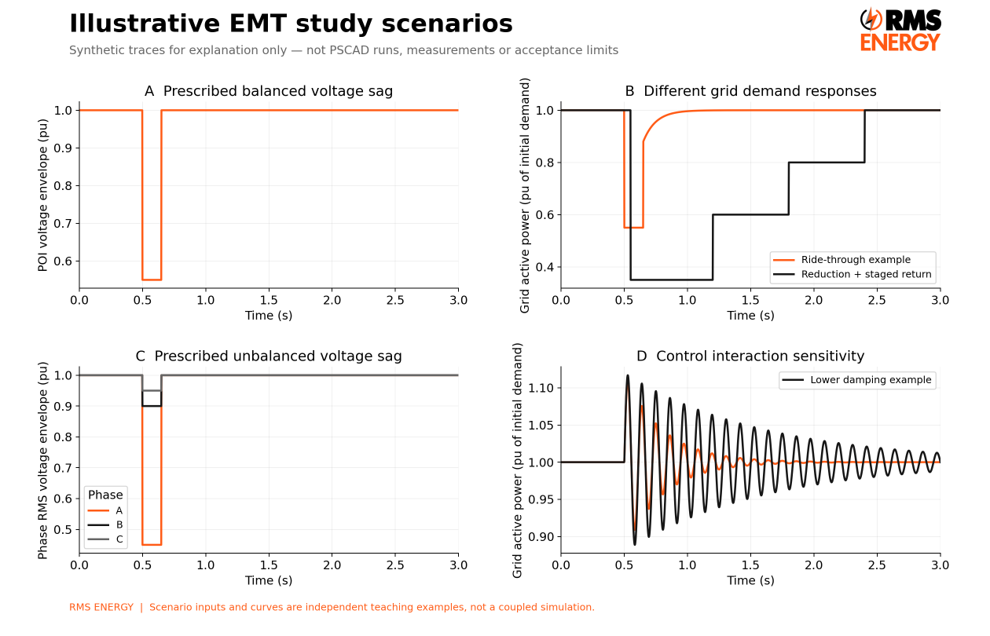
Figure 3. Synthetic teaching examples only. No traces are measured data or outputs from a PSCAD model. Values are not required ride-through thresholds or pass-fail criteria.
Panel A supplies a balanced sag. Panel B contrasts grid-demand responses, including staged restoration. Panel C highlights unequal phase voltages that a positive-sequence quantity alone cannot fully describe. Panel D illustrates why damping and control sensitivity deserve attention. These independent examples are not a coupled facility simulation.
Recovery deserves its own study cases
The return of demand can be as consequential as its initial reduction. Load may recover continuously, restart in blocks, wait for a stable voltage interval or require operator action. UPS recharge, motor acceleration and transformer energization can add demand beyond the returning IT load. These mechanisms should be modeled where relevant rather than represented by one universal restart assumption.
Useful scenario families include balanced and unbalanced faults, delayed clearing, voltage recovery, UPS mode transitions, changes in grid strength, cooling restart and staged computational-load restoration. Additional frequency, harmonic or resonance studies should be scoped to the equipment and concern being investigated. Detailed switching models are necessary only when the phenomenon requires them.
What a study ready model needs
A useful facility equivalent should include relevant network impedances, IT and auxiliary load composition, converter current limits, protection thresholds and timers, control modes, and realistic restoration logic. Optional BESS and backup resources need equipment-specific models and operating assumptions. Initial conditions should document facility demand, reactive power, battery state and the selected operating mode.
Developers should obtain OEM model availability, software compatibility, licensing terms, parameter access and technical support commitments during procurement. Encrypted models can protect intellectual property, but reviewers still need sufficient documentation to understand model boundaries, settings, limitations and expected responses.
Quality testing is not the same as validation
Model Quality Testing establishes that a model compiles, initializes and runs reliably, including appropriate time-step and disturbance checks. RMS to EMT benchmarking checks agreement for phenomena both models are intended to represent; it does not require identical results for effects outside the phasor model bandwidth.
Validation asks a different question: does the model reproduce the equipment or facility? Factory tests, hardware-in-the-loop tests, commissioning measurements and recorded events provide evidence. A generic model is useful for early sensitivity work, but passing quality tests does not make it a validated site-specific model.
Generic libraries are a starting point
PNNL published its Data Center Model Library report on January 16, 2026. It describes generic EMT representations of interfaces such as double-conversion UPS systems and power-factor-correction converters. The report explicitly notes that technical data and engineering judgment are needed before the models represent a real data center.
The National Laboratory of the Rockies also provides data-center EMT modeling resources. These research tools support early analysis and model development, but neither a public library nor a generic template replaces the selected equipment data, actual protection settings or validation evidence.
Requirements and engineering judgment must stay separate
NERC has documented risks associated with emerging large loads and voltage-sensitive load reductions. Its computational-load initiatives include ongoing standards development. Guidance, research models and proposed standards should not be presented as a universal adopted requirement for every data center to submit a PSCAD model. Applicable obligations must be checked against the serving utility, transmission provider and relevant ISO or RTO process.
Keep the model current through commissioning
Changes in UPS technology, transformer impedance, firmware, protection settings or recovery sequences can invalidate an earlier study assumption. Developers should maintain a controlled model version from preliminary interconnection through equipment selection, as-built updates and commissioning validation. Responsibilities for OEM updates and resolving discrepancies should be agreed before they become schedule-critical.
RMS Energy’s engineering focus spans positive-sequence and EMT studies, model development, quality testing, benchmarking and commissioning support. For data-center projects, these activities are most useful when coordinated with the facility design and equipment procurement rather than started after a model request arrives.
The planning question is not only how many megawatts the site will consume. It is how the facility will behave during the milliseconds and seconds that determine its interaction with the grid.
Learn how RMS Energy supports complex transmission projects here: T&D engineering and consulting services
Technical references
NERC — Characteristics and Risks of Emerging Large Loads
https://www.nerc.com/globalassets/who-we-are/standing-committees/rstc/3_doc_white-paper-characteristics-and-risks-of-emerging-large-loads.pdf
PNNL — Electromagnetic Transient Modeling of Large Data Centers for Grid-Level Studies
https://www.pnnl.gov/publications/electromagnetic-transient-modeling-large-data-centers-grid-level-studies
National Laboratory of the Rockies — Electromagnetic Transient Modeling of Data Centers
https://research-hub.nlr.gov/en/publications/electromagnetic-transient-modeling-of-data-centers/