A compressed intake window, project scoring, restricted POIs and tighter model validation raise the bar for interconnection customers
The California ISO will open the Cluster 16 interconnection request window on October 1, 2026, and close it on October 15 at 5:00 p.m. Pacific prevailing time. For developers, however, the more important date may be October 8.
CAISO’s August 2026 Resource Interconnection Standards Fair materials state that applications submitted or corrected after 5:00 p.m. on October 8 will likely not receive another opportunity to cure deficiencies before the window closes. Incomplete applications will not move forward.
THE PRACTICAL DEADLINE: Target a complete, internally validated submission by October 8—not simply a draft application by October 15.
That distinction matters because Cluster 16 is not a first-come, first-served paperwork exercise. Projects must clear intake scoring, demonstrate commercial and site readiness, submit a technically valid model package, and remain responsive through the customer engagement window.
A short application window with multiple decision gates
CAISO expects to review submitted applications for completeness within five business days. Projects that satisfy the intake criteria proceed to technical validation; tied projects may enter an auction; and projects that do not score high enough will not be studied. The customer engagement and validation period continues into January 2027, when the Cluster Study is scheduled to begin.
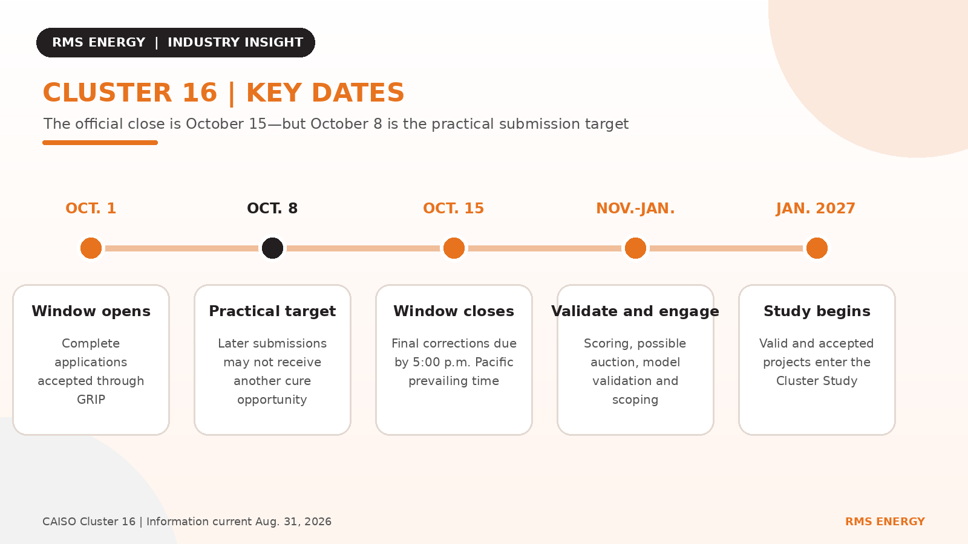
Figure 1. Cluster 16 application and validation timeline. Source: CAISO Resource Interconnection Standards Fair, Aug. 11, 2026.
What a complete Cluster 16 application must contain
Applications will be submitted through CAISO’s Grid Resource Interconnection Portal (GRIP) under the Resource Interconnection Standards in Tariff Appendix KK. The individual forms are only one part of the package; the legal, commercial and technical elements must tell the same project story.
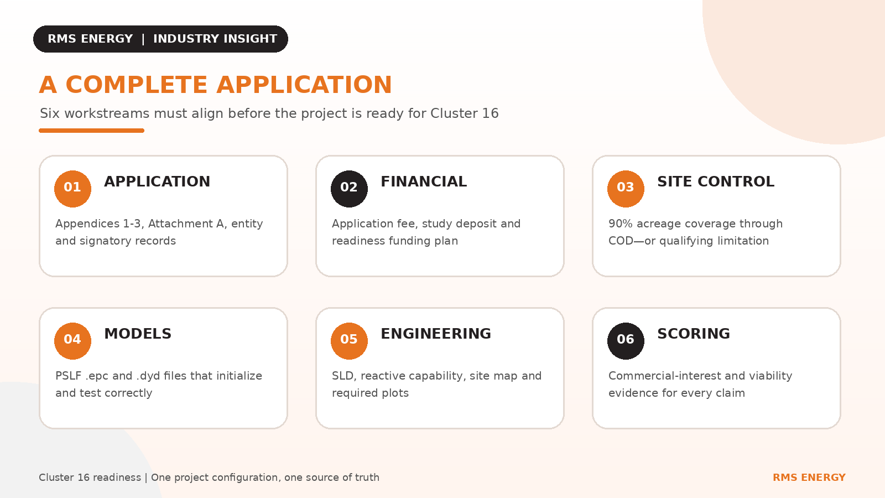
Figure 2. Six aligned workstreams for a complete Cluster 16 application. Financial requirements vary by project type and size.
The application fee is $5,000. CAISO’s current materials show study deposits that increase with project size, while accepted projects generally must post a commercial-readiness deposit equal to two times the study deposit by the end of the customer engagement window. Site control must cover at least 90% of the acreage reasonably necessary for the project and extend through commercial operation, unless the project qualifies for the regulatory-limitation alternative.
The technical package includes a GE PSLF load-flow model and dynamic-data file, reactive-capability documentation, an electrical single-line diagram, a site drawing/KMZ, a requested-MW-at-POI plot, and the required flat-run, bump, reference-step and ride-through plots. Applicants must also support every claimed scoring input; CAISO has stated that unsupported scoring documentation will not receive a cure opportunity after the window closes.
POI selection is now part of the competitive strategy
Selecting the closest substation is not enough. CAISO and the Participating Transmission Owners have published Cluster 16 restricted-POI information identifying locations affected by short-circuit-duty limitations, proximity rules, physical-space constraints and potentially complex upgrades.
The POI heatmap and constraint information are important screening tools, but they are not substitutes for project-specific engineering judgment. A credible POI strategy should evaluate deliverability availability, fault-duty exposure, gen-tie length, substation configuration, land rights, affected-system risk and the likelihood that the selected project technology qualifies for any reserved transmission-plan deliverability capacity.
For projects seeking full or partial capacity deliverability—or reimbursable Energy-Only service—commercial-interest and project-viability scoring can determine study acceptance. Tied projects may enter a sealed-bid auction, making POI selection both a technical and portfolio-allocation decision.
Model consistency is a pass-or-fail risk
CAISO’s August 2026 IBR dynamic-model guideline reinforces a simple principle: a model must be usable, internally consistent and representative of the actual plant. Power-flow and dynamic models should load correctly, initialize without unresolved errors and produce a stable 20-second no-disturbance simulation.
CAISO’s published deficiency examples include mismatched Pmax, Pmin, Qmax and Qmin values; inconsistent transformer impedances and MVA bases; missing auxiliary load; incomplete collector-system representation; incorrect plant controllers; and discrepancies among Attachment A, the single-line diagram, and the .epc and .dyd files.
These are not cosmetic issues. A late model correction can affect reactive capability, network-upgrade assumptions, control settings and study results. The most reliable approach is to treat the application, drawings and models as one controlled technical package with a single source of truth.
How RMS Energy can support Cluster 16 clients
RMS Energy can support developers from early POI strategy through GRIP submission and post-submittal validation, integrating interconnection planning, power-system modeling and engineering documentation in one coordinated workstream.
- POI screening and interconnection strategy — screen candidate POIs for restrictions, deliverability, network-upgrade exposure and affected-system risk.
- Application and GRIP management — prepare application inputs, maintain the requirements tracker, coordinate supporting records and manage the submission schedule.
- PSLF model development and quality testing — develop or update .epc and .dyd files, verify controls, run initialization and flat-run checks, and reconcile equipment data.
- Electrical drawings and technical exhibits — prepare the SLD, site/POI mapping, reactive-capability assessment, power-factor checks and required test plots.
- Scoring and readiness coordination — organize viability evidence, engineering attestations, commercial-interest inputs, deposits and engagement milestones.
- CAISO and PTO deficiency support — coordinate rapid, consistent corrections across disciplines through the engagement window.
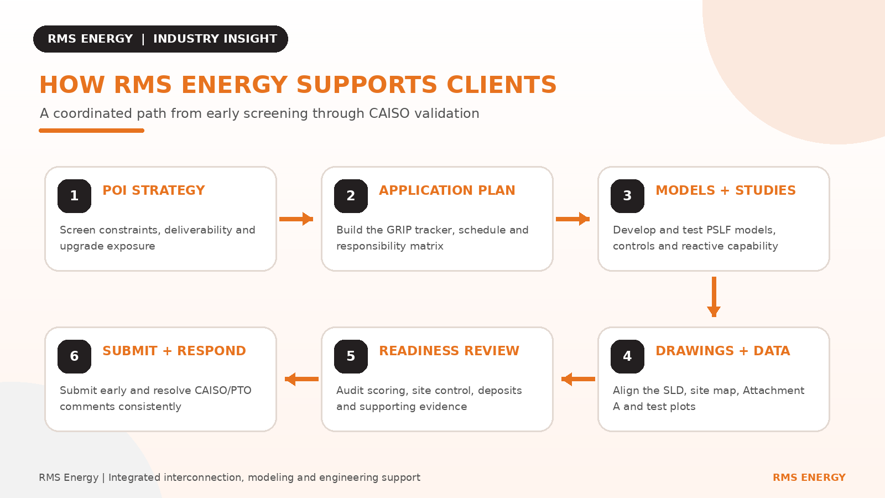
Figure 3. RMS Energy’s coordinated Cluster 16 client-support workflow.
RMS Energy perspective
Cluster 16 reflects a more selective and readiness-driven interconnection process. The official application window lasts only two weeks, but a defensible submission requires weeks of coordinated work across development, commercial, legal and engineering teams.
Projects that freeze their configuration early, select POIs deliberately, secure consistent OEM data and complete an independent technical QA review before October 8 will be better positioned to advance. Projects that wait until the final days may discover that a missing land document, unsupported score or model mismatch cannot be corrected in time.
For clients targeting Cluster 16, the priority now is clear: confirm the project strategy, complete the data package, validate the models and submit early.
#CAISO #Cluster16 #GeneratorInterconnection #EnergyStorage #SolarEnergy #WindEnergy #GridReliability #PowerSystems #RMSEnergy