

How flexibility could shape grid access and project costs
In New England’s proposed large-load rules, the first big decision for a data center may not be its site. It may be how much flexibility it can promise the grid.
Under the proposal, a load that is willing and able to limit its withdrawals may lessen or avoid certain network upgrades. A load that needs firm service can take Interim service as a bridge while it meets the Firm requirements. Each choice changes the study, the bill and the operating obligations.
These are still proposals. NEPOOL’s Reliability and Transmission Committees supported the tariff changes on November 3. The Participants Committee votes on November 12, and the filing goes to FERC shortly after.
Flexibility can shrink your upgrades, but it has a price
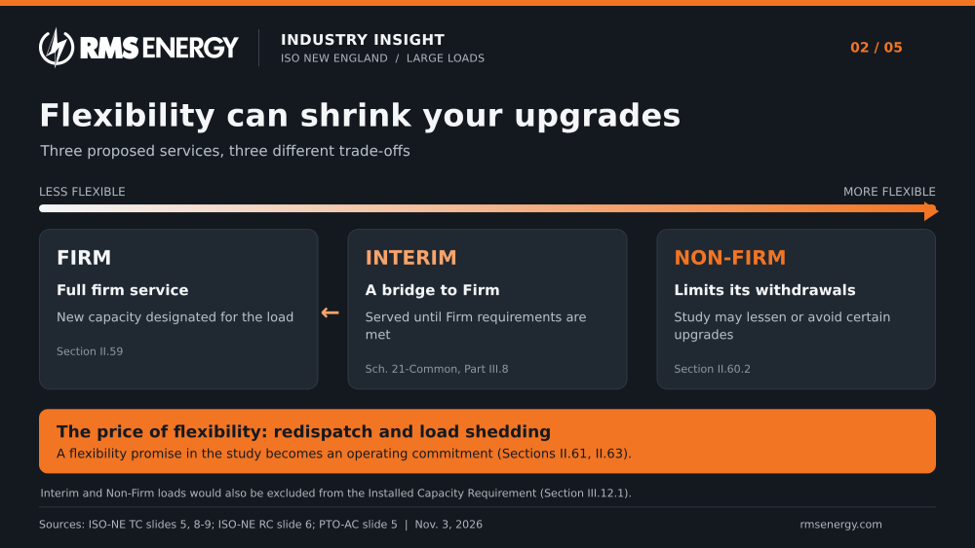
ISO-NE proposes three transmission services for large loads: Firm, Interim and Non-Firm Contract Demand Service. They sit in a new Part II.J of the transmission tariff.
The key line was added to Section II.60.2 on November 3. The System Impact Study would recognize Interim and Non-Firm loads that are willing and able to limit their withdrawals under certain conditions, plus any Non-Firm Large Load Generator Arrangement. That recognition may lessen or avoid certain network upgrades.
Interim service works as a bridge. In the PTO local service language, a customer receives Interim service until it meets all the requirements for Firm service. Interim and Non-Firm loads would also be left out of the Installed Capacity Requirement calculation.
Now the other side. The same Part II.J includes rules on redispatch and load shedding (Section II.61) and on operational arrangements (Section II.63). A flexibility promise made in the study becomes an operating commitment. Engineering, operations and commercial teams should agree on that promise before the application, not after it.
On-site generation is part of the same story. Schedules 22 and 23 add study steps for co-located and electrically proximate generators. For a project that plans its own generation, the generator shapes the large-load study from day one.
Your transmission bill has three parts
Part one is the monthly service charge. Proposed Schedule 9A sets it as the RNS rate ($/kW-year) times the applicable demand (kW) times 1/12. The demand depends on the service: Firm Contract Demand for Firm, Monthly Non-Firm Contract Demand for Non-Firm, and Monthly Interim Contract Demand for Interim.
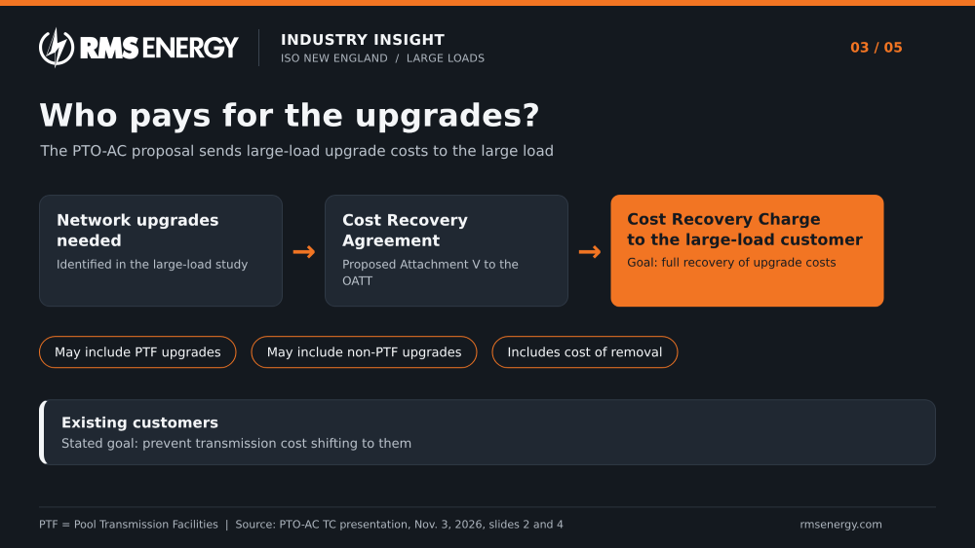
Part two is upgrade cost recovery, through a new Large Load Cost Recovery Agreement (proposed Attachment V). The PTO-AC says the goals are to prevent cost shifting to existing customers and to ensure full recovery of large-load upgrade costs. The November 3 update replaced the earlier spreadsheet tables with written formulas. These can cover both pool (PTF) and non-PTF upgrades, and they include cost of removal.
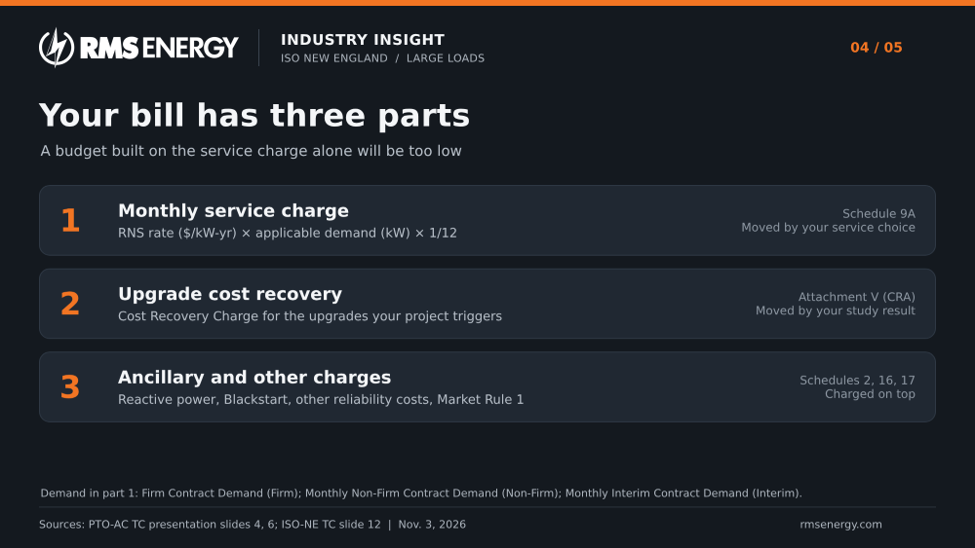
Part three is ancillary and other charges. Schedule 9A keeps the duty to pay ancillary charges and charges under Market Rule 1 and the tariff. Separate schedules cover reactive power, Blackstart and other reliability costs (Schedules 2, 16 and 17).
The so-what: a budget built only on Schedule 9A will be too low. Keep the three parts as separate lines, because different decisions move each one. Your service choice moves part one. Your study result moves part two.
What to do before June 2027
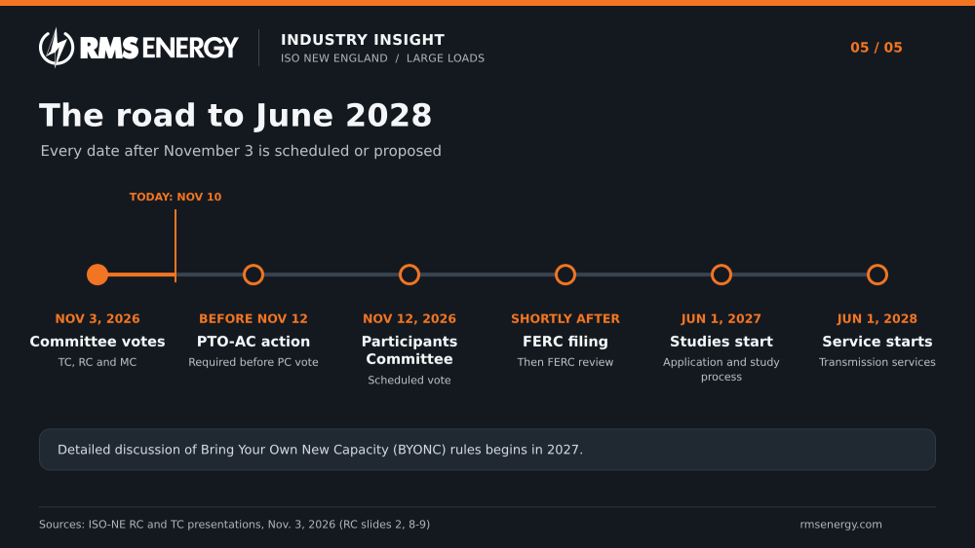
The proposed dates are June 1, 2027 for the application and study process and June 1, 2028 for transmission services. Detailed discussion of Bring Your Own New Capacity rules begins in 2027. That leaves a short window to get ready.
- Developers: Choose the service level before the study. Promise only the flexibility your operations team can deliver under the redispatch and load-shedding rules.
- Projects with on-site generation: Read Schedules 22 and 23 early. The generator has its own study path, and it can shape the large-load study through the Non-Firm generator arrangement.
- Finance and commercial teams: Model the service charge, upgrade recovery and ancillary charges as three separate lines. Tie each one to a tariff section or an agreement.
- Transmission owners: Expect earlier, more technical talks with large-load customers about operating limits, not only megawatts.
In New England, the cheapest megawatt may be the one you promise not to use.
Learn how RMS Energy supports complex transmission projects here: T&D engineering and consulting services
Sources
[1] ISO New England
New England Large Load Show Cause Order EL26-72 Tariff Revisions (Reliability Committee), November 3, 2026
[2] ISO New England
New England Large Load Show Cause Order EL26-72 Tariff Revisions (Transmission Committee), November 3, 2026
[3] PTO-AC
Proposed Large Load Cost Recovery Provisions and Revisions to Local Service Schedules, November 3, 2026
[4] NEPOOL Reliability Committee
Actions of the Reliability Committee, November 3, 2026 meeting, November 3, 2026
[5] NEPOOL Transmission Committee
Actions of the Transmission Committee, November 3, 2026 meeting, November 3, 2026