
What developers need to know about Attachment AY, GRID Contribution, model readiness, and EMT studies
SPP’s Interconnection Cluster Study changes when developers need to resolve critical project decisions. Location, equipment selection, land rights, and model readiness all need attention before substantial capital becomes committed.
The Consolidated Planning Process, or CPP, connects long-term transmission planning with generator interconnection. The Interconnection Cluster Study, or ICS, evaluates individual requests within that framework under Attachment AY.
What developers should take away
- A single cluster study phase and one principal decision point change how projects advance.
- Published GRID Contribution charges improve visibility into planned network upgrade costs. Project-specific obligations remain important.
- The applicable cluster, request type, and effective date determine which modeling and EMT requirements apply.
1 How ICS fits within consolidated planning
SPP’s legacy Definitive Interconnection System Impact Study, or DISIS, operates under Attachment V. Its multiple study phases and restudies exposed projects to changing upgrade allocations as other projects withdrew.
CPP connects transmission portfolio development with generator interconnection. Its planning assessments identify future transmission needs and planned locations for generation. ICS then evaluates the actual requests submitted within a cluster window against the relevant system conditions and planned infrastructure.
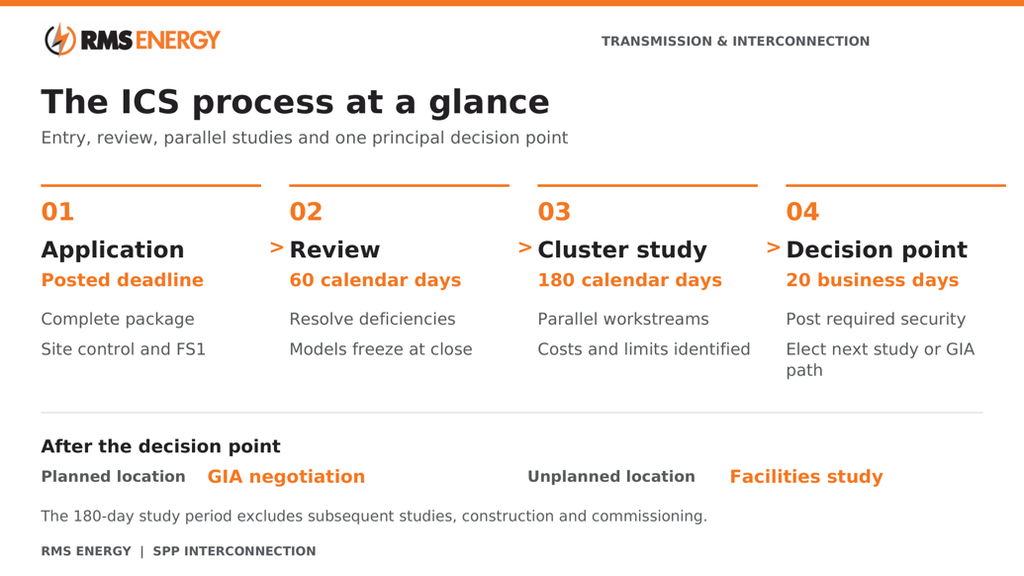
Figure 1 ICS timeline and principal decision paths. Source: SPP process outline pages 8 and 19-23.
The ICS framework uses a 60-calendar-day review period followed by a study phase designed to run for 180 calendar days. Steady-state, stability, short-circuit, and facilities work proceed in parallel, followed by a 20-business-day decision point.
Schedule implication: The 180-day duration describes the cluster study phase. A project schedule must also account for application review, the decision point, any subsequent facilities work or EMT evaluation, agreement negotiation, construction, and commissioning.
Existing DISIS requests retain their applicable transition treatment. Developers should establish which tariff attachment, cluster, and request type govern their project before applying a checklist.
2 Application windows and the initial transition
The initial CPP ICS window opened April 1, 2026. SPP describes its closing date as 60 calendar days after publication of the first East GRID Rates, with a planning estimate around mid-January 2027. Its approximate January 11 date depends on the actual rate posting and any SPP notice extending the window.
Developers should therefore monitor the posted deadline and use the rate publication trigger when scheduling submissions. The estimated date in a presentation should not become a fixed contractual assumption.
Subsequent annual windows are identified as December 15 through February 15, with the next opening on December 15, 2027. East and West GRID Rate publication schedules also differ, so a project in the West needs its own review of the applicable rate and security notices.
3 Location selection determines cost exposure
A Planned Interconnection Location, or PIL, is an SPP-identified location with planned generation capacity. A request that qualifies for that planned capacity uses the GRID Contribution framework for the relevant planned network upgrades.
An Unplanned Interconnection Location, or UPIL, introduces a different exposure. The customer is responsible for directly assigned costs associated with the unplanned interconnection, including applicable system network upgrades, and can face additional facilities analysis after ICS.
PIL status still leaves project-specific questions to resolve. Interconnection facilities, substation work, contingent facilities, operating restrictions, and construction schedules can materially affect the project.
The selected service also affects GRID Contribution. SPP describes region-wide and subregional components by service type. Its NRIS+ framework includes both ERIS and NRIS charges, so a developer should establish which components apply before multiplying a headline rate by project MW. Potential base-plan funding for eligible NRIS costs depends on the applicable resource designation, deliverability-area, and Safe Harbor conditions.
Electrical equivalence also affects the available capacity. SPP describes equivalence at the same substation and nominal voltage, along specified series-connected two-terminal facilities, or on the same radial path. Equivalence ends at well-networked stations. SPP must confirm whether a particular proposed tap qualifies.
Electrically equivalent PILs can share combined planned capacity. Non-equivalent PILs retain independent capacity. A developer should evaluate the applicable shared capacity before treating several nearby locations as separate opportunities.
SPP identifies the Planned_Sites spreadsheet on GlobalScape as the source of record if it differs from the PIL dashboard. An oversubscribed PIL receives pro-rata allocation; submitting earlier within the window does not establish queue priority. A single request exceeding a PIL’s planned MW can also require downsizing or unplanned treatment for the excess.
4 What a complete application needs
SPP organizes application readiness into agreements, site control, financial requirements, and technical submissions. These workstreams should advance together.
Agreements and forms
- Executed CPP Generator Interconnection Study Agreement
- Executed Credit and Security Agreement
Required application forms, W-9, and refund documentation
Land and project readiness
- At entry: 100 percent site control for the generating facility and 50 percent for the generator tie-line, with the applicable financial alternative where permitted.
- At the decision point: 75 percent of the generator tie-line route, 100 percent of the substation site, and at least one qualifying project milestone.
Fees, deposits and security
The initial financial requirements include a $10,000 non-refundable application fee, a cash study deposit, and Financial Security One, or FS1. The study deposit schedule is:
| Requested project size | Study deposit |
| Below 80 MW | $35,000 plus $1,000 per MW |
| 80 MW to below 200 MW | $150,000 |
| 200 MW and above | $250,000 |
FS1 is the greater of $8,000 per MW or 20 percent of the applicable GRID Contribution allocation. A customer using the $8,000-per-MW amount before rates are available needs to evaluate whether a true-up is required before the window closes. Application fees and study deposits are cash requirements; SPP permits cash, a letter of credit, or a surety bond for financial security, subject to SPP’s terms.
Technical package
- Consistent single-line diagrams, transformer and line parameters, and collector-system data
- Generation ratings, operating assumptions, and applicable dynamic models
- For storage and hybrids: export limits, charging demand, and controls that enforce the proposed operating configuration
The presentation distinguishes missing application components from deficiencies found during review. Missing required items can make a submission invalid, while Attachment AY’s review process provides a 10-business-day opportunity to address identified deficiencies. Developers should submit a complete package early enough to address questions before closure.
5 What the cluster study evaluates
ICS brings several engineering workstreams together. Each answers a different question about the proposed interconnection.
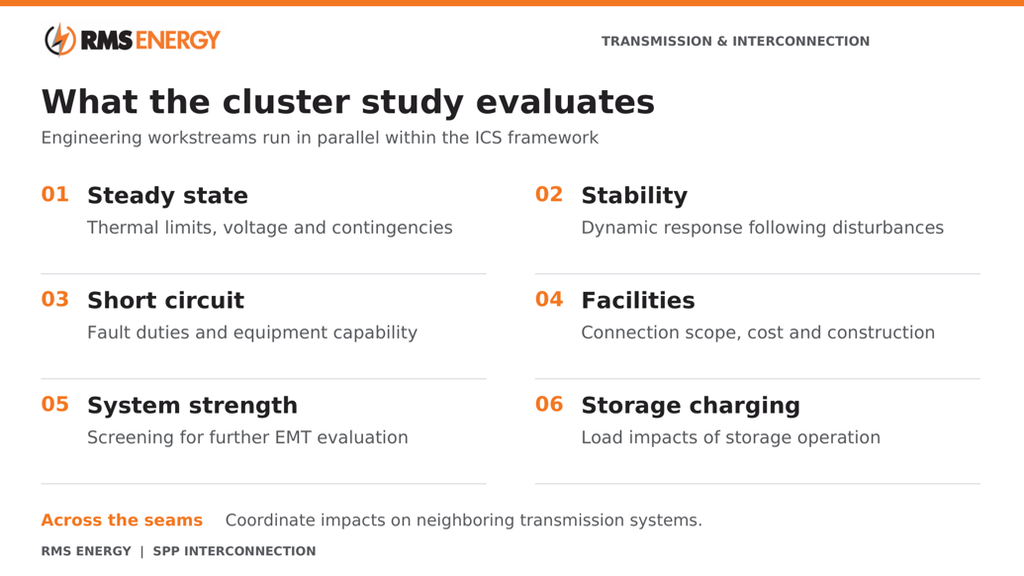
Figure 2 Parallel engineering workstreams. Source: SPP process outline pages 19-21.
Affected-system coordination addresses potential impacts on neighboring transmission systems. The applicable agreements and study findings determine the follow-up needed across those seams.
SPP describes transmission-owner estimates for POI upgrades with a target accuracy of plus or minus 20 percent, provided within 45 calendar days. Such estimates support the commercial decision; they remain estimates of the defined scope.
Model freeze: Study inputs freeze at the end of the review period. Changes to the POI, project size, technology, or controls after that point can disrupt the basis of the study. Equipment procurement and engineering schedules should reflect that constraint.
6 Read the report for operating limits and dependencies
The final ICS report should be reviewed for more than its cost allocation. It identifies GRID Contribution and directly assigned costs, contingent facilities, and any limits on operation before required infrastructure is available.
Contingent facilities are infrastructure dependencies that can affect the project’s viability or schedule. A transmission upgrade assumed in the study may be associated with an earlier request. Its delay, cancellation, or changed treatment can affect the later project’s interconnection path.
Limited-operation findings also deserve a separate revenue assessment. A project’s nameplate capability may exceed the output permitted before upgrades enter service. SPP describes seasonal limited-operation values and stability evaluations using 50 MW increments.
An interconnection study result therefore needs to be translated into an achievable energization date, seasonal export assumptions, upgrade dependencies, and any remaining conditions. Developers should carry those assumptions into financing and commercial forecasts.
7 The decision point requires advance preparation
The decision point opens on the first business day after the final ICS report is posted and runs for 20 business days. Planned requests can elect to proceed toward GIA negotiation; unplanned requests can elect the additional facilities study path. Customers may also withdraw.
The decision-point requirements include additional security covering the remaining GRID Contribution after crediting FS1, together with 20 percent of applicable directly assigned upgrade costs. A planned request can still have directly assigned interconnection or substation costs, so its budget needs to include both components where applicable.
Land rights and a qualifying milestone are also due at this stage. Financing approvals, security instruments, and site-control documentation should be prepared while the study is underway.
Capital at risk: Withdrawal exposure increases as the request advances. SPP identifies application fees, study deposits, and allocated study-cost exposure during the study, with the full GRID Contribution allocation exposed after the decision point. Directly assigned security can also be subject to harm determinations. The applicable tariff and agreements determine the amount retained for a particular withdrawal.
8 A 200 MW example of capital commitment
Consider a hypothetical 200 MW project at a PIL. Assume an applicable total GRID Contribution rate of $80,000 per MW and $5 million of directly assigned interconnection and substation costs. These are illustrative assumptions, not final SPP rates or a project quotation.
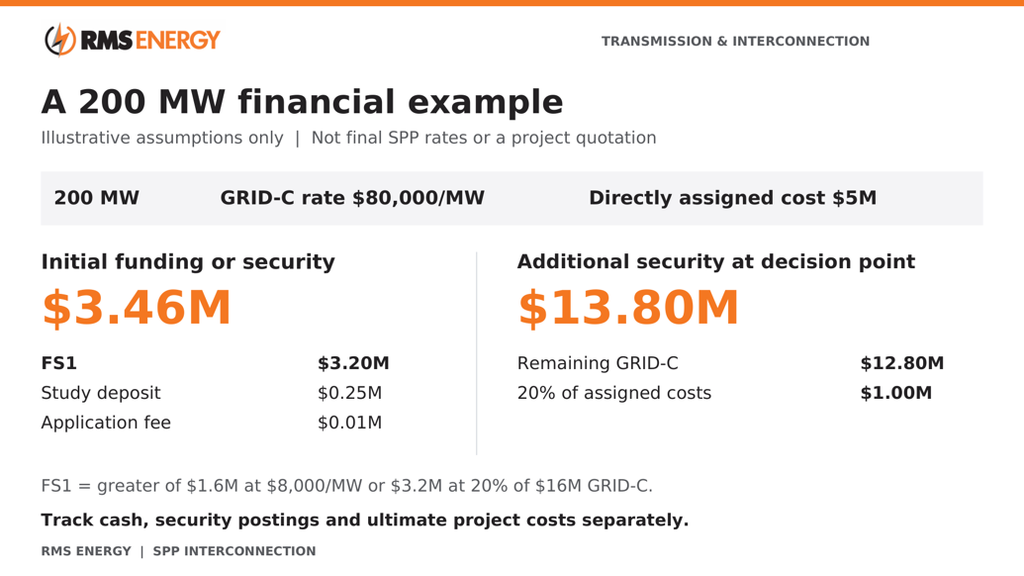
Figure 3 Illustrative funding and security. Assumptions and calculations are explained below.
The GRID Contribution would be $16 million. FS1 would be the greater of $1.6 million, calculated at $8,000 per MW, or $3.2 million, calculated as 20 percent of GRID Contribution. FS1 would therefore be $3.2 million.
Adding the $10,000 application fee and the $250,000 study deposit produces an initial funding or security requirement of $3.46 million. Its cash component depends on the permitted form of FS1.
At the decision point, the additional GRID security would be $12.8 million after crediting FS1. Twenty percent security on the assumed $5 million of directly assigned costs would add $1 million, producing an additional $13.8 million security requirement.
Security and cost: The $1 million security amount does not reduce the underlying $5 million directly assigned obligation. Security postings and ultimate project costs must be tracked separately, alongside construction funding, development costs, and any additional study requirements.
9 Transitional ICS modeling requirements need their own review
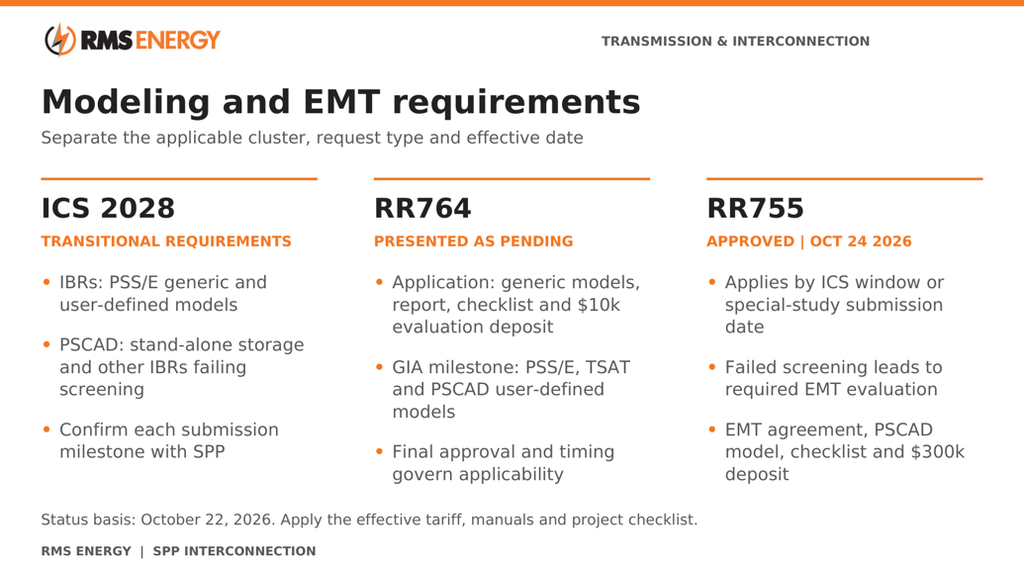
Figure 4 Requirements by cluster and revision. Status basis: October 22, 2026.
SPP distinguishes ICS 2028 from ICS 2029 and beyond. Its detailed ICS 2028 comparison identifies both a PSS/E user-defined model and a WECC-approved generic library model for IBRs. It also identifies PSCAD models for all stand-alone electric storage resources and for other IBRs that fail the applicable short-circuit-ratio and critical-clearing-time screening.
The same comparison identifies IEEE 2800-2022 Phase 1 requirements and grid-forming capability testing for stand-alone storage applications submitted after May 20, 2026. It describes synchronous-generator modeling requirements as unchanged for ICS 2028.
These distinctions matter when requesting OEM deliverables. A storage developer needs to resolve grid-forming capability, model availability, and the required testing evidence early in equipment selection.
The current application checklist and SPP’s project-specific direction should therefore establish exactly when each generic model, user-defined model, and test report is due. Submission timing matters: A lifecycle model obligation does not necessarily mean that every model is due at initial application.
10 RR764 proposes a broader model evaluation framework
SPP’s special-studies presentation identifies the Generating Facility Modeling Requirements as pending FERC approval, with a requested effective date of October 26, 2026. SPP’s October 7 amended filing also requests that date. The following describes the presented requirements, subject to the final FERC action and effective language.
The presentation covers solar, storage, Type III and IV wind, hybrid plants, and synchronous generators. Its special-study scope includes Surplus Interconnection Service System Impact Studies, Generating Facility Replacement Impact Studies, Modification Request Impact Studies, and Interim Availability Interconnection System Impact Studies.
At application under the presented RR764 framework
- Standard-library dynamic model package
- Signed Generating Facilities Model Evaluation Agreement
- $10,000 model evaluation deposit
- Model quality and performance test report
- Completed model checklist
The model evaluation deposit is distinct from the $10,000 ICS application fee.
At the GIA milestone
- PSS/E user-defined model package, test report, and checklist
- TSAT user-defined model package, test report, and checklist
- PSCAD user-defined model package, test report, and checklist
Stand-alone storage PSCAD models must address the applicable grid-forming requirements.
The presentation states that these items precede GIA execution, while flagging a potential RR819 change to the deadline. A proposed extension should not be assumed available in a project schedule before its final approval and applicability are established.
For developers, the engineering task is consistent representation across platforms. Equipment ratings, collector equivalents, control settings, protection, and operating modes should describe the same facility. Differences should be documented and technically justified.
11 RR755 expands the EMT study process
SPP’s special-studies presentation identifies RR755 as FERC-approved with an October 24, 2026 effective date. SPP’s GI EMT Study Manual also uses that date to distinguish applicability. The manual applies to ICS windows opening on or after that date and to specified special-study and affected-system requests submitted on or after it. A request’s applicable rules therefore depend on its window or submission date.
For the four special-study categories discussed in the presentation, SPP uses short-circuit-ratio and critical-clearing-time screening. Requests that fail the applicable screening proceed to EMT evaluation at the interconnection customer’s expense.
SPP’s ICS process overview identifies system-strength measures below 3.0 or a critical clearing time below 0.15 seconds as EMT screening triggers. SPP’s applicable methodology determines the screening result; a preliminary SCR calculation alone does not establish the final EMT obligation.
When an EMT study is required
- Executed Generator Interconnection Electromagnetic Transient Study Agreement
- $300,000 study deposit
- PSCAD user-defined model package
- Applicable EMT checklist
The deposit funds the study; the final study cost depends on the applicable agreement and work performed.
For the listed special studies, the presentation specifies agreement execution within 30 days of report submission, completion as far ahead of commercial operation as possible, and implementation of required mitigations no later than 60 days before commercial operation. Replacement and modification requests that constitute a material modification can require a different interconnection path.
The EMT manual describes evaluation of fast dynamic response, control interactions, ride-through, and other project-specific performance. Obtaining and quality-checking an OEM model can take time even before the network study begins. That work belongs in the development schedule.
12 What model readiness means in engineering practice
My recommendation is to establish one controlled source of project data and use it across the application, diagrams, model packages, and procurement specifications. Each platform should use identifiable versions of the equipment models and controls.
Pre-submission checks should address initialization, operating-point consistency, active and reactive power controls, voltage and frequency response, fault ride-through, protection behavior, and cross-platform benchmarking under the applicable SPP test requirements. Storage checks should cover charging and discharging, the proposed control modes, and the evidence required for grid-forming capability.
A successful model-quality test demonstrates that a model behaves as required by that test. The subsequent network study determines how the modeled plant performs in its proposed grid environment. Both are necessary to support a reliable interconnection decision.
13 How developers should prepare
Before filing
- Confirm the governing attachment, cluster, and requested service type.
- Resolve PIL or UPIL treatment and electrical equivalence.
- Complete site control and the financial package.
- Obtain OEM commitments for every required model platform and milestone.
During review and study
- Resolve deficiencies promptly and control configuration changes.
- Assess charging, system-strength, affected-system, and contingent-facility exposure.
- Prepare decision-point funding and land documentation before the final report arrives.
Before committing to the GIA path
- Translate study findings into a construction and operating plan.
- Identify required infrastructure, interim output restrictions, and outstanding EMT work.
- Quantify the capital exposed if the project later withdraws.
At RMS Energy, our transmission and interconnection work brings together application support, power-flow, dynamics, short-circuit, EMT analysis, and model quality review. For an SPP developer, bringing those disciplines into siting and equipment selection helps resolve technical uncertainties before major financial commitments are due.
SPP’s new framework gives developers a clearer basis for evaluating planned network upgrade charges. Capturing that benefit requires early engineering work and a project configuration that remains consistent through application, study, and construction.
Learn how RMS Energy supports complex transmission projects here: T&D engineering and consulting services
Sources and status
Technical and process basis: SPP Interconnection Cluster Study Process Overview, supplied as 03 – CPP ICS Process Outline.pdf, especially pages 7-11, 19-24, and 29-39; and SPP Special Studies Upcoming Changes, supplied as 08 – Study Requirements for RR755_RR764.pptx, especially slides 2, 6-10, and 14-19.
Official references checked: SPP Consolidated Planning Process Manual v2.0A listing, posted August 21, 2026; SPP GI EMT Study Manual v1.0, dated October 24, 2026, Sections 1.1-1.3; and SPP’s October 7, 2026 amended modeling-requirements filing in ER26-3625-001.
Status is stated as of October 22, 2026. The GRID rates in the supplied outline remain preliminary; the initial window close depends on the official rate posting and subsequent notices. RR764 and the potential RR819 timing revision are presented with their stated approval conditions.
SPP Consolidated Planning Process
SPP planning manuals and document listings
SPP Generator Interconnection resources
SPP GI EMT Study Manual v1.0SPP amended modeling requirements filing of October 7 2026