
September 2026 MISO LLWG
The rapid growth of data centers and other large industrial facilities is changing the interconnection problem. A new load is no longer only a demand forecast added to a transmission model. It may also require new generation, new transmission service, new operating assumptions, detailed dynamic models, and a coordinated plan for construction and commissioning.
MISO’s proposed Large Load Addition Resource Study, or LARS, is designed for this combined problem. The framework would study a large load and its associated generation through a coordinated process, with the stated objective of producing generation Interconnection Service and reliable load-withdrawal outcomes within approximately 120 days. The important change is not only the shorter target timeline. It is the expectation that the load, generation, network upgrades, and reliability evidence must be developed as one technically consistent package.
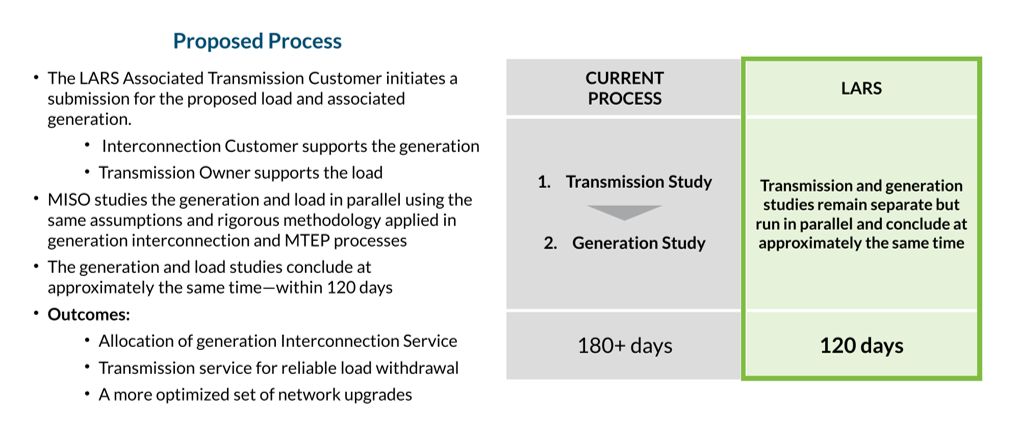
Figure 1. MISO presentation of the proposed LARS alignment of transmission and generation studies. Source: MISO LLWG LARS presentation, September 23, 2026.
How LARS Could Improve Interconnection Planning
The traditional development path can leave the load study and the generation study moving through separate tracks. That separation creates a practical risk: each track may be technically valid on its own while the combined project still has unresolved questions about timing, power delivery, network upgrades, or the relationship between the generator and the load.
LARS is intended to address that coordination gap for paired projects. The proposed process uses a single submission involving the load and associated generation, while MISO studies the two sides in parallel using consistent assumptions and established generation-interconnection and MTEP methodologies. The expected outputs include generation Interconnection Service, transmission service for reliable load withdrawal, and a more optimized set of network upgrades.
What the proposed process requires
The materials presented by MISO identify several requirements that would shape the work of an interconnection-study team:
- A large load generally must meet the proposed 200 MW minimum threshold for LARS participation.
- The load and generation must be directly associated, geographically aligned within the same Local Resource Zone, and supported by an appropriate offtake arrangement.
- The application must be complete and deficient-free, with site-control, facility, modeling, and transmission information available at submission.
- The generation request is limited in relation to the identified load need, with the proposal describing a maximum of 150 percent of the load need for generation Interconnection Service.
- Steady-state, stability, and short-circuit studies remain necessary, and electromagnetic transient modeling requirements must be addressed when applicable.
Getting the Models Ready Before Submission
A 120-day study window cannot function as a model-development window. The proposed materials place responsibility on the applicant and its technical team to provide accurate, verified, and study-ready information before formal analysis begins. That includes the one-line diagram, facility characteristics, demand and development profile, power-flow and dynamic models, ride-through behavior, disturbance files, and supporting model-quality documentation.
For an interconnection consultant, the highest-value work often occurs before the study clock starts: reconciling the electrical design with the model, validating controls and protection assumptions, checking the point of interconnection and point of withdrawal, and confirming that the requested service matches the operating behavior represented in the simulations.
How LARS changes the study conversation
| Study question | Separate study risk | Coordinated LARS focus |
| Network upgrades | Load and generator tracks may identify different needs or timing assumptions. | Common violations and project impacts are evaluated together. |
| Contingencies | Load-loss and generation-loss events may be treated inconsistently. | Contingency development reflects facility design and credible loss events. |
LARS is part of a broader large load lifecycle
The other MISO proposals presented to the Large Load Working Group describe a lifecycle that extends from application review to service commencement. The proposed Large Load Project Review, or LLPR, would provide the core review for large-load requests, while LARS would coordinate the load portion with associated generation when the threshold and pairing conditions are met.
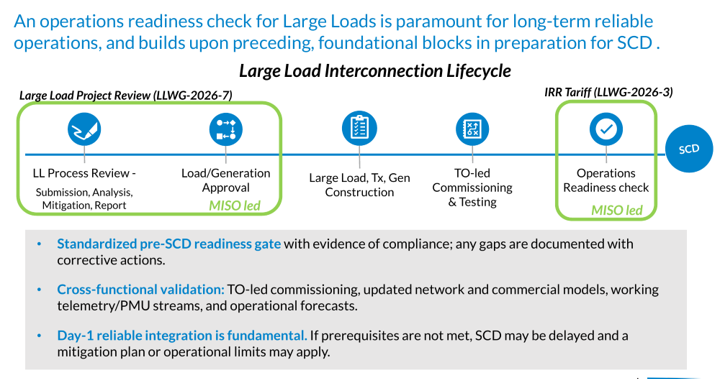
Figure 2. Large load lifecycle linking project review, construction, commissioning, and operations readiness. Source: MISO LLWG Operations Readiness Check presentation, September 23, 2026.
The lifecycle continues after the study report. Before the Service Commencement Date, the proposed operations-readiness check would verify commissioning evidence, updated network and commercial models, telemetry, PMU streams, operational forecasts, and other required information. If prerequisites are incomplete, the materials identify possible consequences including a delayed Service Commencement Date, operating limitations, or a mitigation plan.
LARS Tariff Timeline and Next Steps
MISO introduced LARS in July, gathered stakeholder feedback twice, presented draft tariff language in August, and returned to LLWG on September 23 with final tariff language.
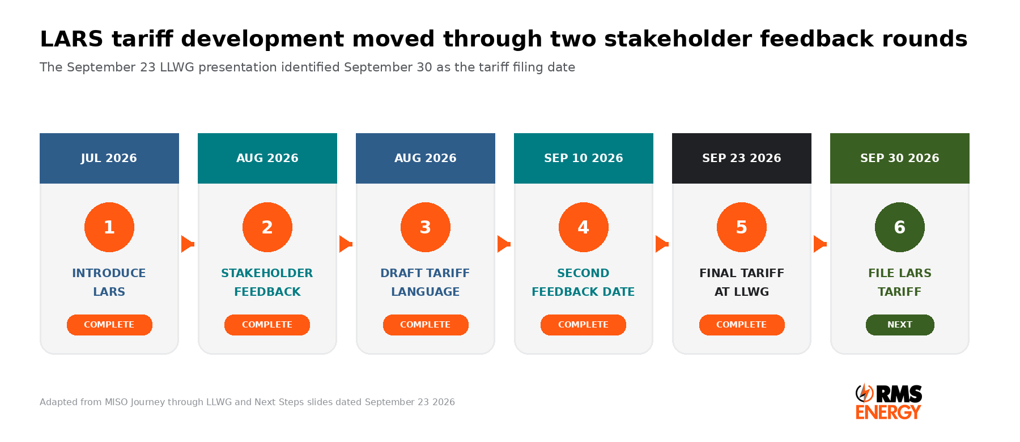
Figure 3. LARS tariff development timeline and next step. Adapted from MISO LLWG materials dated September 23, 2026.
Immediate Next Step
MISO identified September 30, 2026 as the tariff filing date. The filing would move the proposal into regulatory review. Until the relevant provisions are accepted and effective, project teams should continue to treat the LARS requirements, eligibility rules, and 120-day study target as proposed.
Stability Requirements Need to Be Addressed Early
MISO’s proposed large-load framework includes more than steady-state transmission analysis. The stability assessment approach considers transient stability, forced oscillations, system strength, electromagnetic transient studies, and subsynchronous oscillation screening. The proposed framework emphasizes risk-based screening and targeted studies rather than applying the same analysis to every project.
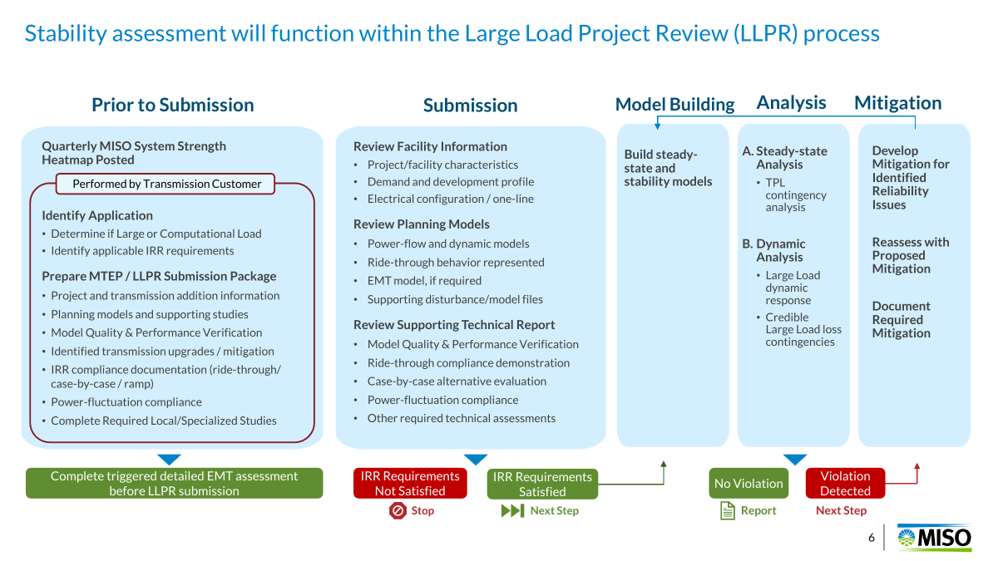
Figure 4. Proposed stability assessment process for large-load projects. Source: MISO Large Load Working Group Stability Assessment presentation, September 23, 2026.
Specialized studies may need to be completed before the formal Large Load Project Review begins. If system-strength screening indicates a potential weak-grid condition, the project may need a detailed EMT study covering converter-control interactions, fast transient behavior, pre- and post-project performance, and mitigation.
The proposed process begins before submission. The project team must identify the applicable Interconnection Reliability Requirements, prepare the facility and network models, demonstrate model quality and ride-through performance, and complete any required local or specialized studies. The formal LLPR study period is intended for analysis and mitigation, not for developing missing models or resolving incomplete technical documentation.
For large electronically controlled loads and inverter-based resources, repetitive power variations are also an important consideration. Load cycling, motor or compressor operation, and other rapid changes can propagate through the transmission system and affect voltage, frequency, transmission loading, or system oscillations. These impacts depend on the facility design, electrical location, network topology, and operating conditions.
A project that enters the process with validated models, documented operating behavior, and completed prerequisite studies is better positioned to meet the study schedule and address reliability concerns before they become project delays.
Where ZGIA fits
MISO’s proposed Zero-Injection Generator Interconnection Arrangement, or ZGIA, is a related but distinct pathway. The presented BPM updates describe individual quarterly studies, limits on network upgrades beyond the Point of Interconnection, and additional scenarios in which the zero-injection resource and its associated load trip separately or together. These details reinforce the same technical principle: the study must represent the electrical relationship between the resource, the load, and the transmission system rather than treating each asset as an unrelated project.
Because the tariff and BPM language were still under stakeholder review in the supplied materials, developers should treat ZGIA details as evolving. The practical lesson is to monitor the applicable pathway early and confirm the service request, study assumptions, model requirements, and upgrade boundaries before finalizing the application package.
What developers should prepare now
For a large-load project paired with generation, the most effective preparation is a disciplined technical-readiness review. Before submission, the project team should be able to answer the following questions:
- Is the requested transmission service clearly defined as firm, non-firm, flexible, or another available service option?
- Does the one-line diagram match the power-flow, dynamic, EMT, protection, and operational models?
- Are the load profile, ramp behavior, ride-through response, and credible load-loss events documented and defensible?
- Have system-strength, oscillation, and EMT screening requirements been evaluated before the formal study cycle?
- Are the generator and load pairing, offtake arrangement, site control, and commercial responsibilities sufficiently clear?
- Can the project provide a complete package without using the formal study period to repair missing models or incomplete technical documentation?
RMS Energy Perspective
MISO’s proposals show that interconnection support must begin before the formal study process. Consultants need to align the facility design with planning and EMT models, verify the assumptions behind network upgrades, and identify specialized study requirements. Faster study timelines will depend on verified models, clear service requirements, realistic operating assumptions, and completed prerequisite studies.
Conclusion
MISO’s proposed LARS framework reflects a broader change in power-system planning: large-load interconnection is becoming a coordinated load, generation, transmission, stability, and operations problem. The strongest project teams will treat those elements as one connected engineering task from the beginning.
For developers, the message is straightforward. Faster study timelines will be valuable only when the technical package is ready before the study begins. For interconnection professionals, the opportunity is to help clients move from a concept to a defensible, study-ready, and operationally reliable project.
Learn how RMS Energy supports complex transmission projects through our T&D engineering and consulting services