
How weak-grid conditions, inverter controls and increasingly complex resource interactions are changing power-system studies
The electric grid is undergoing a fundamental change. Large synchronous machines are being supplemented—and in some regions displaced—by inverter-based resources, battery energy storage systems, high-voltage direct-current links and electronically controlled loads. These technologies can improve flexibility and accelerate the transition to a lower-carbon grid, but they also introduce fast control behavior that traditional stability tools were not designed to represent in detail.
Positive-sequence dynamic simulation remains essential. It is efficient, scalable and well suited to system-wide questions involving frequency, voltage and electromechanical stability over hundreds or thousands of buses. However, as the grid becomes more converter-dominated, some of the highest-consequence risks occur at time scales and levels of detail that positive-sequence models intentionally simplify.
That is where electromagnetic transient, or EMT, modeling becomes important. EMT simulation does not replace conventional planning analysis. It extends the study toolkit so engineers can evaluate fast controls, switching events, phase-domain behavior, protection logic and interactions among nearby devices with much greater fidelity.
The central question is therefore not whether EMT is universally better. It is whether the study method can represent the phenomenon that matters for the decision being made. Selecting the right model—and knowing its limitations—is becoming a core part of defensible interconnection and grid-performance analysis.
What Does EMT Modeling Provide?
EMT programs solve the electrical network using instantaneous phase quantities and very small simulation time steps, commonly in the microsecond range. This allows a model to represent individual phases, detailed converter controls, switching actions, saturation, harmonics, control limiters, protection sequences and other fast phenomena that may be averaged or omitted in a positive-sequence simulation.
Positive-sequence and EMT studies are complementary. Each makes a deliberate tradeoff between system scale and model detail. Positive-sequence analysis can cover a very large interconnection across long simulation windows; EMT analysis concentrates computational effort on the part of the system where fast, detailed behavior may influence reliability.
A Practical Comparison
| Study Dimension | Positive-Sequence | EMT |
| Primary representation | Positive-sequence, phasor-domain network | Instantaneous three-phase waveforms |
| Typical time step | Milliseconds | Microseconds |
| Best at | Broad-area electromechanical behavior | Fast control, switching and unbalanced phenomena |
| Key strengths | Large systems, long-duration events, many contingencies | Detailed converter controls, protection logic and network transients |
| Important limitation | May not capture fast control interactions | Requires more model detail, validation and computational effort |
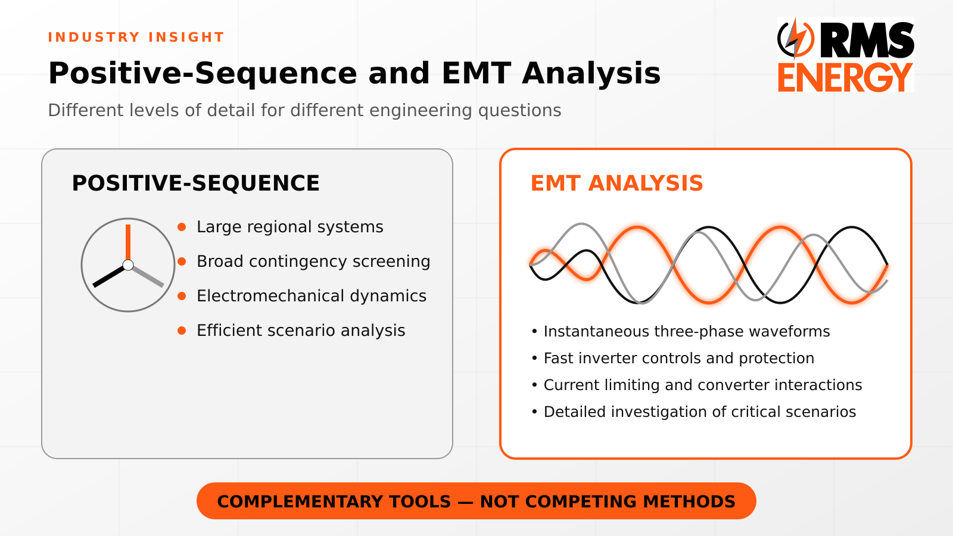
Figure 1. Positive-sequence and EMT simulations are complementary tools designed to answer different engineering questions.
The Difference Is Becoming More Important
Synchronous generators are governed by physical relationships that are comparatively well understood and represented through mature machine, excitation, governor and stabilizer models. Inverter-based resources behave differently. Their apparent electrical response is created by software: phase-locked loops, current controllers, voltage regulators, limiters, filters, protection logic and plant-level coordination.
Two facilities with similar nameplate ratings may respond very differently to the same disturbance because their control objectives, tuning, firmware and protection settings differ. Those differences become more important when the surrounding system is weak, when several converter-based facilities are electrically close, or when network impedance changes materially with outage conditions.
A positive-sequence model may correctly show the broad voltage or frequency trend while missing an unstable fast-control interaction. Conversely, a detailed EMT model that has not been validated can create a false sense of precision. The engineering value comes from using an appropriate model, testing it rigorously and interpreting the result in the context of the real system.
When Should EMT Analysis Be Considered?
EMT analysis is most valuable when a project or system condition creates a credible risk involving fast controls, phase-domain behavior or non-linear equipment response. The following situations frequently justify an EMT screening or detailed study.
Weak-Grid Interconnection
Low short-circuit strength can make converter controls more sensitive to voltage changes and to the behavior of other devices. Phase-locked loops may have difficulty tracking the grid, current limiters may engage repeatedly, and voltage-control loops can interact with the network in ways that are not obvious from steady-state strength metrics alone. EMT analysis can test the actual control response across credible operating and outage conditions.
Multiple Electrically Close IBR Facilities
A project that appears stable when studied by itself may behave differently after nearby solar, wind or storage facilities are added. Similar controllers can reinforce one another, while plant-level controls and transmission devices may compete to regulate the same voltage. Multi-vendor interactions often require enough detail to represent each facility’s relevant control loops and limits.
Grid-Forming Technology
Grid-forming controls are designed to establish voltage and frequency behavior rather than simply follow an existing waveform. Their response depends on current limiting, virtual impedance, energy constraints, mode transitions and coordination with other grid-forming and grid-following devices. EMT studies can evaluate these behaviors during severe faults, islanding, restoration and weak-system operation.
Long Cables and Offshore Transmission
Long HVAC cables, export systems and offshore collection networks introduce charging current, resonances and switching behavior that may require frequency-dependent or phase-domain representation. Transformer energization, cable energization and interactions with reactive compensation can be strongly influenced by point-on-wave conditions and equipment non-linearities.
HVDC and FACTS Devices
HVDC converters, static var compensators and STATCOMs depend on fast controls and switching-based power electronics. The coordination of these devices with generators, IBR plants and protection systems can create local or wide-area consequences. EMT modeling is often necessary to evaluate control recovery, commutation or current-limit behavior, and response to unbalanced faults.
Sub-Synchronous and Control Interactions
Series compensation, converter controls and mechanical systems can interact across sub-synchronous frequencies. EMT simulation can complement impedance-based screening and frequency scans by reproducing the time-domain behavior of a specific operating condition and helping distinguish a network resonance from a control-driven instability.
Large Electronic Loads
Data centers, electrolyzers and other emerging loads may contain power-electronic front ends, on-site generation, storage, uninterruptible power supplies and complex transfer schemes. The aggregate load response may differ sharply from a static or conventional dynamic load model. NERC has identified the need to understand and mitigate reliability risks associated with emerging large loads, including their performance during grid disturbances.
Having a PSCAD Model Is Not the Same as Having a Study-Ready Model
A delivered model may open and run in PSCAD yet still be unsuitable for an interconnection study. Study readiness requires more than successful compilation. The model must reproduce the intended equipment behavior, expose the right parameters, initialize reliably, operate over the required system-strength range and respond correctly to disturbances and setpoint changes.
Common problems include undocumented parameter assumptions, hidden default values, simplified protection logic, unavailable plant-level functions, numerical sensitivity and initialization that works only in a narrow test case. Black-box controls can protect intellectual property, but they also increase the importance of a clear user guide, version control, defined interfaces and repeatable test results.
A study-ready package should identify the exact software and compiler versions, the represented firmware or control release, required external files, initialization process, available operating modes, parameter boundaries and known limitations. It should also contain a test harness that allows the study team to verify the model before integrating it into a large network.
Model Benchmarking Is Critical
Benchmarking establishes confidence that different representations of the same facility tell a consistent engineering story. A positive-sequence model and an EMT model will not produce identical traces: they solve different equations at different time scales. But their fundamental response should be aligned where the underlying phenomenon is within the valid range of both models.
Useful benchmark tests include active- and reactive-power reference steps, voltage and frequency disturbances, balanced and unbalanced faults, fault recovery, current-limit operation and protection thresholds. Engineers should compare not only terminal voltage and power, but also timing, controller saturation, recovery trajectory and the sequence of mode or protection changes.
When two models diverge, the difference should be explained rather than tuned away automatically. The cause may be an intentional difference in model fidelity, a parameter mismatch, an omitted control function or an implementation error. A documented explanation is part of a defensible study record.
A Disciplined EMT Study Process
The strongest EMT studies are structured around a specific engineering risk and a transparent chain of evidence. The workflow below keeps attention on the decision the study must support, while creating checkpoints for model quality and interpretation.
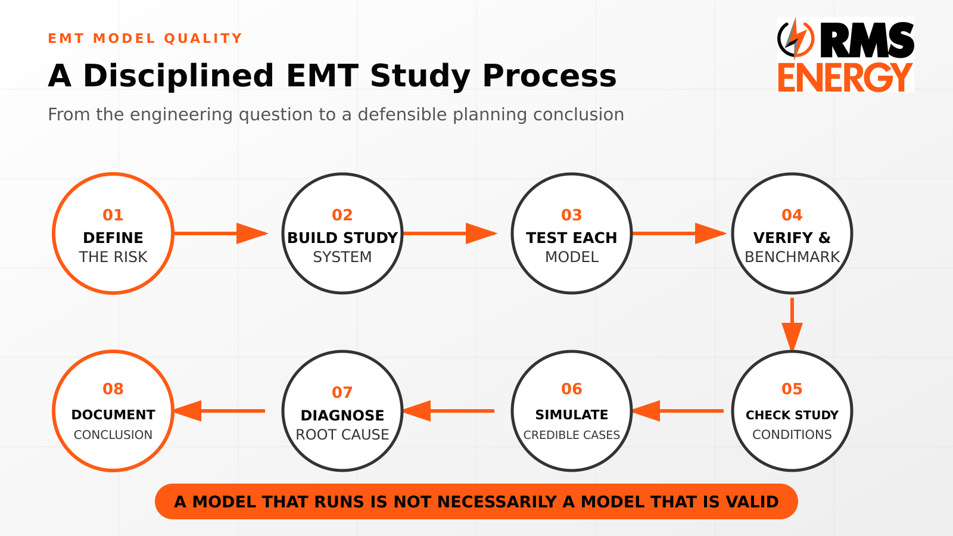
Figure 2. A defensible EMT conclusion begins with a clearly defined risk and requires model testing, benchmarking, credible study conditions and root-cause analysis
Define the Engineering Question
Start with the decision, not the software. Identify the event, operating condition and failure mode that matter. A question such as whether a plant remains stable following a normally cleared fault under a specified outage is more useful than a general request to ‘run PSCAD.’
Establish the Study System
Choose the network boundary, equivalent strength, neighboring resources and transmission-device models needed to represent the risk. The retained system should be detailed enough to preserve the relevant electrical interactions without becoming unnecessarily large or difficult to validate.
Test Individual Models
Exercise each converter, plant controller, protection function and external interface in a controlled test bench. Confirm initialization, setpoint tracking, fault response, limit behavior and restartability before the model is connected to the full study case.
Verify Model and Project Settings
Confirm control modes, gains, limiters, transformer data, collector equivalents, protection thresholds, time steps, interpolation settings and solver options. Record software versions and model checksums so another engineer can reproduce the study.
Benchmark Across Simulation Platforms
Compare EMT behavior with the available positive-sequence representation for disturbances both models are designed to capture. Reconcile material differences or identify them explicitly as limitations before drawing system-level conclusions.
Evaluate Credible Operating Conditions
Study more than a single base case. Consider dispatch, topology, nearby-resource status, fault type, clearing time, grid strength and pre-disturbance voltage. Sensitivity analysis helps distinguish a robust conclusion from a result that depends on one narrow assumption.
Investigate the Cause—not Just the Symptom
An unstable waveform is the beginning of the analysis, not the conclusion. Review internal control signals, limit transitions, protection actions and network quantities to determine the initiating mechanism and identify effective mitigation.
Document Assumptions and Limitations
A useful report connects inputs, test evidence, scenarios, results and conclusions. It distinguishes verified facts from assumptions and clearly states which behaviors the models can—and cannot—support.
EMT Modeling Should Begin Earlier
EMT work is often introduced late, after a project has entered a formal study process or a potential instability has already appeared. That timing can compress model review, vendor coordination, scenario development and mitigation design into a critical project window. It also makes model defects look like study findings and study findings look like schedule surprises.
Earlier EMT screening can identify whether detailed analysis is likely to be required, which vendor models and data must be requested, and which network conditions should be preserved in the case. It gives developers and equipment suppliers time to resolve model issues before the interconnection schedule depends on them.
The goal is not to run an EMT study for every project. The goal is to recognize credible EMT risks early enough to choose the right level of analysis, build a reliable model package and make design decisions while options remain available.
RMS Energy’s EMT Modeling Capability
RMS Energy supports developers, asset owners, utilities and other grid stakeholders with EMT model review, benchmarking, network development, study execution, root-cause analysis and mitigation evaluation. The work combines deep EMT expertise with an understanding of the broader interconnection process, allowing detailed simulations to remain connected to the planning question they are intended to answer.
That capability is especially valuable when a study involves weak-grid performance, multiple nearby inverter-based resources, converter-control interactions, grid-forming functions, HVDC or FACTS equipment, complex protection behavior, or emerging electronic loads. The objective is not simply to produce waveforms. It is to develop technically credible evidence that can support design, interconnection and operating decisions.
RMS Energy’s approach emphasizes traceable inputs, model testing, cross-platform benchmarking, realistic sensitivities and clear communication of assumptions. When unexpected behavior appears, the analysis focuses on the mechanism behind the result and on practical pathways to reduce the identified risk.
The Right Model for the Right Question
The modern grid requires both breadth and detail. Positive-sequence simulation provides the breadth needed to evaluate large interconnected systems efficiently. EMT simulation provides the detail needed to understand fast controls, switching phenomena, phase-domain behavior and interactions that can be decisive in converter-rich systems.
Neither method is sufficient for every question. The strongest engineering programs use screening, model-quality checks and study objectives to decide when a conventional dynamic model is adequate and when EMT fidelity is warranted. They also preserve a clear line from the observed response to the underlying mechanism and from the mechanism to a practical decision.
Better models support better studies. Better studies support better interconnection decisions.
Source
North American Electric Reliability Corporation, Reliability Guideline: Risk Mitigation for Emerging Large Loads. Accessed September 2026.
#EMTModeling #PowerSystems #GridStability #InverterBasedResources #PSCAD #GridInterconnection #RenewableEnergy #RMSEnergy