

Key takeaways from the Sept. 2, 2026 MISO Planning Subcommittee
MISO’s Sept. 2 Planning Subcommittee meeting connected four pieces of the same planning story: a large portfolio of approved transmission projects, changing transfer capability as the grid becomes more heavily used, voltage-stability limits in key interfaces and load pockets, and the next round of long-range models that will shape future solutions.
THE CENTRAL SHIFT MISO is managing today’s transmission buildout while simultaneously testing how much power the evolving grid can move and building the 2045-based models that will define the next set of needs.
1. MISO is carrying a $73.1 billion active transmission portfolio
The Q2 2026 MTEP status report shows 1,505 active Appendix A projects with an estimated total cost of $73.1 billion. Of those, 150 projects are already under construction, representing $5.4 billion.
- Most non-MVP projects are expected to enter service within the next four years.
- MVP projects represent the largest share of active investment by project category.
- The West subregion carries about $38.6 billion of active project cost, the largest of MISO’s four subregions.
- New transmission lines and line upgrades account for 66% of active facility cost; substations, transformers and voltage devices make up the remaining 34%.
The portfolio is therefore not only large on paper. A meaningful portion is approaching construction and in-service milestones, while the 2032-2034 investment profile begins to reflect the approved MTEP24 LRTP portfolio.
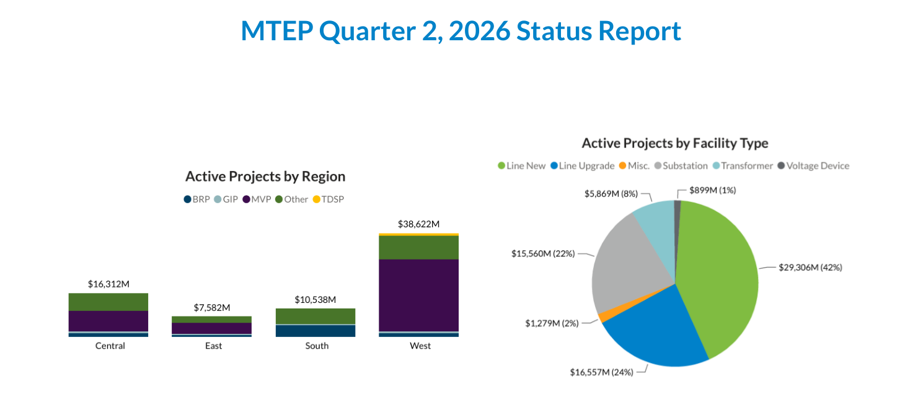
Figure 1. Active MTEP projects by region and facility type.
2. Voltage stability is not moving uniformly across the footprint
MISO presented results for five of the seven MTEP26 voltage-stability transfer scenarios. The broad takeaway is encouraging for the Midwest export interfaces: MISO states that the MWEX interfaces are not stability-limited in the five-year planning horizon.
The South load-pocket results are more mixed. SETEX shows a notable improvement, with its voltage-stability transfer level reaching 1,690 MW, 760 MW above the MTEP25 incremental-transfer result.
- Amite South remains broadly similar to the prior cycle, with a 2,450 MW voltage-stability transfer level.
- DSG falls to 1,823 MW, a 590 MW reduction from MTEP25, which MISO attributes to reactive-power insufficiency outside the DSG pocket.
That contrast matters: system upgrades can materially improve one constrained area while reactive-power conditions elsewhere create a new binding weakness.
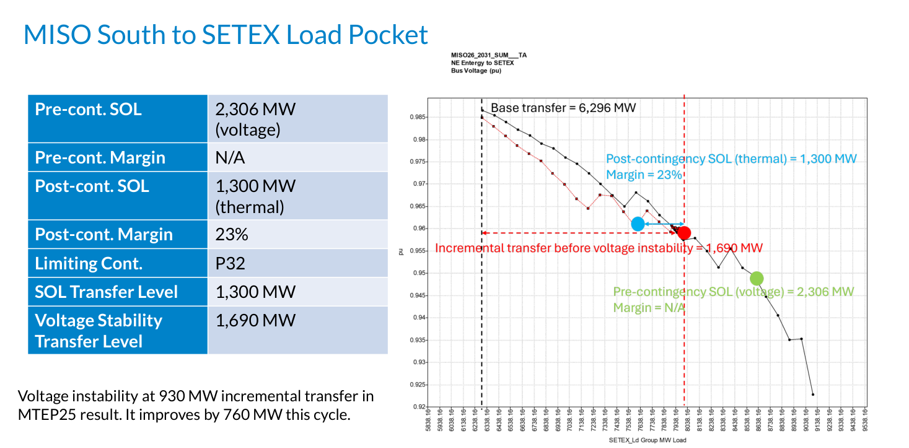
Figure 2. MISO South to SETEX voltage-stability result.
Source: MISO, “MTEP26 Voltage Stability Analysis Results,” Planning Subcommittee, Sept. 2, 2026, p. 9.
3. Transfer capability is increasingly shaped by how heavily the base grid is already being used
MISO finalized two MTEP26 transfer studies that were not covered by the NERC ITC study: North/East into MISO Central, driven by increasing large loads in Central, and Illinois Import, driven by coal-generation retirement.
- For the 2031 North/East-to-Central scenario, the final modeled Total Transfer Capability is 1,021 MW after planned mitigation and redispatch.
- For the 2031 Illinois Import scenario, the updated Total Transfer Capability is 2,178 MW.
- In the 2036 cases, the corresponding final TTC values increase to 2,628 MW and 5,386 MW, respectively.
The larger planning message is not simply the final MW number. MISO notes that as new generation, large loads and other equipment increase base-grid utilization, less unused transmission capacity remains available for very high transfers.
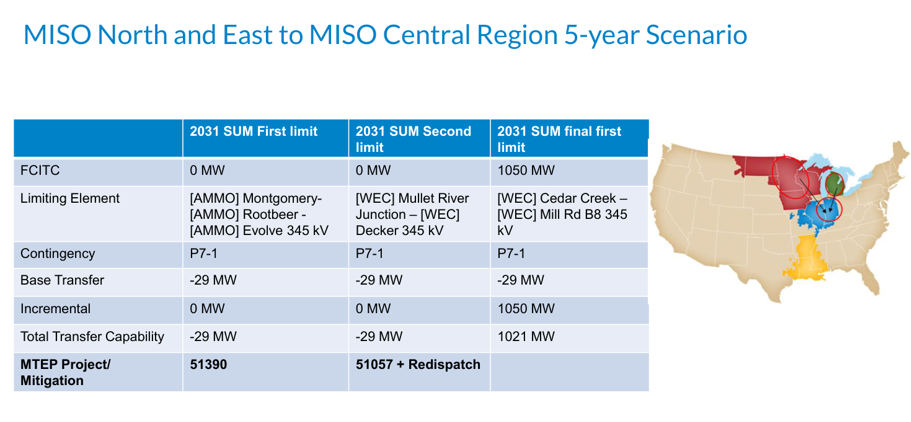
Figure 3. North/East to MISO Central five-year transfer-capability analysis.
Source: MISO, “MTEP26 Transfer Capability Analysis Results,” Planning Subcommittee, Sept. 2, 2026, p. 4.
4. LRTP is moving from Futures into actual reliability-model building
The LRTP update shows MISO transitioning from scenario development into the engineering work that will identify the next set of transmission issues. Future F2 and F3+ will be used to build core reliability models representing a range of long-term outcomes.
- The Futures were developed to represent projected conditions through 2045.
- Core models will combine Midwest and South and evaluate summer peak, winter peak, average-load and light-load conditions.
- Large loads are scaled by Future and study year, while EPR large-load submissions will continue to be monitored for modeling impacts.
- MISO is targeting the Nov. 18 PAC for an initial discussion of identified issues.
The seven-step LRTP process makes the sequencing clear: 2026 is primarily about building models and identifying issues; solution development, testing, recommendation and cost allocation follow as those needs become better defined.
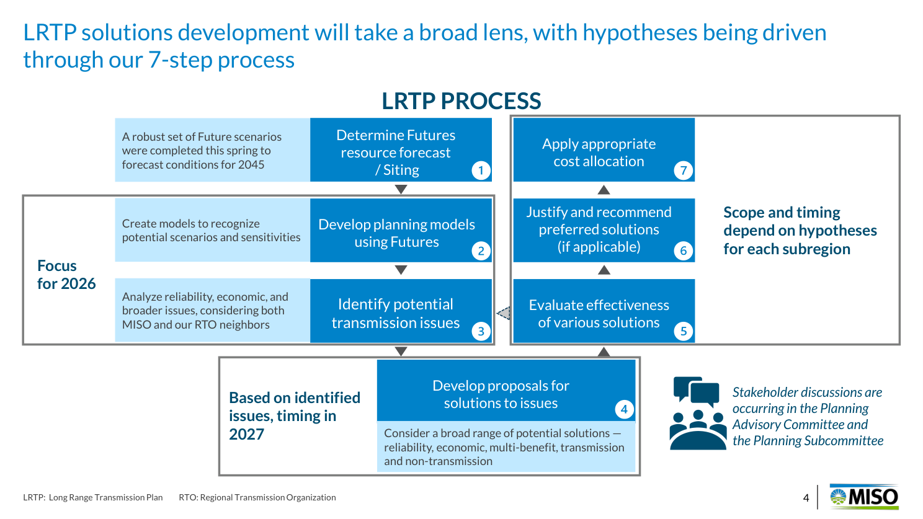
Figure 4. MISO’s seven-step LRTP process and 2026 focus.
Source: MISO, “LRTP Update,” Planning Subcommittee, Sept. 2, 2026, p. 4.
What stakeholders should watch next
- Sept. 30: MISO plans to post the final MTEP26 voltage-stability report.
- Oct. 14: PSC updates are scheduled for both LRTP and the stability/draft transfer-capability report.
- Nov. 18: MISO is targeting PAC for an initial discussion of LRTP issues emerging from the new models.
- Dec. 1: MISO plans to post the final MTEP26 transfer-capability report.
THE BIGGER QUESTION As large-load growth and generation changes consume more of the existing grid’s transfer margin, how quickly can new transmission move from approved portfolio to in-service capacity?
RMS Energy perspective
The Sept. 2 PSC materials show why transmission planning cannot be viewed as a single annual portfolio exercise. MISO is simultaneously tracking a $73 billion active buildout, validating near-term transfer and voltage limits, and constructing the long-range models that will define the next wave of solutions.
For developers and transmission owners, the important signal is that the planning bottleneck is shifting. The question is no longer only whether projects are approved. It is whether the system has enough usable transfer capability, reactive support and timely construction to absorb the next layer of load and generation.
That makes model assumptions, project timing and regional transfer capability increasingly important commercial inputs, not just planning details.
#MISO #TransmissionPlanning #MTEP #LRTP #GridReliability #VoltageStability #TransferCapability #LargeLoads #PowerSystems #RMSEnergy