

(ERCOT Large Load Working Group Meeting — August 21, 2026)
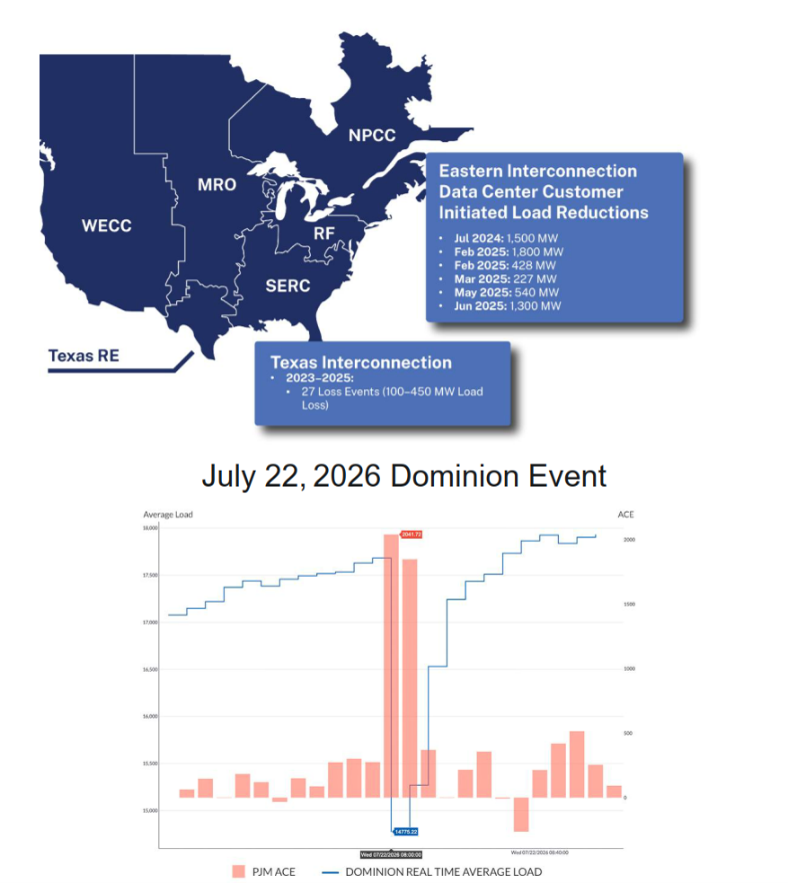
On July 22, roughly 3.8 GW of data center load in Dominion’s service territory dropped off the grid after a routine fault was cleared as expected. The event did not cause a blackout, but it forced a system-wide frequency response and put a number on a risk that regulators had been discussing in general terms. Four weeks later, FERC ordered NERC to file new or modified reliability standards for computational loads by December 31, 2026. The ERCOT Large Load Working Group’s August 21 meeting was the first working-group session after both events, and the agenda reflected the shift: three new draft standards, a disturbance performance SAR headed to the RSTC in four days, and the first EMT-validated ride-through compliance data presented to any ISO working group.
Three items from this meeting matter most for interconnection engineers, data center developers, and transmission planners.
1. NERC Project 2026-02: Three Standards, Three Entity Types, One December Deadline
NERC’s Project 2026-02 has produced three draft standards that, taken together, create the first regulatory framework specifically for computational loads connected to the Bulk Power System. Eric Meier of ERCOT presented the latest drafts and the FERC order that compressed the timeline.
The framework introduces two new registered entity types. A Computational Load Owner (CLO) is the entity that owns and maintains the site. A Computational Load Operator (CLOP) is the entity that operates it. Registration applies to sites of 50 MW or more connected at 100 kV or above. The definition covers AI training and inference, cryptocurrency mining, software services, and other data center activities — broad enough to capture every large-scale computational facility now seeking interconnection.
CLO-001 (Interconnection, Studies, and Modeling Data) requires Transmission Owners, Distribution Providers, and Generation Owners to develop computational-load-specific interconnection requirements. Transmission Planners and Planning Coordinators must conduct steady-state, short-circuit, and dynamics studies for every new computational load and every “qualified change” to an existing one. CLOs must provide modeling data that includes tripping and ride-through parameters, the percentage of IT infrastructure, and the expected behavior of that infrastructure. Data updates are required at least every 13 months and upon commissioning changes.
CLO-002 (Operational Data and Communications) requires Transmission Operators, Balancing Authorities, and Reliability Coordinators to maintain data specifications for computational load sites and share them with entities that need the information. CLOPs must comply with operating instructions from grid operators and maintain interpersonal communication capability with their area’s TO and BA. Operators must complete oral two-party communication training.
CLO-003 (Protection Coordination and Disturbance Monitoring) draws on language from PRC-028 and PRC-027. It requires Sequence of Event Recording for circuit breakers, Fault Recording on the high side of the main power transformer (per phase, all three phases), and Dynamic Disturbance Recording at the same point. If monitoring equipment fails, the CLO must restore it and submit a Corrective Action Plan. CLOs must also establish a formal process for developing and revising protection system settings.
The standards are now in public comment through September 18, 2026. Ballot pools form through September 3, and the initial ballot runs September 9–18. The Disturbance Performance whitepaper comment period closes August 28. A separate Disturbance Performance SAR covering ride-through, post-fault active power recovery, rate-of-change-of-frequency withstand, and current consumption during disturbances went to the NERC LLWG for approval on August 20 and is headed to the RSTC on August 25.
The July 22 Dominion event showed that customer-initiated load reductions are no longer a theoretical risk. NERC’s data shows CILR events growing across both the Eastern Interconnection and ERCOT — 1,500 MW in July 2024 rising to 1,300 MW in June 2025 for the Eastern Interconnection alone, plus 27 events with 100–450 MW losses in Texas from 2023–2025. The 3.8 GW Dominion event dwarfs all previous incidents. These standards are the floor; the SAR roadmap extends through Q4 2027 with additional requirements for model validation, event reporting, balancing operations, and real-time communications.
2. NOGRR 282 Ride-Through: The Physics Problem and the First EMT Evidence
ERCOT’s NOGRR 282 established ride-through requirements for large computational loads under Nodal Operating Guide §2.15, effective August 1, 2026. The rule requires four things during a voltage sag: stay connected for a defined duration (2 seconds at 0.85 pu, down to 150 ms below 0.35 pu); keep current at or below 150% of normal; return to 90% of normal consumption within 2 seconds of voltage recovery; and withstand at least six sags in 90 seconds.
The physics of GPU-based data centers makes the current limit the hardest requirement to meet. GPU racks draw constant power, which means current rises as voltage drops — an unmodified facility hits 150% of normal current at 0.667 pu retained voltage. Below that threshold, the facility either trips its own distribution breakers on overcurrent or forces the grid to absorb excess current during and after the fault. NERC’s January 2026 review of 26 large-load ride-through events in ERCOT documented current reaching 150–160% of pre-fault levels, recovery times ranging from five minutes to nearly two hours, and one event that lost 19% of a facility’s load from a voltage dip to only 0.844 pu.
Praneet Sharma of AIONTRACKS presented what appears to be the first EMT-validated data on a software-based approach to meeting these requirements. The company’s AionLink product reduces computational power within milliseconds of detecting a voltage sag and ramps it back on a controlled trajectory after the fault clears. The presentation reported results from 70 voltage sags at seven depths on two AMD MI300X GPUs running production AI workloads (BERT training and Qwen 2.5-7B inference), with an independent PSCAD model of a 9 MW facility on a 69 kV bus providing the electrical validation. The PSCAD work used an open-source Data Center Model Library and was supported by Pacific Northwest National Laboratory.
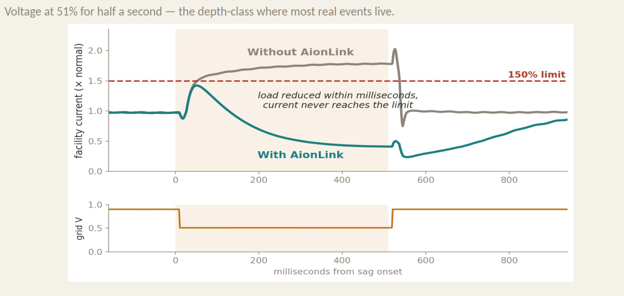
Figure 2: moderate sag current comparison, With vs Without AionLink
The reported results: ride-through duration met at all seven depths; current stayed below 150% down to 0.45 pu retained voltage; 90% recovery was achieved in 0.49 seconds worst case (the rule allows 2 seconds); and the system handled 7 sags in 64 seconds. At moderate sag depths (0.51 pu), peak recovery current dropped 75% compared to the uncontrolled case. The stored energy required to bridge the gap between load demand and the 150% limit fell 85–94% at moderate depths and 44% at the deepest sag tested (0.21 pu). Based on EPRI’s DPQ distribution survey, roughly 81% of voltage events fall in the range where the software alone — without supplemental storage — held current within the limit.
The compute cost was minimal: approximately 25 seconds of reduced power per year across roughly 50 sag events, amounting to under 0.0001% of annual operating time. Inference service was maintained throughout testing — 21,907 requests served through eight sags with a median response time of 47.9 ms.
What to watch: This is a single vendor’s test data on a 9 MW model, not a 500 MW production facility. The PSCAD model disabled protection elements by design, so it does not answer whether internal supply protection trips under deep sags. The 150% current limit was met to 0.45 pu but not below. Still, it is the first quantitative evidence presented to an ISO working group that software-level load modification can address the ride-through challenge, and it reframes the compliance question from “how much storage do we need?” to “how much less storage do we need if the load cooperates?”
3. Netted Networks: ERCOT Rethinks the Co-Location Market Structure
Sai Moorty presented the Netted Networks concept, which addresses a growing structural problem: ERCOT currently has only one registration path for sites with co-located load, generation, and storage — the Private Use Network (PUN). Under PUN rules, generation and load are netted for settlement and dispatch, which means ERCOT’s market and reliability unit commitment processes see only the surplus MW after the load is served. Storage in a PUN is not eligible for Wholesale Storage Load treatment. And ERCOT’s dispatch engines are not designed to call on offline PUN generation when there is a reliability need.
The Netted Networks proposal changes three things. First, all generation and storage in a Netted Network must register as market resources (Generation Resources or Energy Storage Resources), giving ERCOT full visibility into the site’s capacity. Second, the gross load behind the interconnection point counts as ERCOT Load, rather than disappearing behind the net meter — which makes co-located ESRs eligible for WSL treatment. Third, resources offer their entire gross capacity into the market rather than only the surplus after serving co-located load.
Energy settlement remains net at the point of interconnection, the same as a PUN. But two policy questions are explicitly marked as TBD: whether Load Ratio Share charges are calculated on gross load or net at the POI, and whether Transmission Cost (TCOST/4CP) allocation uses gross or net. These are not technical questions — they are cost-allocation decisions that will determine whether the Netted Networks structure is economically attractive compared to the existing PUN path.
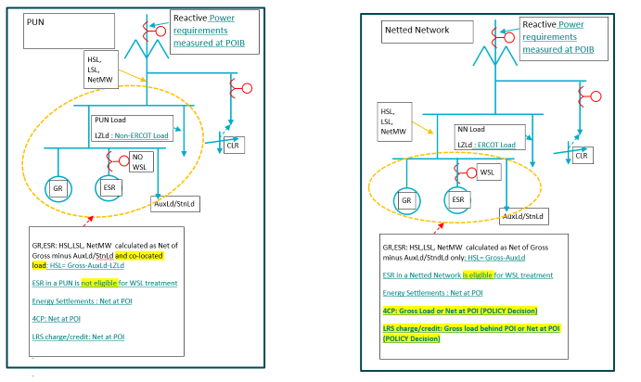
Figure 3: PUN vs Netted Network comparison diagram
Source: Sai Moorty, “Netted Networks Proposal,” ERCOT LLWG Meeting, August 21, 2026
The cross-ISO parallel: NYISO is moving in the same direction. Its proposed Connected Load Resource (CLR) model replaces the existing Capacity Supply Resource and behind-the-meter net generation structure with gross accounting — no netting of co-located generation against load. NYISO’s framing comes from the FERC Show Cause docket (EL26-69), while ERCOT’s comes from its own market design process, but both ISOs are converging on the same conclusion: grid operators need to see the full load and the full generation separately, not just the net.
What Market Participants Should Do Now
Data center developers and CLOs: Review the three draft CLO standards and the Disturbance Performance whitepaper before the comment deadlines. The CLO-001 modeling data requirements — tripping parameters, IT infrastructure percentages, expected load behavior — will define what interconnection applicants must provide. The 13-month data update cycle and model verification requirements will be ongoing compliance obligations. If your site is 50 MW or above at 100 kV or higher, you are in scope.
Transmission planners and protection engineers: CLO-003’s Fault Recording and DDR requirements will add monitoring infrastructure at every computational load POI. The Disturbance Performance SAR’s scope includes coordination of computational load ride-through with co-located generation ride-through at a shared PCC — relevant to every co-location project now in the interconnection queue.
Co-located project developers: Track the Netted Networks discussion and the two open policy questions on LRS and TCOST. The answer to “gross or net?” will shift the economics of co-location — gross-load-based charges increase costs but align ERCOT’s incentives with full visibility. If you are currently registered as a PUN, understand what changes the Netted Network path would require.
Key deadlines: August 25 — Disturbance Performance SAR to RSTC. August 28 — Disturbance Performance whitepaper comments close. September 3 — Ballot pool formation closes. September 9–18 — Initial ballot on CLO standards. December 31 — FERC-directed filing deadline for NERC standards.
RMS Energy tracks computational load policy across all ISOs and supports clients navigating ride-through compliance, co-location market structures, and the interconnection study requirements that these standards will create. If your organization is preparing comments or assessing compliance exposure, our T&D engineering team can help scope the work.
“The grid has been studying what happens when generation drops off unexpectedly for decades. Now it has to learn the same thing about load — and the December deadline means the learning curve is measured in months, not years.”
Source: ERCOT Large Load Working Group Meeting, August 21, 2026
Meeting materials: https://www.ercot.com/committees/tac/llwg
#ERCOT #NERC #ComputationalLoads #DataCenterInterconnection #RideThrough #NOGRR282 #GridReliability #LargeLoads #CoLocation #EnergyStorage #TransmissionPlanning