

Three proposals are reshaping how New England evaluates major demand growth, proposed system changes and inverter-based resource interconnections.
Public materials prepared for the August 18-19, 2026 joint NEPOOL Reliability Committee and Transmission Committee meeting show how quickly ISO New England’s planning framework is evolving.
Three initiatives are particularly important:
- A proposed interconnection and transmission-service framework for large and co-located loads
- Enhancements to the Proposed Plan Application process under Planning Procedures 5-1 and 5-3
- Updates to Planning Procedure 5-6 in preparation for the first regular Cluster Study
Taken together, these proposals point toward a common direction: projects will need to provide better technical data, more mature models and clearer evidence of readiness earlier in the development process.
1. A dedicated framework for large loads is taking shape
In response to FERC’s large-load show cause proceeding in Docket EL26-72, ISO-NE and the Participating Transmission Owners are developing a dedicated framework for large and co-located loads.
The initial proposal would generally define a Large Load using:
- Gross peak demand of at least 50 MW
- A single commercial or industrial site
- Interconnection at 69 kV or higher
- Direct transmission interconnection or connection through a system primarily designed to serve the customer
The threshold would also capture expansions of existing facilities that cause their gross peak demand to reach or exceed 50 MW. Loads associated with co-located generation would still be evaluated based on gross demand rather than net demand.
ISO-NE is also proposing separate definitions for Co-Located Loads and Electrically Proximate Loads. Generating facilities supporting these arrangements may be eligible for a coordinated process outside the regular generator Cluster Study, allowing the load and supporting generation to be evaluated together.
Three proposed transmission-service options
The conceptual design includes three transmission-service options:
- Firm Contract Demand Service: Permanent firm service for a fixed contracted MW quantity. Required network upgrades would need to be completed before firm service begins.
- Interim Contract Demand Service: Temporary non-firm service that could allow a Large Load to operate before all network upgrades are completed.
- Non-Firm Contract Demand Service: Permanent non-firm service reflecting the customer’s ability to reduce demand during specified system conditions, potentially reducing the upgrades needed for interconnection.
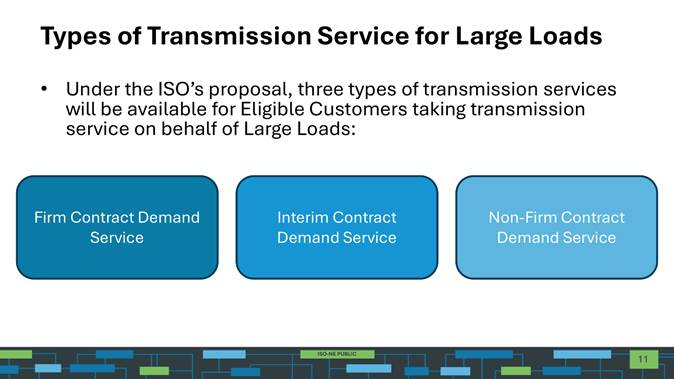
The service selection will influence study assumptions, network-upgrade requirements, curtailment exposure and resource-adequacy obligations.
ISO-NE also anticipates advancing a “bring your own new generation,” or BYONG, concept. Under the current direction, sufficient new resources may need to be designated before Firm Contract Demand Service can be provided. Non-Firm Contract Demand Service would not be subject to the same requirement because the load could be curtailed when needed to address resource-adequacy concerns.
The detailed BYONG implementation rules remain under development.
A rolling 90-day study process
Large Load applications would be accepted on a rolling basis and studied outside the generation Cluster Study process.
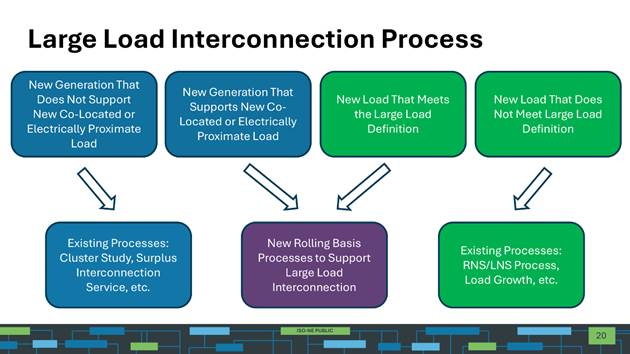
However, the proposed 90-day study period would not begin until:
- The application is complete
- Required deposits and readiness requirements are satisfied
- Technical and modeling data are accepted
- The interconnecting utility has identified the necessary interconnection facilities for the proposed point of interconnection
This distinction is important. A nominal 90-day study does not necessarily mean a project can begin the formal study immediately after making initial contact with the utility.
ISO-NE also proposes creating a publicly accessible Large Load list containing identified network upgrades, cost estimates and project status. Additional details concerning operational visibility, communications, protection, control equipment and remote-disconnection requirements will be addressed in future stakeholder meetings.
2. New England may have two important load thresholds
One of the most consequential takeaways is the distinction between the proposed 50 MW Large Load threshold and the proposed 20 MW Load PPA threshold.
These thresholds serve different purposes.
The 50 MW threshold would determine whether a facility is subject to the new Large Load transmission-service and interconnection framework. The 20 MW threshold would determine whether a load facility must submit a Proposed Plan Application for regional reliability review.
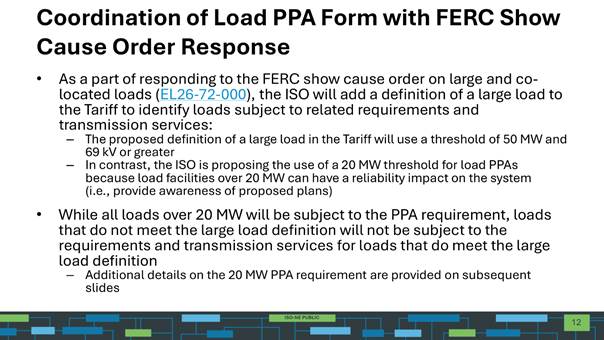
As a result, a 20 MW to 49.9 MW project may not qualify as a Large Load under the proposed Tariff definition, but it could still require a Load PPA, site-specific modeling and detailed reliability analysis.
Proposed Load PPA requirements
Under the proposed PP5-1 revisions, a Load PPA would generally be required for a physical industrial or commercial site with peak demand of at least 20 MW.
The peak demand would be evaluated:
- At the facility’s points of coupling with the transmission or distribution system
- With on-site generation assumed out of service
- By aggregating geographically proximate sites under common ownership or control
A new Load PPA is expected to require Level III analysis and site-specific modeling data.
A new or revised application could also be triggered by:
- Increasing a facility from below 20 MW to 20 MW or more
- Increasing an existing facility of at least 20 MW by 10 MW or more
- Changing the facility’s primary function, such as converting to AI training or cryptocurrency mining
- Modifying how the load responds to normal or abnormal system conditions
- Changing the technical data used to represent the facility in reliability studies
The proposed form would collect MW and MVAR demand, daily and seasonal profiles, ramp rates, load cycling, primary load function and information regarding co-located or backup generation.
This is especially important for data centers and other computational loads. Their fast ramping, cycling, voltage sensitivity, backup-generation arrangements and control behavior can be just as important as their maximum demand.
Broader PPA process improvements
ISO-NE is also proposing broader improvements to PP5-1 and PP5-3, including:
- Fillable PDF applications
- Elimination of separate cover letters
- Standardized documentation checklists
- Clearer study and model-submission requirements
- A dedicated withdrawal form
- Clarification of when project changes require a revised PPA
- Requirements to address differences between as-studied and as-built facilities
The objective is to reduce incomplete submissions and repeated information requests while improving consistency across generation, transmission and load applications.
3. PP5-6 is being updated for the first regular Cluster Study
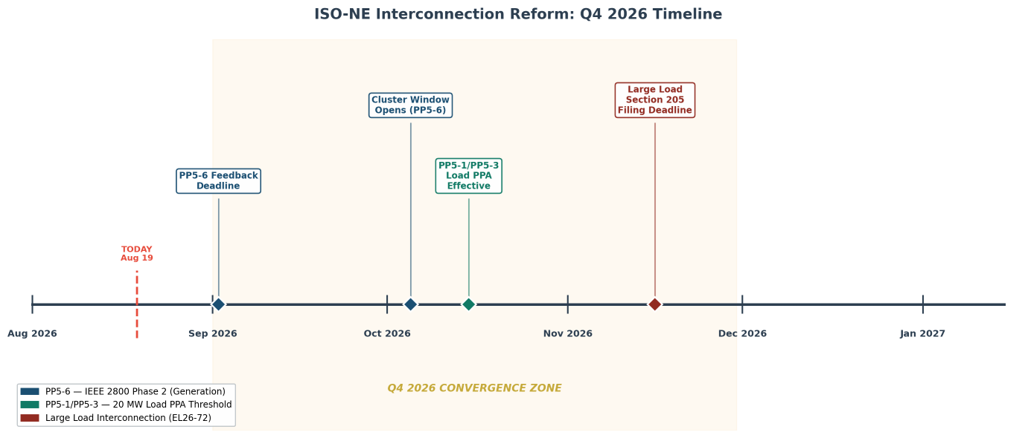
The first regular Cluster Request Window under ISO-NE’s Order No. 2023 framework is scheduled to open on October 5, 2026. The proposed PP5-6 changes are intended to be effective immediately before that window.
The revisions address IEEE 2800 implementation, model acceptance, study scenarios, project inclusion criteria and other requirements that will directly affect interconnection customers.
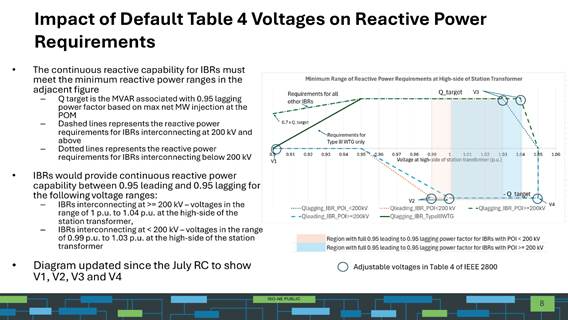
IEEE 2800 and reactive-power requirements
ISO-NE’s earlier IEEE 2800 implementation focused on adopting selected performance specifications. The current proposal moves toward verification and testing of those capabilities.
The changes would clarify:
- Voltage ranges associated with reactive-power requirements
- Evaluation of 0.95 leading and 0.95 lagging capability across a range of voltages
- Power-factor evaluation for both IBRs and synchronous generators
- Design attestations confirming that a proposed IBR facility will satisfy adopted IEEE 2800 requirements
Appendix C-2 would add three model acceptance tests:
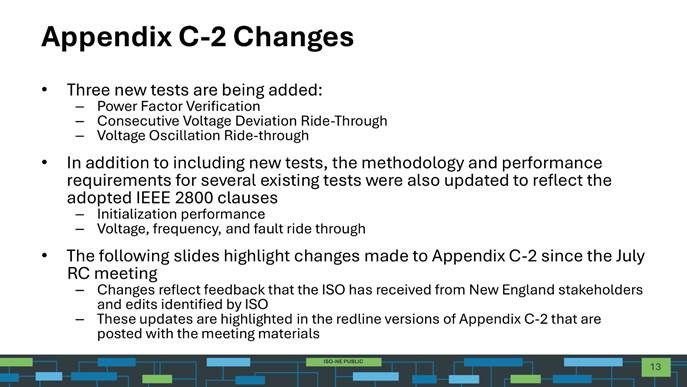
Existing initialization, voltage, frequency and fault ride-through tests would also be updated. ISO-NE is also introducing a new Appendix F-1 attestation confirming that the plant will be designed to meet applicable IEEE 2800 requirements, and tightening EMT model validation and version control documentation.
These requirements reinforce an important industry trend: demonstrating a nominal inverter capability will not be sufficient. The complete plant—including inverter controls, plant controller, collector system, station transformer and reactive equipment—must be modeled and designed to meet the requirement at the specified measurement point and voltage conditions.
EMT model quality and change management
PP5-6 Appendix C-1 would continue to require EMT model-quality attestations. A revised attestation would be required when a project’s EMT model changes.
This creates a stronger connection between:
- The submitted interconnection model
- The proposed plant design
- Subsequent control or equipment changes
- The model ultimately used for commissioning and operational studies
Developers and OEMs should therefore maintain disciplined version control and evaluate model changes before they affect Cluster Study assumptions or schedules.
Cluster Study base-case readiness
The proposal would also clarify when transmission projects and state-jurisdictional generation projects can be included in Cluster Study base cases.
Among other requirements, initial models for qualifying projects and their associated upgrades would need to be submitted at least 15 business days before the Cluster Study begins. Only minor model refinements would be permitted during the remaining period.
This schedule increases the importance of early coordination among developers, transmission owners, consultants and equipment suppliers.
The current PP5-6 proposal does not change the underlying NCIS or CCIS study methodologies. ISO-NE indicated that broader questions concerning those methodologies and the stresses used in interconnection studies require additional evaluation and are expected to be discussed separately.
What Should Interconnection Customers Do Now?
Key dates to track: September 2 is the stakeholder feedback deadline for PP5-1/PP5-3 and PP5-6 proposals. September 16 brings the scheduled Reliability Committee votes. October 2 is the targeted action date on the Planning Procedure changes. October 5 is when the first Cluster Request Window opens. And the Large Load reforms continue through November toward the planned FERC filing.
For large load developers (50 MW+): Track the Section 205 filing and engage in the comment process. The BYONG requirement, cost allocation methodology, and the distinction between Firm/Interim/Non-Firm service types are all still being finalized. The decisions made in the next 90 days will set the rules for years.
For mid-size load developers (20–50 MW): Identify whether your project triggers the new Load PPA requirement and begin collecting the required technical data. The October effective date does not leave much lead time.
For generation and storage developers entering the October 5 cluster: Contact your OEM now about the three new Appendix C-2 acceptance tests. Verify that your dynamic model (PSS/E and EMT) meets the updated PP5-6 requirements, including the power factor verification at the station transformer high side. Do not wait for the cluster window to open to discover your model does not pass.
For transmission owners and planners: The convergence of the Large Load process, the PP5-1/PP5-3 threshold, and the PP5-6 modeling updates means that Q4 2026 will bring a significant increase in data submissions and study requests. Staffing and review workflows should be planned accordingly.
RMS Energy Co, LLC sees these developments as part of a broader shift in how ISO-NE is defining interconnection readiness — for both loads and generation. Navigating these changes successfully will require coordinated expertise across interconnection studies, power system modeling, EMT and dynamic simulation, protection engineering, IEEE 2800 compliance, and transmission planning.
The bar for what constitutes a complete interconnection application is rising. The projects that move forward will be the ones that can demonstrate — through rigorous modeling, validated performance data, and engineering documentation — that they are ready to operate reliably on the system from day one.
Sources: ISO New England Reliability Committee, Order No. 2023 Key Project, and Proposed Plan Application materials.
#ISONEInterconnection #PlanningProcedures #IEEE2800 #LargeLoadInterconnection #GridPlanning #InterconnectionReform #EnergyStorage #TransmissionPlanning #RMSENERGY